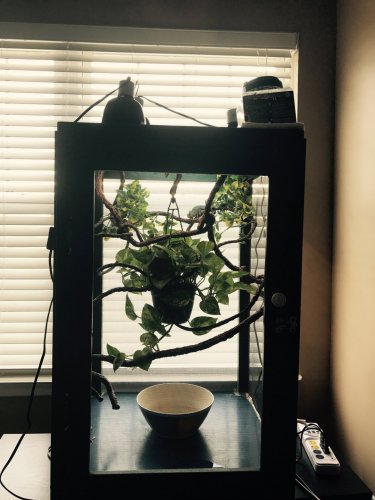
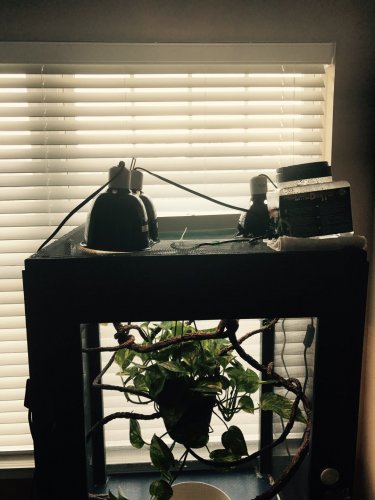
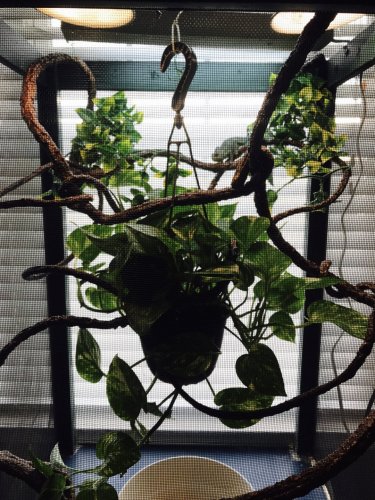
@Whatascene Did your vet diagnose him with "dysecdysis"?
Most shedding problems are caused by poor husbandry--improper temperature, humidity, hydration, nutrition, etc, for that particular species. Lizards kept in too dry an environment often retain skin around the eyes and the toes (Mader,
Reptile Medicine and Surgery). The thyroid also plays a role in shedding, but by far the majority of shedding problems are caused by poor husbandry which is something very much in your control
I'm sorry to say but the picture of your chameleon looking "healthy" doesn't look like a very healthy animal to me. He looks dehydrated.
You state that you mist, etc., but I am curious to know exactly how this animal is kept. I see you have artificial plants which don't help to raise humidity. Can you send pictures of your set up? Do you have an automatic misting system? Screen cage? Fogger?
I'm curious about the genetic disease your vet has diagnosed him with since very few studies are ever done on chameleons, let alone genetic studies. What injection did he give him? Was it subcutaneous fluids?
Shedding in reptiles is quite unique. At the beginning of a shed, lymph fluid floods between the two top layers of skin. There are enzymes that break down the connective tissues that keep the outer layer of skin attached to the inner layer. The lymph fluid eventually dries and with nothing holding the two layers of skin together, the top layer sloughs off. (Most interesting is that the enzymes that break down the connections between the two top layers do not break down the connections laterally, so the skin comes off in a sheet rather than cell by cell.) If the environment is too dry, the lymph fluid between the two layers of skin dies out prematurely and the digestive enzymes aren't able to do their job and break down the connective bonds holding the top two layers together, hence a retained shed.
Shedding problems are usually a symptom of a husbandry issue, not a disease process although parasites, infections and trauma (scars) can all play a role in poor shedding.
I'm going to be blunt. When I read your post, I had the distinct feeling you were asking us for permission to give up on your animal, that for whatever reason you didn't want him and wanted our approval for allowing him to die. I recently had a very disturbing conversation with a fellow breeder who stated that most chameleons are bought by someone who gets bored with their animal after about six months and at that point, they stop being extremely careful with their husbandry and surprise surprise, the chameleon dies. I was horrified by that discussion. Please prove him wrong.
I am always the first on this forum to defend anyone for deciding not to spend a lot of money to save an ill chameleon. I also expect people to humanely euthanize rather than allowing an animal to suffer. I honestly believe that if you give a chameleon optimum conditions for its species, it will thrive and
never need a vet. Sick chameleons are a symptom that they are not being kept properly (there are a few caveats such as wild caughts but even wild caughts will heal themselves if given the opportunity).
I'm not intimately familiar with commercially bred veileds, but have picked up a few bits and pieces of information from very reliable sources to lead me to the conclusion that commercially bred veileds are hatched with calcium and vitamin deficiencies. They wholesale for about $8. Their cheap price means that short cuts on nutrition are made. The health of a hatchling is directly related to the health and nutritional status of its mother. I've been told that veiled breeders get one clutch from a female and then dispatch her because one clutch depletes her so much. A nutritionally depleted female produces eggs that are nutritionally depleted. There
should be enough calcium and Vitamin A (and who knows what else) in the egg yolk that the baby pulls into their abdomen just before hatching to last for months. A calcium/Vitamin A deficient mother does not have those resources available to put into the eggs, so the babies
hatch deficient. Those babies are unhealthy right out of the egg.
Your healthy pictures shows some evidence of calcium issues--look at how his lips do not meet smoothly at the very front of his face. Look at the picture of the young wild caught gracilior pictured in my avatar--do you see how his lips meet perfectly at the front of his face? Look also at the rostral crest (the ridge that goes from the orbital crest--which is the ridge over the eyes--to the very tip of his face) of your chameleon. Do you see it isn't a straight line, but pinched? That's not right. It should be straight and his fore face should be broad with his lips meeting perfectly. I think your chameleon has quite a few issues and husbandry can likely fix it all.
I believe all chameleons need--
absolutely need--an automatic misting system. MistKing sells a very good unit for about $130. (Don't buy the cheap ones that will self destruct if the reservoir runs out of water because that happens.) They need a fine foggy mist to clean the debris out of their eyes. A hand mister produces very large droplets and most chameleons just don't like it. They want a foggy mist and they don't want you around making them nervous.
If I were dealing with your animal, I would put him in cage with three or four solid sides filled with live plants. I would run an automatic mister for 20 minutes and then 10 minutes every hour for several days or a week before dropping the misting to a more normal level. I would mist him many many times a day for minutes at a time with an automatic mister, more than the species really needs but this particular seems to need. I might add a fogger. I would soak him and keep it really really humid. I would make sure my temps were correct. I would make sure he had the best lighting and would replace what UVB lights you have since it is about 6 months old anyway. I would give him 10% (ZooMed) or 12% (Arcadia) strength UVB bulbs. I would make sure he had lots of bright light from regular bulbs. I would try to get him outside in the sun if at all possible. It can be done even in the winter if you are really careful about it--setting up a tote with a 1/4" wire screen top in a south facing corner where the sun warms up the area. Add heat bulbs. You can get cheap reflectors and heat lamps from feed stores. Feed stores sell heat lamps that are 150 and 250 watts, both white light and infrared. They also sell the reflectors that can handle that high a wattage. If farmers in Minnesota can keep day old chicks at 95F in an unheated drafty barn in Janurary, you can keep a chameleon warm for an hour in the sun. Last but not least, I would be extremely careful about his nutrition and make sure I fed him very very healthy well-fed properly gut-loaded feeders. Dusting with plain calcium of every food item, etc., etc.
I'm happy to help you get your husbandry right, but it starts with you and a will to do it. It isn't hard or particularly expensive.