Howdy Laura,
I'd still lead with the
http://www.uvguide.co.uk/ site when you speak with the store owner about UVB issues.
Although the UK site has the disclaimer: "
Please understand that we are hobbyists. We are not experts", don't discount their ability or their data

. Being that UVB UK Site member and researcher Frances M. Baines,
M.A., Vet.M.B., M.R.C.V.S. is also
"UV advisor to the British and Irish Association of Zoos and Aquaria (BIAZA)'s Reptile and Amphibian Working Group" probably doesn't hurt either

. In fact, some of the manufacturers themselves, relied on the UK's spectrometer and also various metered data as
proof enough for them. The mfgr(s) realized that their own in-house lab was not as well-equipped (properly equipped) as the UK investigators' facility was at the time of discovery and deferred to them. These mfgrs had equipment to find the "good" UVB spectral content/levels but not to detect the "bad" shorter wavelengths which was what was doing most of the damage.
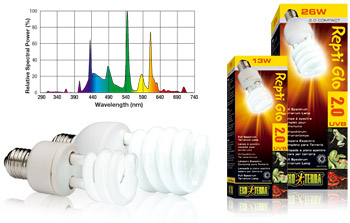
Ben is correct that Hagen Exo Terra Repti Glo CFL product is not directly implicated in the injury of reptiles as was/are the Zoomed 10.0 CFL and other various mfgrs' UVB products.
My concern with CFLs in general, is that they concentrate their energy into a narrower radiated surface compared to linear tubes. It's kind of like comparing spot vs. flood basking lights. This makes it harder to get UVB CFLs positioned to deliver the desired levels over a wide area.