my scope picks
imo the best overall range is 40-400x (up to 600x max) anything over that will be counter productive.
most common reptile pathogens can be identified at 100x or less. there are even some 100x pocket viewers that will work, depending on what you are trying to accomplish.
imo, it definitely pays to include photomicroscopy as part of the plan. photomicroscopy allows you to share images online with vets, universities, other forum members etc. this is especially helpful when first starting out or otherwise in doubt. it also allows you to keep an actual photographic record of your chams pathology for later reference. depending on scope choices, photomicroscopy does not necessarily cost anymore than standard microscopy. thats whats great about the celestron lcd/ldm scopes, the have plug and play idiot proof user friendly photo microscopy built right in, at a price that is comparable with other likely cham scope candidates.
http://www.celestron.com/science_education/microscopes.html
people ask me about scopes all of the time, so ill just throw out my default recommendations, starting with the cheapest.
1. celestron 44302 (150X) . first off, i'd like to point out that i am not currently recommending this scope as a viable pathology scope (although i am evaluating it as such) but i will say that for less than $50 this thing is awesome (retail$70, typically online for$45, i payed $30 on sale at bartells, last years xmas stock). typically, top lighted scopes dont make the best pathology viewers, but this would still be a great tool for taking pics/vids of things like whats in your soil, tail or eye problems, skin lesions etc. capable of taking very clear pics but has a very shallow depth of field. i recently posted some pics using one of these, of tenodera sinensis mantis nymphs. also posted a vid using it on youtube lol.
2. celestron amoeba 44325 (200X), ive never actually used this scope, this is a fairly new release for celestron, but it does have photomicroscopy function, and theoretically enough (marginally) magnification for reptile pathology. being lower end celestron, imo its probably got a not great but still viable quality of build. all plastic. if i absolutely had to stay under $100, this is what i would get.
3. celestron 44340 (40-400x) the choice of scopes on the market is endless, but imo, as Dave Weldon and others before me have pointed out, this scope clearly stands out in the under $200 price range. full built in user friendly photomicroscopy and vids. lcd/ldm so better for users with glasses than a traditional scope. mediocre quality of build but still viable. so many usefull features that its other faults can be overlooked for the price. (retail $240 but can be found new for around 170) imo, this scope punks most other scopes in the <$200 price range. i had one of these for about 2 years. pros; lots of great features, fairly user friendly, comes with a nice case. cons passable quality of build, fragile batt door. single focus only. imo, this scope is ideally suited for cham pathology.
4. celestron 44345 (40-400x) basically, the little brother to the pentaview. uses a pentaview style frame and has a touch screen instead of buttons. also has dual focus retails $329, can be had for <$250 also a great scope very well suited to cham pathology, however its almost $250 price tag puts it in the same price range as an amscope t-490-a, which makes it a real tough choice
5. amscope t-490-a (40-1600x) $270. this is a full optical, non ldm trinocular microscope. imo, the t490-a is the holy grail of biological scopes under a $1000. this is a high quality scope that holds it own against scopes many x its $. this scope is suitable for professional lab work and well taken care of would last a lifetime. excellent parts availability, mountains of options/accessories available but does not include photo microscopy. trinoculars are ideally suited for microscopy, but the camera is usually a separate deal. you can get a 3 mp ccd to fit a 490a for about $130 or you could just get c mount adapter and use a dslr. either way, you are talking about another $150 to add photomicroscopy which sort of changes things.
imo, if a person was committed to long term learning of pathology, and was confident of that from the start, and had the $cash to buy but only wanted to do it once, then imo the t 490a would be the scope to get.
6. celestron pentaview 44348. ($370-430) 40-600x basically the big brother to the 44340/44345, recently released at ces 2011, this is the flagship of the celestron ldm line. this thing is off the chart in wow factor (and fairly difficult to get a hold of i might add). more features, better, larger tft screen, better quality of build.
http://www.celestron.com/science_education/microscopes/pentaview-lcd-digital-microscope.html
http://www.celestron.com/science_education/microscopes/pentaview-lcd-digital-microscope.html
sorry, you cant own this microscope, only xanthoman is allowed to own the celestron pentaview

. after 2 mths of being on backorder my pentaview has finally arrived at my shipping location, but i wont actually have my hands on it for a couple more days. i was really torn between this and a 490-a, but the 490a with 3 mp ccd would have been $500, i got this for $370 which was already above the upper end of my budget. i'll be doing a unboxing/review in the near future. imo some basic features desired in a cham pathology microscope;
finally, you dont need to get a new scope to get into pathology, there are some great deals on cl and ebay. one of my favorite scopes that i had for many years was a swift binocular scope that my sister got at a garage sale for <$50.
aside from fecalizers, fecasol, and all of that stuff, some other optional things that might come in handy;
- stage micrometer, basically a micro ruler for your stage.
- McMasters slides, an etched, usually chambered slide designed especially for determining pathogen count/load
- 30ml buchner funnel with filter paper or coarse fritted disc to filter to 200 microns
- test tubes/racks
- glass stir rods
- a couple of pipettes, beakers or burettes can come in handy too. jmo



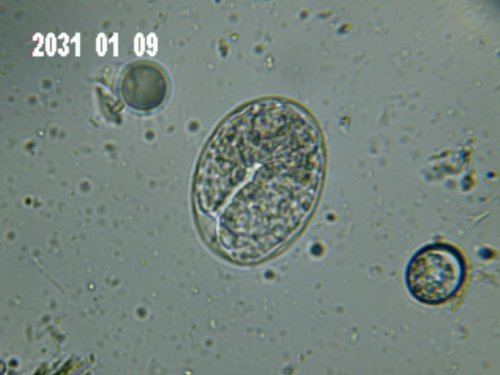

 He also recommeded that brand because they are are cheap but just as good quality. It was nice to be able to just look at the screen and scan the entire slide and be able to take pics.


