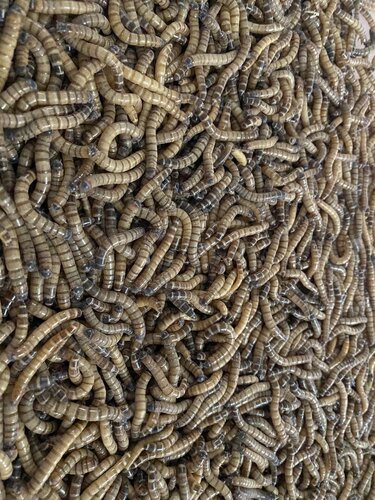
That is nightmare fuel for me. I'm so skittish around supers, even with the foot long tongs. Lol. My own kid makes fun of me.
Something about them just heebies my jeebies. ?
I've fed them by hand and otherwise to my beardie for the past year+ If I've ever been bitten, it was a non-event, or I think I'd recall it more vividly.
I agree, if it ever happened, a horrible death would result.
It would promptly be eaten alive by a reptile. AHHHHH!!!
I've fed them by hand and otherwise to my beardie for the past year+ If I've ever been bitten, it was a non-event, or I think I'd recall it more vividly.
I agree, if it ever happened, a horrible death would result.
It would promptly be eaten alive by a reptile. AHHHHH!!!
eep. I have screamed over supers before. A couple of years ago when I started feeding them to an anole I had (I later realized they aren't good for them). I was digging into the container to find them. All of a sudden this big worm pops out and I shoot up into the air and scream.
Those things will live forever if kept together. They will only get so big and their max size is still good to feed adults.
Cold turkey is the way to go if breaking a habit but it'll sometimes make you pull your hair out?
I've fed them by hand and otherwise to my beardie for the past year+ If I've ever been bitten, it was a non-event, or I think I'd recall it more vividly.
I agree, if it ever happened, a horrible death would result.
It would promptly be eaten alive by a reptile. AHHHHH!!!
Granted, this is not the exact species we usually feed our reptiles, but it's closely related.
From Wikipedia:
Perhaps the best known species is Zophobas morio, a beetle whose larvae are robust mealworms sold as food for pets such as lizards. The larvae are known commonly as "superworms".[2]
Zophobas atratus is also used as pet food, sold in pet stores[3] under the name "giant mealworms", but should not be confused with darkling beetle mealworms sprayed with juvenile hormone.[4] Studies have found that in the wild the larvae sometimes live in bat guano, and they tend to cannibalize the pupae of their own species.[5] Researchers have discovered that the larvae can subsist on a diet solely of polystyrene (Styrofoam).[6]





 ?
?


