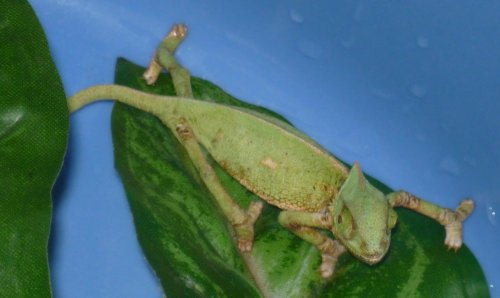
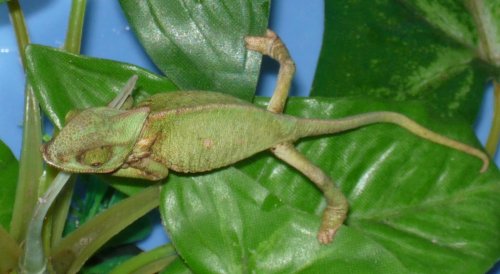
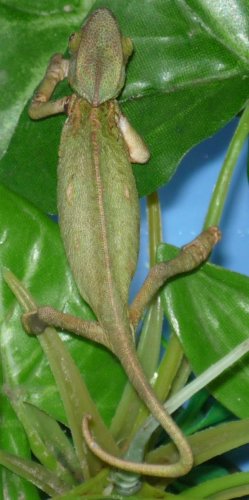
I got a baby chameleon two months ago. I think it is about four-month old now. But its skin looks very different now. It was light green all over. Please refer to the pictures. It's hardly possible for me to find a vet for chameleon. Any suggestion is appreciated. Thank you.

Navigation
Install the app
How to install the app on iOS
Follow along with the video below to see how to install our site as a web app on your home screen.
Note: This feature may not be available in some browsers.
More options
You are using an out of date browser. It may not display this or other websites correctly.
You should upgrade or use an alternative browser.
You should upgrade or use an alternative browser.
Skin problem with baby chameleon
- Thread starter crab13
- Start date

FroggtheCham
New Member
Fill this out and it will help everyone be able to help you.
https://www.chameleonforums.com/how-ask-help-66/
https://www.chameleonforums.com/how-ask-help-66/
Chameleon Info:
Your Chameleon - The species, sex, and age of your chameleon. How long has it been in your care?
The vendor did not provide much info of the pet except for its age. I don't really know the type. But I beleive it is a veiled chameleon after seeing many pitures from internet. Sorry that I haven't examed its sex. I will learn to do it later. I think it is about four months old. The main body is around 6 cm (tail length excluded). I have it under my care for two months.
Handling - How often do you handle your chameleon?
I don't know what the handling means. Every week I will let him climb on my hand to transfer him to another temporary place so that I can do some cleaning to the cage.
Feeding - What are you feeding your cham? What amount? What is the schedule? How are you gut-loading your feeders?
The food is pinhead cricket, whose body is around 1cm long. Around 12~15 crickets are thrown into the cage at one time, usually in the morning.
Supplements - What brand and type of calcium and vitamin products are you dusting your feeders with and what is the schedule?
I have bought a bottle of vitamin for reptile but I don't know how to feed my chameleon with this. So there is actually no vitamin and calcium.
Watering - What kind of watering technique do you use? How often and how long to you mist? Do you see your chameleon drinking?
The water is filled into a small container which is placed in the cage. The water is changed everyday but I don't see him drinking. Everyday I mist twice, each time for 20 seconds. I did not mist more than 20 seconds because the cage is already very wet in the bottom and it is not easy to keep it clean under a very humid environment (sometime it smells). I realized today that it might be not long enough. So I put the plant together with the chameleon out into a bason and sprayed for about 3 minutes. I saw my chameleon open his mouth at first and then eat the water drops from one leaf. This is the first time I see him drinking.
Fecal Description - Briefly note colors and consistency from recent droppings. Has this chameleon ever been tested for parasites?
The dejection appears almost everyday. Usually there shall be one pile with half white and half black. It is never tested for parasites.
History - Any previous information about your cham that might be useful to others when trying to help you.
When I see him two months ago, he looks very healthy, with light green skin all over. Now it is obviously not the case. I now start to wonder if there's anything I did wrong.
Cage Info:
Cage Type - Describe your cage (Glass, Screen, Combo?) What are the dimensions?
It's a 20x20x20 cm transparent plastic cage.
Lighting - What brand, model, and types of lighting are you using? What is your daily lighting schedule?
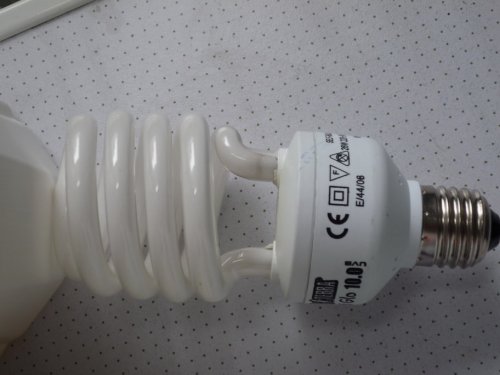
A daylight with compact model from CL UVB lamp (UVB10.0 15W). The light was on from 8:00 to 14:00 and from 16:30 to 18:30 everyday.
Temperature - What temp range have you created (cage floor to basking spot)? Lowest overnight temp? How do you measure these temps?
The day temperature is 28~35 Celsius and the night temp is around 24~27 Celsius. The temperature is measured by a thermometer beside the cage.
Humidity - What are your humidity levels? How are you creating and maintaining these levels? What do you use to measure humidity?
There is no humidity measurement. The way to keep a high level humidity is to mist twice everyday. The floor of the cage is always wet.
Plants - Are you using live plants? If so, what kind?
There's one plastic plant inside the cage.
Placement - Where is your cage located? Is it near any fans, air vents, or high traffic areas? At what height is the top of the cage relative to your room floor?
The cage is placed indoor. The windows are opened for daytime. It is placed on a desk near the window from 8:00 to 18:00 and on the floor at night. Since the room is quite small, so everywhere is high traffic area.
Location - Where are you geographically located?
I live in Shanghai, China.
Thank you so much in advance.
Your Chameleon - The species, sex, and age of your chameleon. How long has it been in your care?
The vendor did not provide much info of the pet except for its age. I don't really know the type. But I beleive it is a veiled chameleon after seeing many pitures from internet. Sorry that I haven't examed its sex. I will learn to do it later. I think it is about four months old. The main body is around 6 cm (tail length excluded). I have it under my care for two months.
Handling - How often do you handle your chameleon?
I don't know what the handling means. Every week I will let him climb on my hand to transfer him to another temporary place so that I can do some cleaning to the cage.
Feeding - What are you feeding your cham? What amount? What is the schedule? How are you gut-loading your feeders?
The food is pinhead cricket, whose body is around 1cm long. Around 12~15 crickets are thrown into the cage at one time, usually in the morning.
Supplements - What brand and type of calcium and vitamin products are you dusting your feeders with and what is the schedule?
I have bought a bottle of vitamin for reptile but I don't know how to feed my chameleon with this. So there is actually no vitamin and calcium.
Watering - What kind of watering technique do you use? How often and how long to you mist? Do you see your chameleon drinking?
The water is filled into a small container which is placed in the cage. The water is changed everyday but I don't see him drinking. Everyday I mist twice, each time for 20 seconds. I did not mist more than 20 seconds because the cage is already very wet in the bottom and it is not easy to keep it clean under a very humid environment (sometime it smells). I realized today that it might be not long enough. So I put the plant together with the chameleon out into a bason and sprayed for about 3 minutes. I saw my chameleon open his mouth at first and then eat the water drops from one leaf. This is the first time I see him drinking.
Fecal Description - Briefly note colors and consistency from recent droppings. Has this chameleon ever been tested for parasites?
The dejection appears almost everyday. Usually there shall be one pile with half white and half black. It is never tested for parasites.
History - Any previous information about your cham that might be useful to others when trying to help you.
When I see him two months ago, he looks very healthy, with light green skin all over. Now it is obviously not the case. I now start to wonder if there's anything I did wrong.
Cage Info:
Cage Type - Describe your cage (Glass, Screen, Combo?) What are the dimensions?
It's a 20x20x20 cm transparent plastic cage.
Lighting - What brand, model, and types of lighting are you using? What is your daily lighting schedule?
A daylight with compact model from CL UVB lamp (UVB10.0 15W). The light was on from 8:00 to 14:00 and from 16:30 to 18:30 everyday.
Temperature - What temp range have you created (cage floor to basking spot)? Lowest overnight temp? How do you measure these temps?
The day temperature is 28~35 Celsius and the night temp is around 24~27 Celsius. The temperature is measured by a thermometer beside the cage.
Humidity - What are your humidity levels? How are you creating and maintaining these levels? What do you use to measure humidity?
There is no humidity measurement. The way to keep a high level humidity is to mist twice everyday. The floor of the cage is always wet.
Plants - Are you using live plants? If so, what kind?
There's one plastic plant inside the cage.
Placement - Where is your cage located? Is it near any fans, air vents, or high traffic areas? At what height is the top of the cage relative to your room floor?
The cage is placed indoor. The windows are opened for daytime. It is placed on a desk near the window from 8:00 to 18:00 and on the floor at night. Since the room is quite small, so everywhere is high traffic area.
Location - Where are you geographically located?
I live in Shanghai, China.
Thank you so much in advance.
Elizadolots
New Member
Chameleons don't usually drink out of bowls. They drink water that drips onto leaves. You can use a plastic cup or bottle (top off). Poke 1 or 2 holes in it with a needle. Set that on top of the cage.
You don't want the floor of the cage to be wet all the time. You need a way for the water to drain out of the cage.
Your container is too small. It should be more like 60cm x 60cm x1 meter tall. Screen or Screen + Glass.
You don't want the floor of the cage to be wet all the time. You need a way for the water to drain out of the cage.
Your container is too small. It should be more like 60cm x 60cm x1 meter tall. Screen or Screen + Glass.

Monkeykungphu
New Member
You should be supplementing calcium without D3 almost everyday!! Calcium with D3 about twice a month & multivitamin about once a month! Just lightly dust whatever feeders you are giving him with the supplements.
You should have a 40 or 60 watt regular incandescant bulb for basking. Also, I would switch your 10.0 compact flouro to a linear (long & straight) 5.0 UVB bulb as many compact flouros can cause blindess.
Get a larger cage with better ventilation. 20x20x20 CM is WAY too small.
You should have a 40 or 60 watt regular incandescant bulb for basking. Also, I would switch your 10.0 compact flouro to a linear (long & straight) 5.0 UVB bulb as many compact flouros can cause blindess.
Get a larger cage with better ventilation. 20x20x20 CM is WAY too small.

PedroANDAshley
New Member
I think I read he said its a really humid enviroment so he should just go with a all screen cage to help keep the air flow good and so he can mantain correct humidity levels.
Also, cange your campact bulb to a liner blue (the long ones) because the compact bulb
WILL eventually create eye problems with your cham. Its to much uvb in one spot and the high uvb levels will burn his eyes.
Is your heat lamp just laying on top of your cage? Or is it suspened?
Do you notice your cham hanging upside down under neath it?
Are those mark on his belly as well?
Because the skin sort of looks like recovering burns...
Just a guess.
Also, cange your campact bulb to a liner blue (the long ones) because the compact bulb
WILL eventually create eye problems with your cham. Its to much uvb in one spot and the high uvb levels will burn his eyes.
Is your heat lamp just laying on top of your cage? Or is it suspened?
Do you notice your cham hanging upside down under neath it?
Are those mark on his belly as well?
Because the skin sort of looks like recovering burns...
Just a guess.
Thank you all. I will try to get a LARGE case this weekend. I'm new to the UVB lighting. So I don't know if I told you the wrong name of the light I bought. Could you help me to see the attached picture and tell me what type it is. Yes, I'm using this kind of lamp. I will stop turnning it on tomorrow if this is not good. As to the skin, I still wonder if it may be cause by some bacteria disease because the environment was quite wet and sometime smells. It is over midnight here. I will read tomorrow morning. Thank you again for your kind suggestion!
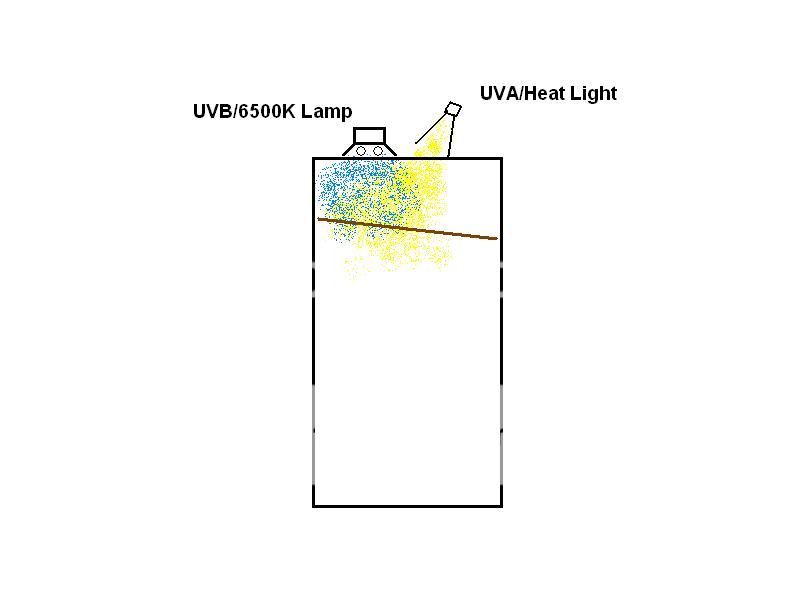
The lamp is put outside the cage. I heard that UVB light will attenuate when it goes though the plastic. So I put it about 10 cm away from the cage.
-----------
| |
| | <----- ________
| cage | <----- | lamp | (connector) lamp set
| | <----- ---------
| | light goes horizontally
-----------
The lamp is put outside the cage. I heard that UVB light will attenuate when it goes though the plastic. So I put it about 10 cm away from the cage.
-----------
| |
| | <----- ________
| cage | <----- | lamp | (connector) lamp set
| | <----- ---------
| | light goes horizontally
-----------
Attachments

Are the marks on the skin starting out like a blister or pox mark?
Also it has slight swellings at both the "wrists"...this could be caused by a few things including infection or gout.
I really think you need to take it to a vet.
Sounds like your chameleon may not be getting any proper UVB and you need to provide supplements and gutload/feed the insects properly.
Since most of the feeder insects have a poor ratio of calcium to phos., its important to dust the insects before feeding them to the chameleon at most feedings with a phosphorus-free calcium powder (like rep-cal).
I also dust twice a month with a phos.-free calcium/D3 powder to ensure that the chameleon gets some D3 without overdoing it. D3 from supplements can build up in the system and cause problems. D3 produced from exposure to UVB shouldn't as long as the chameleon can move in and out of it.
I also dust with a vitamin powder that has a beta carotene source of vitamin A. Beta carotene (prOformed) vitamin A sources will not build up in the system like prEformed sources will but there is controversy as to whether all/any chameleons can convert it so some people give a little prEformed once in a while. Excess prEformed vitamin A may prevent the D3 from doing its job and push the chameleon towards MBD so be careful if you do use it.
Without these supplements you are lucky that your chameleon hasn't already shown signs of MBD. Calcium, phos., D3 and vitamin A are all important nutrients for bone health and other systems in the chameleon and they need to be in balance. You need to look at what you supplement with, what you feed the insects and what you feed to the chameleon when trying to balance them.
Crickets, locusts, roaches, superworms can be gutloaded with a variety of greens (dandelions, kale, collards, endive, escarole, etc.) and veggies (carrots, squash, zucchini, sweet potato, sweet red pepper, etc.)
The veiled can be offered the same greens and veggies and a SMALL amount of fruit (apple, pear, melon, berries, etc.).
Its important not to leave water laying stagnant in the bottom of the cage or in a dish in the cage. It could very well be part of your chameleon's problem.
Also it has slight swellings at both the "wrists"...this could be caused by a few things including infection or gout.
I really think you need to take it to a vet.
Sounds like your chameleon may not be getting any proper UVB and you need to provide supplements and gutload/feed the insects properly.
Since most of the feeder insects have a poor ratio of calcium to phos., its important to dust the insects before feeding them to the chameleon at most feedings with a phosphorus-free calcium powder (like rep-cal).
I also dust twice a month with a phos.-free calcium/D3 powder to ensure that the chameleon gets some D3 without overdoing it. D3 from supplements can build up in the system and cause problems. D3 produced from exposure to UVB shouldn't as long as the chameleon can move in and out of it.
I also dust with a vitamin powder that has a beta carotene source of vitamin A. Beta carotene (prOformed) vitamin A sources will not build up in the system like prEformed sources will but there is controversy as to whether all/any chameleons can convert it so some people give a little prEformed once in a while. Excess prEformed vitamin A may prevent the D3 from doing its job and push the chameleon towards MBD so be careful if you do use it.
Without these supplements you are lucky that your chameleon hasn't already shown signs of MBD. Calcium, phos., D3 and vitamin A are all important nutrients for bone health and other systems in the chameleon and they need to be in balance. You need to look at what you supplement with, what you feed the insects and what you feed to the chameleon when trying to balance them.
Crickets, locusts, roaches, superworms can be gutloaded with a variety of greens (dandelions, kale, collards, endive, escarole, etc.) and veggies (carrots, squash, zucchini, sweet potato, sweet red pepper, etc.)
The veiled can be offered the same greens and veggies and a SMALL amount of fruit (apple, pear, melon, berries, etc.).
Its important not to leave water laying stagnant in the bottom of the cage or in a dish in the cage. It could very well be part of your chameleon's problem.
Last edited:
PedroANDAshley
New Member
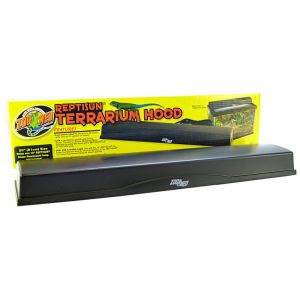
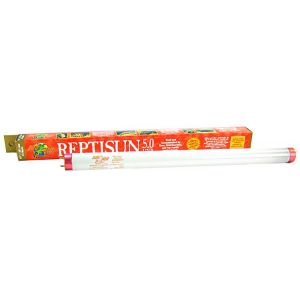
For uvb you need a bulb like this and a fixture like this as well.
It must be a 5.0 reptisun IF you have no way of gettin one you can use a 5.0 reptiglo while you figure out how to get one.
And yea, it looks like somethin serious you should deff. go see a vet.
It must be a 5.0 reptisun IF you have no way of gettin one you can use a 5.0 reptiglo while you figure out how to get one.
And yea, it looks like somethin serious you should deff. go see a vet.
Attachments
Elizadolots
New Member
You don't want the light to go through plastic or glass. That filters out the good part of the light.
Okay. I finally understand the meaning of gut loading. Sorry for my poor English. Here I don't need to feed the feeder. I go to the vender everyweek and get a bottle of crickets together with proper small amount of food that is already mixed in the bottle. I guess the crickets won't get hungery. In addition, I have a bottle of CHAMELEON DUST by T-REX, all-in-one super food includes all foods, vitamins and minerals. I dusted the crikets about twice a week before feeding. Start from tomorrow, I shall dust them everyday.
The cage may be too small, but currently the most important thing is here in China we don't have experienced vet for chameleons. We only have dog/cat vets. The local vets does not know anything about chameleons.
So I guess I have to treat by myself. I just wonder what I can do for it. How can I prove if it is infected. If I should try mixing the feeder with tiny amount of anti-bacteria medicine (the medicine for human body and I will make powder of them at first).
After carefully watch over, I consider there is no blister or pox mark at all. All guesses goes to lack of water or infect because the neck part skin has a lot of "wrink". What's more, the bottom part of his head appears grey instead of light green. It's very "wrinky" between neck and front leg.
Any idea, specially for the medicine cure attempt? Thank you.
The cage may be too small, but currently the most important thing is here in China we don't have experienced vet for chameleons. We only have dog/cat vets. The local vets does not know anything about chameleons.
So I guess I have to treat by myself. I just wonder what I can do for it. How can I prove if it is infected. If I should try mixing the feeder with tiny amount of anti-bacteria medicine (the medicine for human body and I will make powder of them at first).
After carefully watch over, I consider there is no blister or pox mark at all. All guesses goes to lack of water or infect because the neck part skin has a lot of "wrink". What's more, the bottom part of his head appears grey instead of light green. It's very "wrinky" between neck and front leg.
Any idea, specially for the medicine cure attempt? Thank you.
PedroANDAshley
New Member
Im not a vet but giving a cham human medicine might not be such a good idea.
Some of the other member on here might have some solutions,
but Im totally stumped :/
Some of the other member on here might have some solutions,
but Im totally stumped :/
Elizadolots
New Member
I'm convinced that the enclosure is a huge part of the problem. I think the chameleon is dehydrated and getting very little fresh air. If I had this animal, I would get it out of there now.
Make sure your new enclosure has screen on at least one side as well as the top.
Make sure your new enclosure has screen on at least one side as well as the top.

ChrisnLisa
Avid Member
It's hopeless to find an experienced cham vet here however I will try to find some vets for cats or dogs instead tomorrow.
As Kinyonga has said, any vet can do the test you need. I would ask the vet to do a culture and sensitivity test for both bacteria and fungus. The vet should take a swab and rub it on the infected skin. They will then send it to a lab, or do it at their own office if they have the proper equipment. Your test results should tell you if they were able to grow any types of bacteria or fungus (and what they are) from the sample taken off of your chameleons skin. Once they do that, they will be able to tell you exactly what type of medication will kill the bacteria and/or fungus present.
Medicating without having any idea of the real problem is not a good idea. In the meantime I would remove your chameleon from that enclosure as soon as possible. Try to buy or build an enclosure with more ventilation, as well as a way for extra water to drain out. Ventilation along with proper lighting, humidity, and supplements will do nothing but help. If the weather permits, it's a great idea to take a plant outside so your animal can bask and soak up some real sun. Good luck, keep us updated.
I contacted several big and popular "pet hospital" (direct translation from Chinese, I found top five on a local website). I got the result as I expected. There is no detail test regarding the skin problem. One of them answered that they have a fluorescent lamp to see if there is fungus on the skin (strange enough). When I cliamed my pet is a chameleon whose body is only 4~5 cm, I was told that they only do treatment to dogs or cats. So sad about it. Maybe the chameleon is only dehydrated. I'm giving him shower (spray with a water mist maker) with warm water for 5 minutes two times a day. I hope he can recover and get well without medicine treatment.
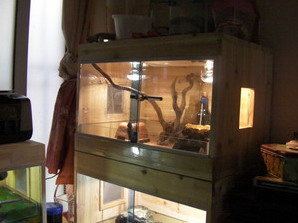
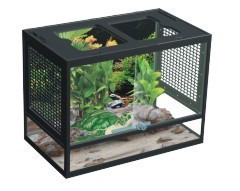
I'm going to buy a new cage. I did some homework and find two different types. One is made of wood and glass. It has two small side windows and no roof window. Because it is wooden, I can install lamp fixture freely. But the air flow could be bad. The other type is plastic plus glass. It has bigger side windows and also a roof window. But the cage size may be smaller (60 x 40 x40cm, maybe large enough for my baby chameleon). Any suggestion?
I'm going to buy a new cage. I did some homework and find two different types. One is made of wood and glass. It has two small side windows and no roof window. Because it is wooden, I can install lamp fixture freely. But the air flow could be bad. The other type is plastic plus glass. It has bigger side windows and also a roof window. But the cage size may be smaller (60 x 40 x40cm, maybe large enough for my baby chameleon). Any suggestion?
Attachments
Elizadolots
New Member
The small one looks better to me. Is the top open? I'm thinking it would be better on end. Chameleons like to climb up and down. 60 cm tall would be a good starting size. It will certainly be a huge improvement over what you have. If your animal ever gets to full size, then that will be too small, but you have plenty of time to deal with that.
Is that mesh plastic? If so, you'll need to watch how close you can get your heat lamp.
Do you have a drip system set up so there's always water dripping into the enclosure? If not, I'd suggest that.
Is that mesh plastic? If so, you'll need to watch how close you can get your heat lamp.
Do you have a drip system set up so there's always water dripping into the enclosure? If not, I'd suggest that.

summoner12
Avid Member


Cage:

Lights:

Lights:
Similar threads


- Replies
- 96
- Views
- 10K

- Replies
- 2
- Views
- 1K


