@cyberlocc whats your opinion on KindLED? I saw them in use at a local exotic plant nursery.
https://www.kindledgrowlights.com/products/x40-x80-bar-led-grow-lights
Those look good, But.
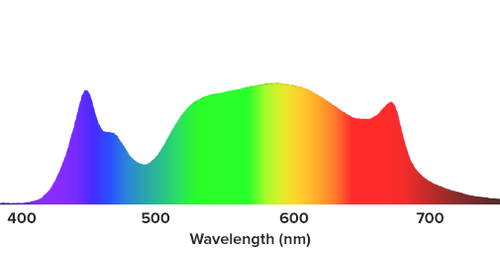
My concern with them, would be the spectrum modifications.
So the theory here, is what we call PUR. So when looking at lights, usually lights are gauged by the amount of PAR they offer at a given distance from the fixture.
PAR is the measurement of Photosynthetically Active Radiation. This means, this how much light reach's the plant that it could theoretically use for photosynthesis.
However researchers have found, that Plants do not use all of the light spectrum to the same degree. Plants, being green, tend to reflect green light away from them. So when we look at PAR, people have decided that it's a bad way to judge a light. While PAR gives us an accurate amount of light being hit by the plant, some of that light is wasted, or rejected or just unused.
So they came up with "PUR", meaning Photosynthetically Usable Radiation. This measures, unlike PAR, the amount of radiation that the plant is recieving that it can and will actually use. The problem with this, is it changes on a per plant basis. While a green plant, is reflecting green light, a Red plant is doing the same for Red, whilst absorbing green. So PUR varies on a per plant basis.
The PUR meter avaible, takes this into account with alot of water plants (it's a water meter, fish tanks, reef tanks) and let's you set and see your PUR on a per Plant basis.
Now, on to why the Blurple, the majority of grown plants, are green. As we know, and thus the majority don't care about Green. In an effort make their lights more efficient, use less power and get the same (DLI, Moles per day of useable light) they made the "Blurple" Light. The theory is, since plants mostly use Blue Light for Vegation and Red light for Flowering, that adding those 2, or using solely those 2 was best, from an effiency standpoint.
The theory, makes sense, in practice it doesn't work very well. It does work, the way nature intended, which has to due with seasonal changes in light. The sun on a spring afternoon is 10k+ so a Blue light, and in the fall, it's closer to 4/5k. Morning sun is also, low in K, as is sunrise, the reds are strong during that time. However, Life can see and tell the difference and the plants use more green and yellows than people tend to provide.
So what happens, is some of harvest growers, who want both, but at seasonal times (they want growth in the spring and summer, and flowering in the fall) they change their lights with the season. This means, when using T5s, to use a 6500k-10k bulbs in the spring and summer, and then switch to 2700-3500k in the fall and winter. And this works out well for them, Flos are by nature Full Spectrum. LEDs are not. So back again, to Blurple they have decided to switch to just blue and just red, to try and save electricity. It's not too bad with a Cham cage, but imagine have a bunch of tall, high light requirements plants, the wattage stacks quickly.
So what I am getting at with my long winded post, those lights look good, they are for plant growth from a reputable plant growth company, and I have seen them brought up in the shady sites. However, in using them, you have to remember they are season specific.
If you look at the options, they offer Flower and Veg. So a light for Spring/Summer, and a light for Fall/Winter, that you will have to swap every season.
If you want something that grows, evenly, with a perfect balance all year, than you are left with 2 options. 1 is 6500k, High CRI. The only way to obtain High CRI, is to balance the spectrum. If you take a blue LED, and coat it with phorurus, it will be White, and it can be dialed into 6500k white, but it's CRI will be trash. Without the addition of the other colors the CRI is not good. In some cases this is useful. Their is specialized LEDs for that very case. Such as Meat, the grocery store has LEDs that lack Red Spectrums, these LEDs are low CRI, but for a reason. Because they lack Red, it alters the way we perceive the color of the meat. It makes the meats reds look better, they glow almost. This is also how blacklights work, their Spectrums are so void of other colors that it makes them glow in the light.
For a Chameleon, we want the opposite, we want High CRI, we want to see the colors the way they truly are. To achieve this, we use a High CRI LED, that also provides use a balanced spectrum of color, they will usually be High in Red and Blue, but that's because so is the Sun. These LEDs tend to cost more, as they are harder to make. Remember how the cheap Blue light was turned to white, that's not a "Full Spectrum"
The other way, is to buy lights, that offer all the colors. Or, they may utilize WW and CW LEDs to balance the colors. Again, these need to be High CRI. So there is 2 ways to go about this, as I mentioned.
1 is how the Radions I mentioned earlier do it. They have an LED makeup, of Cool White, Warm White, Blue (Royal) Red (Photo) and Lime. By using these colors, they can blend them in that pick shape to look like a solid color light, that is adjustable.
What this gives you is the ability to change the spectrum on the fly, or throughout the day, our for the season. CRI, can still and will still be high, from HIGH CRI Base, and the adjustments made. The Radion will tell you, what color tempature your outputted light will be, without needing a Spectrometer.
The other way, is to build or buy a fixture with multiple colors like that, or just WW/CW, and then adjust the spectrum yourself with a Spectrometer or just guess.
So my suggestion on grow lights. And we can TLDR here lol.
Is to either build a High CRI 5600-6500k LED light, or buy one.
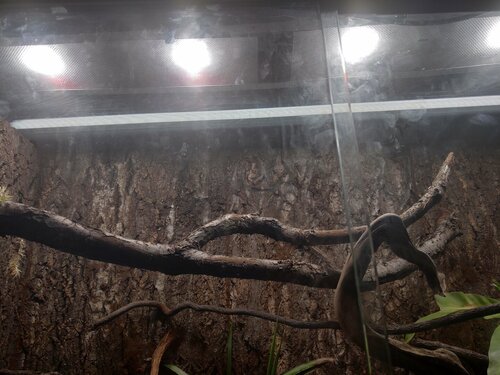
Of the top of my head, I can't say that I know of a Bar that fits that bill outside of the Arcadia (not sure the CRI) but the Jungle Dawn spot by Arcadia, is pretty bright (almost 2x brighter than the bar you linked, per). 2 of those, should light up your cage pretty well.
Or if you want more light, with less wattage, check out the DIY "EZ bright" blog I just made. It will offer more lumens, for the same wattage (almost 3x as much) and a better spread for not much more $$$ but requires a little DIYing. (It's not too bad)
Or to build or buy a customizable spectrum fixture.
Finnex has some good ones, the Planted+ and so does Current USA, as well as the more expensive Radions and AI primes. My suggestion if you want the sunrise and sunsets ect, easily.
Go with the AI prime here.
https://www.amazon.com/Aqua-Illumin...hd+freshwater&qid=1563155078&s=gateway&sr=8-3
One of those in the center of your cage, would be a good amount of light, likely enough for most plants you will likely have.
The LEDs you linked, are good, but need to be switched depending on time of the year, and will alter the colors of your enclosure and Cham. However their supporting reds and blues, are at least quality ones and in the correct spectrum.
Now if this is for the Angrecums cage that we discussed, depending where you mount them, you might want DIY.
Angrecums while being rainforest plants, as I am sure you know grow on trees on the top of the canopy. They want seriously high light. Which makes alot of the options just discussed lack luster, and I would go straight to 4JD spots or 2 COB diy, per 24x24.



 . That will handle the pothos add good accent lighting and is super cheap.