My chameleon died sadly, anyone think they could give me a husbandry review so I don't make the same mistake next time?

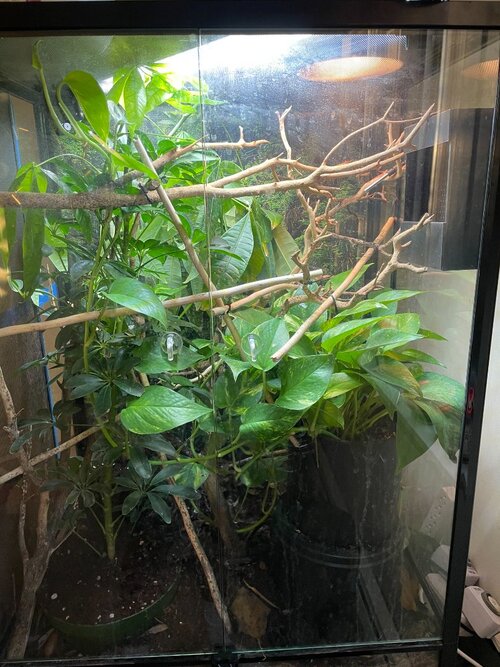
Hey guys so, I got a female panther chameleon from a pretty well respected breeder and sadly just two weeks after I got her, she died. And I love chameleons a lot, and definitely want to get another one at some point but I really want to make sure that my husbandry is on point before I do. I'll post a picture of the cage and generally describe my husbandry here:

- 36 x 24 x 18, glass cage on all sides except for top and one of the smaller sides.
- humidity was 90% during the night and I believe would go down to 30% during the day
- Used fogger between 2 and 7 AM
- Mist king would go off at midnight and then again at 10 AM (this is because she really never drank water when she woke up, so I decided to give her water a bit later)
- Heat lamp gave her a basking spot at 85 °F and an ambient temperature of on average 75 °F (the coldest part of cage is 68 °F).
- Arcadia 6% T5HO UVB gave her a basking spot at 2.5 UVI
- Food was originally 15 BSFL/day, but I recently started giving her 12 medium sized dubia roaches/day which were dusted with Arcadia ProA.
- The bottom of the cage was soil, with the plants placed in the soil in their pots.
- Soil was half sand and half peat moss (this was put on the top few inches of the plants pots) as well.
- A cleanup crew also was there to clean up poop, but I did spot cleaning bc I don't think I had enough isopods.
- Plants were all washed in the appropriate manner
- She had a small laying bin (8 x 6 inch) which I was intending to replace with a bigger one as she got closer to laying age.
- One of my plants (despite being quarantined) developed a fungus gnat infection and there was often some gnats in the cage.
- One day, because I think my humidity was too high, I noticed that the branches had some kind of dark surface on them (I think mold) and in my laying bin was a mushroom fungus which died off the next day. Maybe the whole cage had that fungus, I'm not quite sure.

Now, her behavior was kind of interesting.
- She had absolutely no signs of being unhealthy, no sunken-in eyes, no excessive gaping or hissing, never had closed eyes during the day.
- The thing that was the most concerning was her color. She would often become really dark even when she wasn't basking. In the last few days of her life, she was dark less and less.
- I also never saw her drink water, but her poop was usually pretty moist and I didn't see any of the orange crust you usually see with dehydrated chams.
- In the last few days of her life though I have struggled to locate any poop.

Obviously really sad, she was an awesome chameleon. I have really grown to appreciate female chameleons in the short time I had her. I definitely want to try again in the future, ideally in the next few months after I can adjust any problems with my husbandry. Thank you so much for any advice you could give.
 

Attachments

  • IMG_4174.jpg
    IMG_4174.jpg
    228.6 KB · Views: 1
I’m so sorry that your little lady passed away. I’ll go thru your husbandry, but I do have some questions. Do you have any photos of her in her last days? How old was she? Had you ever taken her to a vet or had done any fecal testing for parasites?
 
I'm sorry for your loss, two weeks is really sudden.

Lots of pictures of her please, including as recent as when she arrived until the last one you took. How old was she? What all were you feeding her, just BSFL and roaches?

I'm not sure about bioactive, MissSkittles can comment more. That's an interesting combination of potted plants and bioactive bottom.

Sorry again, I know you put a lot of research into getting a Cham.
 
My feedback will be in bold.
- 36 x 24 x 18, glass cage on all sides except for top and one of the smaller sides. The smaller side - I assume is screened, but is it the entire side or just a small part of it?
- humidity was 90% during the night and I believe would go down to 30% during the day Did you not measure it during the day? 30% is quite low for a panther, but it would not prove fatal.
- Used fogger between 2 and 7 AM What were the temps at night when you were fogging?
- Mist king would go off at midnight and then again at 10 AM (this is because she really never drank water when she woke up, so I decided to give her water a bit later) Is this the only times you misted? How long was the misting for? What color were her urates? Did you know that many/most chameleons are secretive about drinking and it is not at all unusual to never see one drink? Still, we want to provide misting sessions of at least 2 full minutes, at least twice daily (before lights go on and go off). We look to the urates to gauge hydration status and if we need to add an additional misting or dripper. Not being adequately hydrated can cause kidney impairment/failure, either chronic or acute. It can also affect the bowel movements, making them harder and drier.
- Heat lamp gave her a basking spot at 85 °F This is a bit too high for a girl. For young/baby chameleons and girls, we don’t want basking temps to go any higher than 80F. and an ambient temperature of on average 75 °F (the coldest part of cage is 68 °F).
- Arcadia 6% T5HO UVB gave her a basking spot at 2.5 UVI Do you have a solarmeter? If not, how did you measure this? What was the distance between her basking branch and the lights?
- Food was originally 15 BSFL/day, but I recently started giving her 12 medium sized dubia roaches/day This is an oddly specific diet. Is there any particular reason for choosing it to be like this? Both are good staple feeders, but I question the exclusivity of giving any one specific feeder without any variety. I know you didn’t have her for very long, but more variety would definitely be much much better. For example, my two main staple feeders are crickets and roaches. I like to give a couple of those with a couple of other feeders, like silkworms or bsfl, maybe a superworm or waxworms treat, etc. which were dusted with Arcadia ProA. Is this the only supplement that you used? Were you planning on using the full Arcadia supplement regimen? The EarthProA is ok, but it is not complete in itself and I believe is just a calcium plus some minerals. She would also be needing some multivitamins and Vutamin D3. If not following the full Arcadia regiment, you would want to use a combination product, like Repashy calcium plus LoD or ReptiVite with D3 at one feeding every other week. Do you know what the breeder used for supplements?
- The bottom of the cage was soil, with the plants placed in the soil in their pots.
- Soil was half sand and half peat moss (this was put on the top few inches of the plants pots) as well. What about a drainage layer? So, technically, the addition of soil substrate and a clean up crew could be considered bioactive, you really need to put in a bit more work to set it up properly. If you want me to go over that with you, I will. Otherwise I’ll leave this comment as is for now.
- A cleanup crew also was there to clean up poop, but I did spot cleaning bc I don't think I had enough isopods. When their basic needs are provided, they will multiply.
- Plants were all washed in the appropriate manner Can you be more specific? Did you use any soap or cleanser? What about rinsing?
- She had a small laying bin (8 x 6 inch) which I was intending to replace with a bigger one as she got closer to laying age. Most definitely a bigger one would be better. Even though they use just a tiny corner, they do like having space to maneuver.
- One of my plants (despite being quarantined) developed a fungus gnat infection and there was often some gnats in the cage. It happens. Soil gnats are inescapable.
- One day, because I think my humidity was too high, I noticed that the branches had some kind of dark surface on them (I think mold) and in my laying bin was a mushroom fungus which died off the next day. Maybe the whole cage had that fungus, I'm not quite sure. This can go back to having your bioactive set up properly with a drainage layer. While mushrooms are actually a sign of a healthy set up and nothing to worry about, mold on the other hand is not good.

Now, her behavior was kind of interesting.
- She had absolutely no signs of being unhealthy, no sunken-in eyes, no excessive gaping or hissing, never had closed eyes during the day. Was she active and moving around? What part of the enclosure was she favoring - basking level, lower levels, etc? Did she ever sit with her head pointed up, like Star-gazing?
- The thing that was the most concerning was her color. She would often become really dark even when she wasn't basking. In the last few days of her life, she was dark less and less. Generally they will darken in attempts to warm up or better absorb uvb. What is your uvb sitting on? Is it glass, screen, plastic, what?
- I also never saw her drink water, but her poop was usually pretty moist and I didn't see any of the orange crust you usually see with dehydrated chams. Refer back to my feedback about water and hydration.
- In the last few days of her life though I have struggled to locate any poop. About how long ago did you find a poop from her? Was she eating normally right up until passing? How did she pass? Did she have any time of failing or ailing or did you just one day find her at the bottom, already gone?
You haven’t mentioned anything about where her enclosure was located, how often she was handled, what her regular or normal views were of. For example, was her enclosure sitting on the floor of a heavy traffic room with maybe a cat or dog staring at her half the day? We humans are used to stress and while it can kill us eventually, it takes a long long time to do so. Chameleons and some other animals have a much much lower tolerance and higher fatality rate to stress.
 
While it’s near impossible for me or even you to have 100% of the details, based on what you’ve said, I don’t really see anything jumping out at me which would prove fatal in just a period of a couple of weeks. The biggest areas I see that could potentially contribute are: hydration - was she getting enough water every day to keep her kidneys working well?
Possibly supplementation depending on what the breeder was using or not using.
Respiratory infection or perhaps something related to unhealthy mold in the enclosure.
Chronic stress maybe.
She may have just had some sort of condition or defect that was imperceptible, like maybe a bad heart or other system. Who really knows. We always assume that every chameleon/animal is 100% healthy, but it just isn’t so.
Egg binding? Was she even old enough? Was she overly active or lethargic?

You do need to make some changes if you choose to try again, and I strongly suggest breaking everything down completely. Wash and sanitize the enclosure very well. There are several good products, like what veterinarians use. In addition to that, consider using a steam cleaner to heat sterilize. Avoid strong or caustic products and make sure to rinse rinse rinse after cleaning. You don’t need to throw the plants away, but I would get all new ones and new soil for them. After getting rid of as much soil as I can from the roots, I wash my plants with a bucket of soapy water (I use Dawn original dish soap), dunking them repeatedly upside down and massage the leaves in the water too. Then it’s rinse rinse rinse and rinse again, as well as removing the rest of the soil from the roots with the water from the hose. Plants and bioactive needs a drainage layer of some sort of rock or clay. Not only do you not want the roots sitting in water all the time getting root rot, but there also needs to be some way for the soil to dry out or you’ll get mold and disgusting bacterial muck.
Get all new branches and vines too and I wash mine the same as I do my plants.
If you are going to go bioactive again, then we need to talk more about proper set up. You’ll need to have it all set up and running a few cycles to ensure everything is within desired parameters and give your clean up crew some time to settle in. However, I would also suggest getting a quarantine basic set up to use until you get a clean bill of health (no parasites).
Lastly, once you have the date that you’ll be expecting your new chameleon, call and set up a veterinary wellness visit and get a fecal done for parasites! Once you get the all clear, your new friend can go in the full enclosure.
If you want help as you go step by step, you don’t even have to ask…just post.
 
Ok guys thank you so much for your feedback and everything. I will be adjusting my husbandry based on y'alls advice in the coming weeks in preparation for another cham if I do decide to get one.

I was cleaning the cage today and I found a poop which had no urate as far as I could tell and the poop was insanely dry, like so dry that it would crumble in my hands so I think it would be accurate to say that she probably died of severe hydration. So, I'm going to describe my hydration routine for her and maybe you guys can tell me if there's anything I could do better so my next cham stays well hydrated:

Initially, I had the misting at @12 AM for 3 min, then fog @2 AM - 7 AM, then misting for 3 min @7:00 AM (lights turn on then). However, I was worried about how she never drank, so after the first few days I gave her a dripper which she always seemed uninterested in. Now, I used to have a male panther a few years ago and he would always wake up and start drinking but this female, she would literally wake up in a cage with a ton of water all over it, and she would basically ignore all of the water (maybe she drank in secret, I know they can do this, but I never saw her drinking).

Then, I stopped the dripper and adjusted her second misting to be at 10 AM, because I thought maybe the problem was she was too sluggish in the morning to drink. I never saw her drinking bc I was out of the house at this time, but I assumed she was. The day before she died I was worried about mold and fungal growth so I turned off her mister for the 10 AM, and moved it to be at 7 AM again, so her last day she probably went 24 hrs without water.

Anything maybe I could have done better for my hydration strategy?
 
My feedback will be in bold.
- 36 x 24 x 18, glass cage on all sides except for top and one of the smaller sides. The smaller side - I assume is screened, but is it the entire side or just a small part of it?
- humidity was 90% during the night and I believe would go down to 30% during the day Did you not measure it during the day? 30% is quite low for a panther, but it would not prove fatal.
- Used fogger between 2 and 7 AM What were the temps at night when you were fogging?
- Mist king would go off at midnight and then again at 10 AM (this is because she really never drank water when she woke up, so I decided to give her water a bit later) Is this the only times you misted? How long was the misting for? What color were her urates? Did you know that many/most chameleons are secretive about drinking and it is not at all unusual to never see one drink? Still, we want to provide misting sessions of at least 2 full minutes, at least twice daily (before lights go on and go off). We look to the urates to gauge hydration status and if we need to add an additional misting or dripper. Not being adequately hydrated can cause kidney impairment/failure, either chronic or acute. It can also affect the bowel movements, making them harder and drier.
- Heat lamp gave her a basking spot at 85 °F This is a bit too high for a girl. For young/baby chameleons and girls, we don’t want basking temps to go any higher than 80F. and an ambient temperature of on average 75 °F (the coldest part of cage is 68 °F).
- Arcadia 6% T5HO UVB gave her a basking spot at 2.5 UVI Do you have a solarmeter? If not, how did you measure this? What was the distance between her basking branch and the lights?
- Food was originally 15 BSFL/day, but I recently started giving her 12 medium sized dubia roaches/day This is an oddly specific diet. Is there any particular reason for choosing it to be like this? Both are good staple feeders, but I question the exclusivity of giving any one specific feeder without any variety. I know you didn’t have her for very long, but more variety would definitely be much much better. For example, my two main staple feeders are crickets and roaches. I like to give a couple of those with a couple of other feeders, like silkworms or bsfl, maybe a superworm or waxworms treat, etc. which were dusted with Arcadia ProA. Is this the only supplement that you used? Were you planning on using the full Arcadia supplement regimen? The EarthProA is ok, but it is not complete in itself and I believe is just a calcium plus some minerals. She would also be needing some multivitamins and Vutamin D3. If not following the full Arcadia regiment, you would want to use a combination product, like Repashy calcium plus LoD or ReptiVite with D3 at one feeding every other week. Do you know what the breeder used for supplements?
- The bottom of the cage was soil, with the plants placed in the soil in their pots.
- Soil was half sand and half peat moss (this was put on the top few inches of the plants pots) as well. What about a drainage layer? So, technically, the addition of soil substrate and a clean up crew could be considered bioactive, you really need to put in a bit more work to set it up properly. If you want me to go over that with you, I will. Otherwise I’ll leave this comment as is for now.
- A cleanup crew also was there to clean up poop, but I did spot cleaning bc I don't think I had enough isopods. When their basic needs are provided, they will multiply.
- Plants were all washed in the appropriate manner Can you be more specific? Did you use any soap or cleanser? What about rinsing?
- She had a small laying bin (8 x 6 inch) which I was intending to replace with a bigger one as she got closer to laying age. Most definitely a bigger one would be better. Even though they use just a tiny corner, they do like having space to maneuver.
- One of my plants (despite being quarantined) developed a fungus gnat infection and there was often some gnats in the cage. It happens. Soil gnats are inescapable.
- One day, because I think my humidity was too high, I noticed that the branches had some kind of dark surface on them (I think mold) and in my laying bin was a mushroom fungus which died off the next day. Maybe the whole cage had that fungus, I'm not quite sure. This can go back to having your bioactive set up properly with a drainage layer. While mushrooms are actually a sign of a healthy set up and nothing to worry about, mold on the other hand is not good.

Now, her behavior was kind of interesting.
- She had absolutely no signs of being unhealthy, no sunken-in eyes, no excessive gaping or hissing, never had closed eyes during the day. Was she active and moving around? What part of the enclosure was she favoring - basking level, lower levels, etc? Did she ever sit with her head pointed up, like Star-gazing?
- The thing that was the most concerning was her color. She would often become really dark even when she wasn't basking. In the last few days of her life, she was dark less and less. Generally they will darken in attempts to warm up or better absorb uvb. What is your uvb sitting on? Is it glass, screen, plastic, what?
- I also never saw her drink water, but her poop was usually pretty moist and I didn't see any of the orange crust you usually see with dehydrated chams. Refer back to my feedback about water and hydration.
- In the last few days of her life though I have struggled to locate any poop. About how long ago did you find a poop from her? Was she eating normally right up until passing? How did she pass? Did she have any time of failing or ailing or did you just one day find her at the bottom, already gone?
You haven’t mentioned anything about where her enclosure was located, how often she was handled, what her regular or normal views were of. For example, was her enclosure sitting on the floor of a heavy traffic room with maybe a cat or dog staring at her half the day? We humans are used to stress and while it can kill us eventually, it takes a long long time to do so. Chameleons and some other animals have a much much lower tolerance and higher fatality rate to stress.
- the "screen side" was about two thirds screen
- Just remeasured, and I think 50% is a more accurate reading for daytime humidity
- Those were the only times I misted, in my recent post on this chain I went over my hydration in more detail
- I did not know they were secretive about drinking though this makes sense. I think its fair to say in her case though that she stopped drinking at a certain point (again, see my post above).
- Yeah I did check her urates, in the beginning they were white (a bit smaller than I've seen online though).
- Ok, noted, I'll move that temperature down to 80 °F for next time.
- Yes, I have solarimeter.
- Her basking branch closed to the UVB was 6 inches away
- I forgot to mention that she had a superworm once or twice a week. But, yeah her diet could have done with a bit more variety for sure.
- Yes, I had a multivitamin for her that I was giving to her every other week. I didn't mention bc she sadly didn't live long enough to get it.
- I do not know what my breeder used, but I can easily find out, and will probably just use that verbatim in the future.
- I forgot to mention I had the typical drainage layer of hydra-balls and on top of that was a really fine mesh (the one recommended by Chameleon academy) and then the soil mixture.
- I washed plants by putting them upside down into a solution of dish soap and water and left them there for a few min, then rinsed off all leaves.
- One week ago was the last healthy poop, I just found a dry one as I mentioned in a recent comment on this thread.
- Yeah, she was always a big eater, though her last day of life she didn't finish the dubia roaches I left her.
- Her enclosure was in the corner of my room pressed against the wall, so by only two sides was she visible to me. The enclosure is on top of this end table which is 25" tall, her basking branch was slightly below my eye level.
- I actually never handled or even touched her, and when she looked like she wasn't in the mood I would leave the room to give her time to herself.
- My room was low traffic, no other animals at all.
 
While it’s near impossible for me or even you to have 100% of the details, based on what you’ve said, I don’t really see anything jumping out at me which would prove fatal in just a period of a couple of weeks. The biggest areas I see that could potentially contribute are: hydration - was she getting enough water every day to keep her kidneys working well?
Possibly supplementation depending on what the breeder was using or not using.
Respiratory infection or perhaps something related to unhealthy mold in the enclosure.
Chronic stress maybe.
She may have just had some sort of condition or defect that was imperceptible, like maybe a bad heart or other system. Who really knows. We always assume that every chameleon/animal is 100% healthy, but it just isn’t so.
Egg binding? Was she even old enough? Was she overly active or lethargic?

You do need to make some changes if you choose to try again, and I strongly suggest breaking everything down completely. Wash and sanitize the enclosure very well. There are several good products, like what veterinarians use. In addition to that, consider using a steam cleaner to heat sterilize. Avoid strong or caustic products and make sure to rinse rinse rinse after cleaning. You don’t need to throw the plants away, but I would get all new ones and new soil for them. After getting rid of as much soil as I can from the roots, I wash my plants with a bucket of soapy water (I use Dawn original dish soap), dunking them repeatedly upside down and massage the leaves in the water too. Then it’s rinse rinse rinse and rinse again, as well as removing the rest of the soil from the roots with the water from the hose. Plants and bioactive needs a drainage layer of some sort of rock or clay. Not only do you not want the roots sitting in water all the time getting root rot, but there also needs to be some way for the soil to dry out or you’ll get mold and disgusting bacterial muck.
Get all new branches and vines too and I wash mine the same as I do my plants.
If you are going to go bioactive again, then we need to talk more about proper set up. You’ll need to have it all set up and running a few cycles to ensure everything is within desired parameters and give your clean up crew some time to settle in. However, I would also suggest getting a quarantine basic set up to use until you get a clean bill of health (no parasites).
Lastly, once you have the date that you’ll be expecting your new chameleon, call and set up a veterinary wellness visit and get a fecal done for parasites! Once you get the all clear, your new friend can go in the full enclosure.
If you want help as you go step by step, you don’t even have to ask…just post.
Thank you so much. If I can be reasonably confident she died from dehydration, is there any way I could keep the plants and sanitize them, or do you think I should remove and get new ones?
 
While dehydration may have played a large role in your girl’s passing, I’m unconvinced that it was the sole reason. There had to have been something else going on…maybe biological defect. Without having had a full necropsy, the question will go unanswered. So, to provide the very best start for another chameleon, you do want to eliminate everything that can not be fully sanitized.
Yes, the plants need to go. You can clean them well, repot them and use them in another part of the house as houseplants (outside if you are in the south with warm winters). For the enclosure though, you need all new/fresh plants.
Regarding supplements, unless you are using the same exact husbandry as the breeder, it is best to follow the standard supplement regimen - phosphorus free calcium without D3 at every feeding and one of the multivitamin/D3 combos I mentioned above one feeding every other week.
I would also suggest perhaps getting a chameleon from a different breeder, just in case. There are several who have solid reputations and gorgeous animals…to name just a couple https://framschams.com/ and https://readysrainforest.com/ They don’t just want to sell you their animals, but they want you to give one the very best home and have the best experience and enjoyment for many years from one of their beauties. They are very supportive to their clients.
I’m also going to suggest that you buy a fresh uvb. A UVI of 2.5 at a distance of just 6” isn’t so great. You want a UVI of at least 3.0 at a distance of 8-9”.
I want to go over your bioactive, but that may be long enough for its own reply.
 
Because of the growth of mold and that you found a poo, I’m going to advise that you do a lot of work which is a total pain in the butt…take down completely your current bioactive, sanitize the enclosure fully before redoing. Once all is sanitized, you can redo, but I’d like to guide you in a better way.
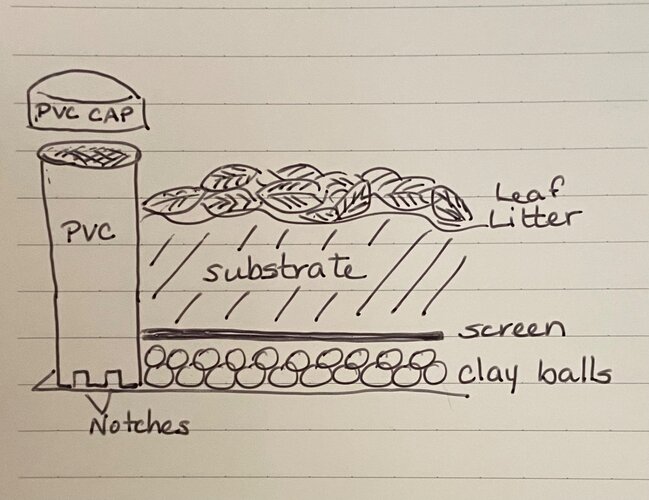
You will need: organic garden or potting soil, sandbox sand, coco coir, horticultural charcoal, orchid bark, sphagnum moss (cut up in small pieces), landscape fabric or other screening to separate drainage layer, clay balls or lava rock, piece of pvc pipe with a cap and a good amount of clean leaf litter. It’s also nice to have a medium sized piece of cork bark.
The first step is to cut some notches in one end of the pvc pipe and cut the pipe to a length which will be several inches longer than the depth of your substrate. Place the pipe, notched side down in whichever corner of your enclosure you desire and that will be easy to reach. Keep the cap on the end sticking out.Fill in your clay balls/lava rock around it and then place your separation barrier. All the rest of the items you want to mix together. I just eyeball my amounts and put in about 1/4 to 1/3 each of sand and coco coir, a couple of generous handfuls of charcoal, bark and moss. Put in some of your substrate mix and then place your plants directly in the soil and put the rest of the substrate. Gently tamp things down a bit. Cover with a generous layer of leaf litter. Ideally all of the soil should be covered with it. Lastly, add your isopods and springtails. Until things get fully established, you may want to give your clean up crew some veggie scraps. I also add a calcium source for the clean up crew…broken up cuttlebone (when I had it) or crushed eggshells. Water everything in well. Just in case of too much water drainage, you will need a way to remove the excess via the pvc pipe. I think something like this would work well. https://www.amazon.com/AQUANEAT-Sip...9276&sprefix=Aquarium+drainage,aps,242&sr=8-6
In time, the leaf litter will degrade and disappear as the clean up crew eats it. If you don’t have a source of clean leaf litter in your yard, there are some sellers on Etsy and even Amazon with much better prices than places like the bio dude.
This is where I learned from. https://www.chameleonforums.com/blogs/intro-to-bio-activity.2429/ My first set ups were to the letter until I realized that nature isn’t always so precise. Each element does have a purpose and function though.
Btw, yes, I am so very well aware of the expense and physical labor of taking down, cleaning and setting up fresh. I am in the middle of taking down my 5 well established double sized (4’ long & 2’ wide) bioactive enclosures (because Florida) and ugh! New plants to replace those which outgrew the enclosures too…💸💸💸
IMG_4528.jpeg
 
Back
Top Bottom