silas.edwin.johnson
Member
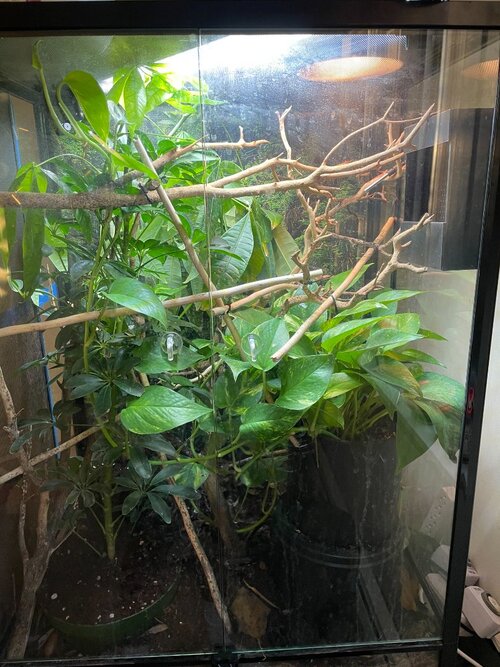
Hey guys so, I got a female panther chameleon from a pretty well respected breeder and sadly just two weeks after I got her, she died. And I love chameleons a lot, and definitely want to get another one at some point but I really want to make sure that my husbandry is on point before I do. I'll post a picture of the cage and generally describe my husbandry here:
- 36 x 24 x 18, glass cage on all sides except for top and one of the smaller sides.
- humidity was 90% during the night and I believe would go down to 30% during the day
- Used fogger between 2 and 7 AM
- Mist king would go off at midnight and then again at 10 AM (this is because she really never drank water when she woke up, so I decided to give her water a bit later)
- Heat lamp gave her a basking spot at 85 °F and an ambient temperature of on average 75 °F (the coldest part of cage is 68 °F).
- Arcadia 6% T5HO UVB gave her a basking spot at 2.5 UVI
- Food was originally 15 BSFL/day, but I recently started giving her 12 medium sized dubia roaches/day which were dusted with Arcadia ProA.
- The bottom of the cage was soil, with the plants placed in the soil in their pots.
- Soil was half sand and half peat moss (this was put on the top few inches of the plants pots) as well.
- A cleanup crew also was there to clean up poop, but I did spot cleaning bc I don't think I had enough isopods.
- Plants were all washed in the appropriate manner
- She had a small laying bin (8 x 6 inch) which I was intending to replace with a bigger one as she got closer to laying age.
- One of my plants (despite being quarantined) developed a fungus gnat infection and there was often some gnats in the cage.
- One day, because I think my humidity was too high, I noticed that the branches had some kind of dark surface on them (I think mold) and in my laying bin was a mushroom fungus which died off the next day. Maybe the whole cage had that fungus, I'm not quite sure.
Now, her behavior was kind of interesting.
- She had absolutely no signs of being unhealthy, no sunken-in eyes, no excessive gaping or hissing, never had closed eyes during the day.
- The thing that was the most concerning was her color. She would often become really dark even when she wasn't basking. In the last few days of her life, she was dark less and less.
- I also never saw her drink water, but her poop was usually pretty moist and I didn't see any of the orange crust you usually see with dehydrated chams.
- In the last few days of her life though I have struggled to locate any poop.
Obviously really sad, she was an awesome chameleon. I have really grown to appreciate female chameleons in the short time I had her. I definitely want to try again in the future, ideally in the next few months after I can adjust any problems with my husbandry. Thank you so much for any advice you could give.
- 36 x 24 x 18, glass cage on all sides except for top and one of the smaller sides.
- humidity was 90% during the night and I believe would go down to 30% during the day
- Used fogger between 2 and 7 AM
- Mist king would go off at midnight and then again at 10 AM (this is because she really never drank water when she woke up, so I decided to give her water a bit later)
- Heat lamp gave her a basking spot at 85 °F and an ambient temperature of on average 75 °F (the coldest part of cage is 68 °F).
- Arcadia 6% T5HO UVB gave her a basking spot at 2.5 UVI
- Food was originally 15 BSFL/day, but I recently started giving her 12 medium sized dubia roaches/day which were dusted with Arcadia ProA.
- The bottom of the cage was soil, with the plants placed in the soil in their pots.
- Soil was half sand and half peat moss (this was put on the top few inches of the plants pots) as well.
- A cleanup crew also was there to clean up poop, but I did spot cleaning bc I don't think I had enough isopods.
- Plants were all washed in the appropriate manner
- She had a small laying bin (8 x 6 inch) which I was intending to replace with a bigger one as she got closer to laying age.
- One of my plants (despite being quarantined) developed a fungus gnat infection and there was often some gnats in the cage.
- One day, because I think my humidity was too high, I noticed that the branches had some kind of dark surface on them (I think mold) and in my laying bin was a mushroom fungus which died off the next day. Maybe the whole cage had that fungus, I'm not quite sure.
Now, her behavior was kind of interesting.
- She had absolutely no signs of being unhealthy, no sunken-in eyes, no excessive gaping or hissing, never had closed eyes during the day.
- The thing that was the most concerning was her color. She would often become really dark even when she wasn't basking. In the last few days of her life, she was dark less and less.
- I also never saw her drink water, but her poop was usually pretty moist and I didn't see any of the orange crust you usually see with dehydrated chams.
- In the last few days of her life though I have struggled to locate any poop.
Obviously really sad, she was an awesome chameleon. I have really grown to appreciate female chameleons in the short time I had her. I definitely want to try again in the future, ideally in the next few months after I can adjust any problems with my husbandry. Thank you so much for any advice you could give.