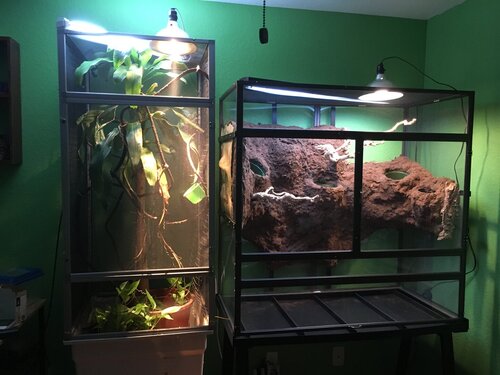
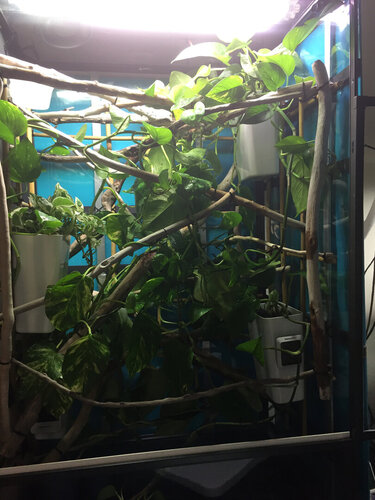
I am also planning on having the enclosure in my room, as there is not a lot of extra space in my home. I have also heard that it is better to have real plants in there as opposed to fake, does anyone have any knowledge of this?
Welcome to the forums! Just a little word of advice, don't ever get rid of your reptile supplies. I am yet to find someone that doesn't become addicted to one type of critter or another. lol
Kinyonga gave some great links. Check those out.
I can tell you what I use and have success with:
-
T5 Linear UVB light Fixture & Bulb: Typically 5.0 Zoo Med or 6% Arcadia bulb when I had them sitting on the top of the cage. I stress this being one of the most important parts of your husbandry. Don't be cheap on this. Get the nicer fixture out the gate and the correlating size for the size cage you get.
-
Heat Bulb: I use reptibasking spot light. Wattage varies between all enclosures. Some use a regular house bulb for this. Basking temp will vary for age of your cham.
-
6500K LED Bulb: for my plants to keep them alive and give some visible light to my cham.
-Fixtures for both heat and led bulb
-
Supplements: Plain calcium, calcium with d3, mutivitamin. Brand is up to you. I can tell you I've used Repcal brand with no problems.
-
Live plants, tons of them. I use no fake plants at all.
-
Branches and
vines. Most of my branches are non synthetic and I think they look better.
-
Mistking and
hand mister for hydration. I bought a $50 RO machine from amazon I use for both. That one is up to you, though. It's mostly for convenience.
-
Fogger for nighttime humidity (Do your research before deciding on this one. It's controversial whether they are good or bad if not maintained properly)
-
Screen cage: If you're experienced you can use glass, but my knowledge is with screen so I can't tell you about glass. A number of members, including Kinyonga, use glass with success. For a male panther you'll want a 2'x2'x4' minimum. Plan to have room for at least that size cage if not bigger.
-
Depending on your location you might consider covering left, right and back sides of cage to help with humidity and heat. I have done this for many many moons and suggest this to anyone asking for tips.
-
Plastic Feeder Bins: I use these to hold all of my feeders so they don't jump or crawl out of smaller containers. Also, if you plan to use crickets, I find they survive better in a larger plastic bin.
-
Food for feeders: I use Bugburger with added bee pollen for most of my feeders (unless they specifically have a need for a different chow). Otherwise, fruits and veggies. There's a list on the good ones if you'd like to have it.
-
Feeders: I suggest getting these sooner than later. A lot of places are back ordered right now and take a minute to get delivered. Make sure you have a variety: silworms, crickets, dubias, hornworms, black soldier fly and black soldier fly larvae, locusts/grasshoppers. I use all of these and use silkworms and crickets as a staple. You'll find what your cham likes and doesn't like. I suggest to stay away from superworms, meal worms, waxworms. If you feed those do so in moderation. That's basics, we can delve into it more if you'd like.
-
Hygrometer/Thermometer: I use Acurite brand they sell on amazon around the room for ambient temp and ambient humidity. Inside the cages I use the Govee bluetooth hygrometer/thermometer.
-
Temp Gun: I have a zoo med infrared temp gun that's used to test the temps at the basking spots. I highly suggest this and find it one of the most useful tools I own (aside from my UVI meter)
I can explain why I use each item I listed if you wish. I'm sure I probably forgot something. I bet another member will add to it.