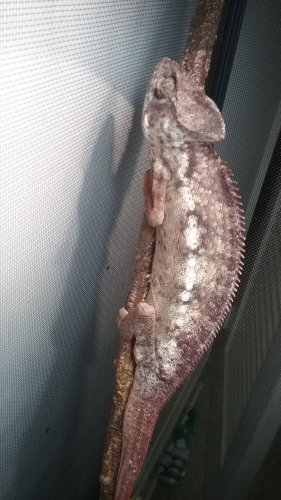
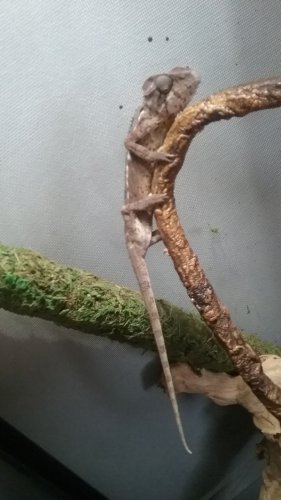
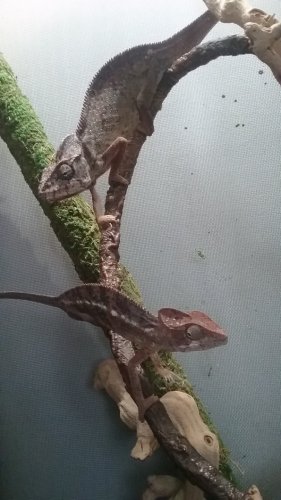
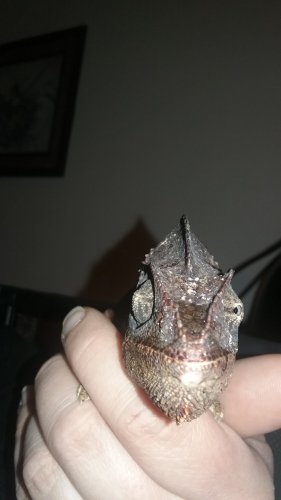
You said..."he faced his head down, opened his mouth wide, and was moving his tongue up and down like he was trying to get something out of his throat and then more drool came down. So now I'm worried he might have parasites? I did notice this morning a white spot on the front of his mouth, i don't think it was part of his pattern" ...a photo of the white spot would help. I've heard of this trying to get something out of a throat activity before ...while it's possible something is in it's throat or the pouch where the tongue is stored lately I've been wondering if it's an indication of lung worms..but not sure about this.
I have to agree with the make possibly being stressed by the female being in the cage depending on a few things...is she gravid? Is she reacting in a way that is repelling him? How big are they both? Please post some photos.
It's important that you feed/gutload the insects well. What the insects eat ends up in the chameleon so you want the insects to be well fed/healthy and contain nutrient that will benefit the chameleon's. Crickets, roaches, superworms, locusts can be fed/gutloaded with dandelion greens, kale, collards, endive, squash, zucchini, carrots, sweet potato, sweet red pepper, etc and a SMALL amount of berries, melon, pears, mango, apple, papaya, etc.
It's recommended that you dust the insects with a phosphorus-free calcium powder at almost every feeding to help make up for the poor ratio of calcium to phosphorus found in most feeder insects. It's recommended that you dust twice a month with a phosphorus-free calcium/D3 powder to ensure that the chameleon gets some D3 without overdosing it and allowing it to produce the rest from it's exposure to the UVB light. D3 from supplements can build up in the system leading to health issues such as MBD but D3 produced from exposure to the UVB light won't as long as the chameleon can move in and out if it at will. It's recommended that you dust twice a month with a vitamin powder that contains a beta carotene prOformed source of vitamin A. This prOformed source of vitamin A will not build up in the system like prEformed sources of it will but this leaves it up to you to decide if/when your chameleon needs some prEformed vitamin A. It's thought that chameleons can't convert the prOformed sources.
It's also important not to feed the chameleon too many waxworms and very few mealworms too. Silkworms, superworms, roaches, locusts, hornworms, BSFL, etc are better choices along with crickets as a staple.
Both the misting sessions and the dripper times need to be long enough to stimulate drinking each time and should be stopped in time to let the cage dry out quite a bit at night.
I would recommend a separate cage for each and a visual barrier between them.
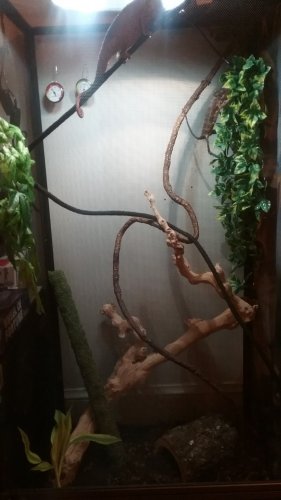
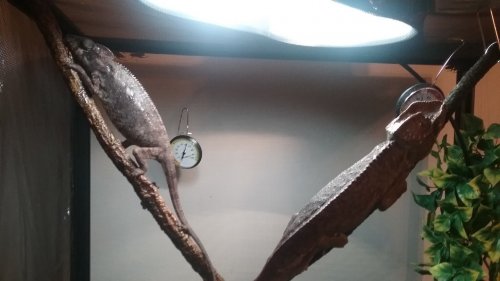
You said..." It's a save your reptiles zoo med combo deep dome light. The cage has not been warm enough so i have not shut off Any of the lights, didn't know i was supposed to honestly"...no lights at night at all. If it falls below 60 F at night then use a ceramic heat emitter. The basking temperature should be in the mid to high 80's F. It it's too low it can affect the eating because it plays a part in digestion. The lights should not be colored producing. A regular household incandescent bulb of a wattage that puts the temperature in the basking range may be used for a basking light.
You said..."I have 1 live plant, it just said terrarium plant lol"...please post a photo of it. It helps with the humidity if you have all real plants in the cage. They should be on the nontoxic plant list here on the forum and should be well washed ..both sides if the leaves before using them.
You said... "The only real traffic is my cats, which I'm also worried that they might be making him nervous' it could and it could try to break into the cage too.
Hope this helps! I'd like to see photos of both chameleons!