A note about your dragons supplement. Unless it is only Vitamin D3, mixing vitamins and Calcium (minerals) make them degrade, essentially rendering them useless. This pertains to the large majority of brands, and very few of the companies have discovered even adequate ways to offer vitamins and minerals in the same bottle. It is has even been suggested and recommended that you give them on days apart to aid in their utilization within the body.
I personally recommend the Rep-Cal and Miner-All products. You will require for the chameleons, all three of the following. The are to be used in a specific frequency and amount, and this will change depending on the chameleons age, sex, growth, health, food etc. They are as follows;
-Calcium (NO Vitamin D3, NO Phosphorous)
-Calcium with Vitamin D3 (NO Phosphorous)
-Multi-Vitamin Supplement (With Beta Carotene for a Vitamin A)
No red bulbs should be used. No additional heat at night unless it is consistently dropping into the 50's F. If it were you would need to raise ambient temperatures, not with a point heat source.
A heat "light", a basking spot or flood lamp should be used to create a basking spot in one top corner of the terrarium. This should create a temperature gradient downwards to the opposite corner. Chameleons will utilize every point in this heat great to regulate their temperatures.
For UV for these chameleons, I'd most likely first think to personally try two choices. First, a double bulb ballast with dual 10.0 florescent bulbs in them, mounted right on top against the screen. The ballast fixtures should have a good metal reflector on them. I suggest one that covers the length of the cage top, on a diagonal, utilizing the most area available. Secondly, a lower wattage Mercury Vapor Reptile lamp, which would provide both heat and strong UV. The Mesh on reptarium cages has been frequently reported to block 50% and MORE UVB penetration.
As always, there is nothing that beats real sunlight. If you live in an area where it might be possible to provide it, I do recommend doing so, if for only half a day a week, there can be benefits.
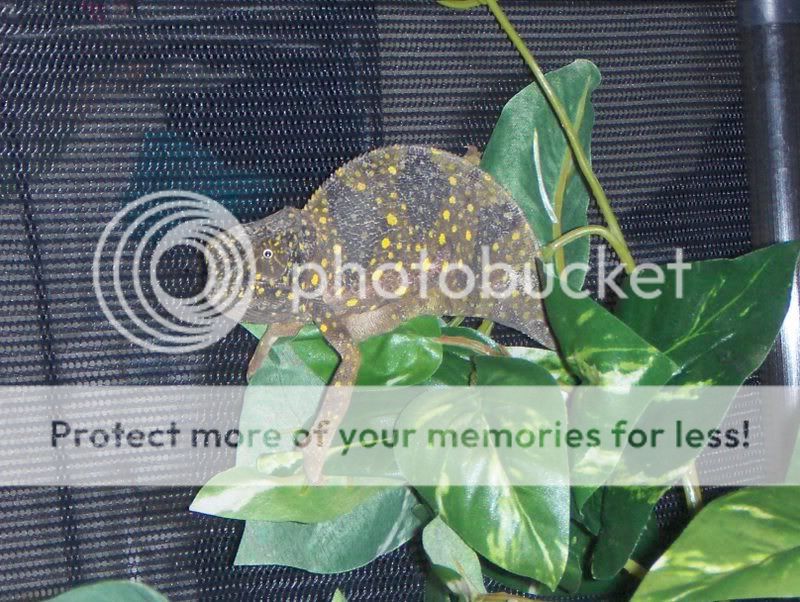
Also, notice the sunken eyes due to dehydration in this Wild Caught female of mine, it was due to the stress of both laying and having parasites (as you can see, there is a worm under the skin, that can be seen in the eye cavity. It bothered her to no end by the way...)
The cage should be vertically oriented, and chameleons, being probably one of, if not the most arboreal group of lizard, will most certainly suffer from the horizontal position of the cage, if not, at the very least not thrive in it during the most difficult of times: the acclimation period of a new home and owner.
The cage is also best off in a vertical orientation, to provide the needed hight for a few LIVE plants. Use something along the lines of Shefflera (Umbrella Plant), Ficus, Hibiscus (Requires high light best w/ Mercury Vapor Lights) and the addition of some branches, vines, and Live 'Pothos' vines. The live plants create an incredible difference in the chameleons care and well being. Raising humidity, oxygenating, and creating a piece of mind for their instinctive thoughts. The plants may also became a small part of the chameleons diet, so be sure to stick with either non toxic- or low toxicity plants that are deemed safe by chameleon keepers, also the plants should be prepared for the chameleons, washing the leaves in a mild soapy water solution and re potting it in plain topsoil (No added chemicals or fertilizers etc.)
A cage of mine, slightly different than the majority of north American keepers since it accounts for my locations non existent humidity and cool ambient temperatures. In addition, it is strongly recommended by the general population of keepers that no substrate be used, and I too recommend this for those that are not experienced enough, or prepared to deal with the dangers of it- yes dangers.
However, other than those differences, this is a good example of a well planted cage. As you can see in the front left, there is a clearing with the heat lamp above creating a warm basking area for the chameleon come to when in need of regulating and raising its temperature. It will vary in its distances from this top section based on its temperature desires. There are also plenty of strong horizontal and vertical branches and climbing pathways/perches.
Keep watch on the food intake, and the hydration of the chameleons. Watch and witness drinking, give plenty of opportunities, and daily, long thorough morning mistings (rain showers). During periods of stress, such as when chameleons are getting used to new caging, care and routines, they may show signs of dehydration, and it may suddenly appear. Keep watch for the skulls to become thin and bone-like, but more so, how bulbous the eyes are. Infrequent showers (see next photos) may be given to further provide better hydration, and a "wash" (especially a good eye cleaning as you will probably experience sometime). You can offer this every few weeks, and when the chameleon is dehydrated- be sure to balance it out with the stress of you handling them if they are sick and dehydrated- they may be better off left in the cage if its stressing them.
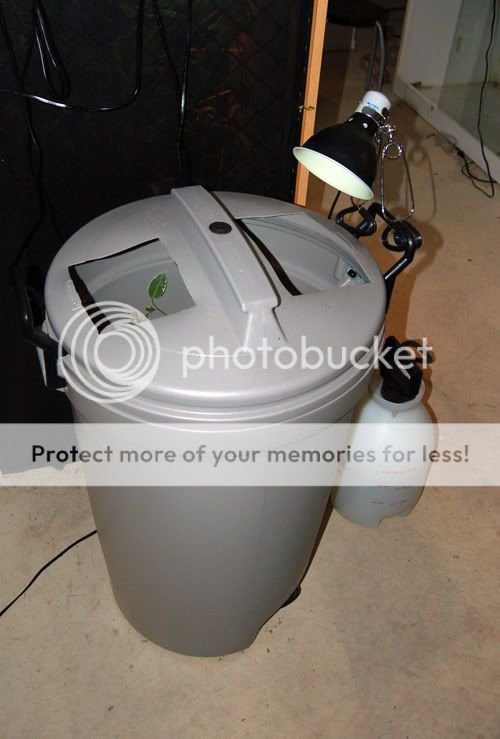
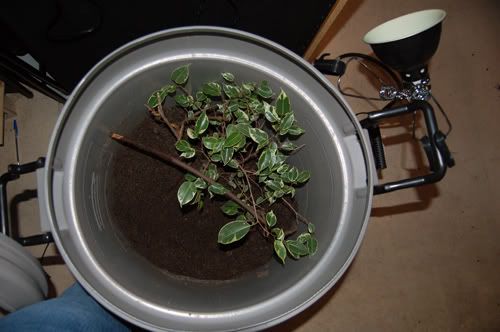
There is more information far below on the subject of females, laying and incubation, but here are some of my photos to give you some ideas for after you have finished your reading. I use Sand, Topsoil & Coco fiber mixed together. It should me misted with water, then mixed up, and misted again, and again, under the mix has a strong feel to it so that if she digs a long tunnel it will hold up and not collapse. If shes in there for extended amounts of time you'll need to mist to keep the soil moist enough.
I do mist for drinking water in the morning, no dripper as you don't want to saturate the bottom of the tubs soil. I usually place a few silkworms inside in the event that she will eat- although many will not. I usually put my computers webcam inside to spy on her. If she sees you she could abandon the whole shes digging and eventually become eggbound and die.
The laying bucket, minus the cloth that usually covers the hole not occupied by the light. The hole in the lid that is not covered by the lamp I cover with a type of perforated fabric that allows airflow.
I don't use a heat lamp, I use a florescent Coil, or a low wattage incandescent. You'll need to monitor the temperature and test a couple bulbs probably.
Provide vines, branches, and a plant as if it were her real cage.
Forgive me, however your friend does not seem like the type who is deserving of a chameleons responsibility. Give her the money she paid for the split purchase and keep the pair to yourself. Once she has been educated enough and witnesses your (hopefully) successful care and acclimation of them, she may wise up enough to hear your (and our) suggestions.
Here is your homework. Call me what you will, but it is your duty to read, understand, and ask for clarification as to what you have read and do not understand in the reading you have in front of you. I have recently realized it's not enough for me to simply provide the information, but apparently we need to be a little more forceful about the importance of proper, active ongoing research. It is one of the constant responsibility of keeping chameleons, and it is the key to providing up-to-date care, as these creatures care and keeping guidelines are in an ever evolving state.
-
Chamaeleo dilepis complex By Steven Deckers
This is the group of the type of chameleon you care for. Defining which exact subspecies is something you should look into after you have them acclimated and well off in your care. For the time being, the care for this species is general, and this article may enlighten you on some important points.
-
A Simple Nesting Site by Ken Kalisch
-
Eggs: Laying to Hatching by Bill Strand
The above 2 articles will outline the laying process of a female. It is generalized and not specific to your species, however they are detailed in instructions. Follow them carefully, they have worked time and time again for many people. You'll need to do research for info on dilepis incubation. Also, take concern with the female before, during, and after the laying. She will need special care to properly have her regain strength.
-
Co-Habitation by Bill Strand
An overall discouraged practice, but none the less possible. However, it is agreed upon by those that don't do it, and those that successfully do, that no one without experience and knowledge of chameleons, chameleon mentality and instinct, and more significantly- the in and outs of chameleon interaction, communication and signals. As Bill concludes in the article,
"As a beginning keeper of chameleons you have enough to worry about with just learning the basics of chameleon care. Do your self a favor and do not add the difficulties of making a co-habitation work."