General advice needed

AlsMango

New Member
Hello all, new here and to the world of Chams!
Bought a ambilobe last Monday and took advice from store with looking after and keeping my chameleon that the whole family have fallen in love with. But we want the best for her so after finding this forum we have a few questions!
We initially used a glass aquarium but after finding out how detrimental this would be we built a wooden and screen enclosure.
The store told us she needed 12hrs lights on and 12hr off but after the sale told us they only have the lights on from 9am-6pm!
And like clockwork she goes to 'bed' at 6pm and I'm trying to train her to get used to having the lights on until 8pm at least. Which leads to the next thing that even with the lights going on at 8am she's wont surface until midday- she's fully awake eyes open and alert but won't move even if food has been offered. Now in the large enclosure she is happy to climb up and down and loves exploring. Maybe the 2 moves in a week haven't helped but when she was in the aquarium she would hand feed and allowed my partner to pick her up by climbing onto his hand under her chin, now in the enclosure she won't hand feed which is annoying because she rarely sees it and we have to strategically place it until she does... And now walks away when we open the door to feed her and now is not tolerating us as she appeared to before.
We are also learning about diet, here in the UK we are feeding her locusts, again this is what we were told she would be fine on alone. We have the supplements to dust them with, but now we are reading about gut loading but no mention of locusts much. We asked so many questions at the store but wasn't told about all this so we have much to learn.
We are using compact bulbs 5.0 UVB and as we told the store we are using a wide glass tank we were worried that it wouldn't be enough so we were advised to use 2... (?!) we have moved her to a tall screen enclosure should we be using 2 ? still seems too much..
We were also told she eats 4 locusts a day but in the whole week we haven't been able to feed her more than 2 a day. She's 8 months old.
It's really cold here at the moment but maintain 80F using a infrared basking bulb 150w. We have the thermostat set at 86F. Temps range from 75-80 and at night are 60-70F humidity about 50% we are using 3 real plants from the safe plant list. Hand misting I'm doing 2/3 times a day. I'm using a spray bottle and wet all the plants and then spray one in particular and she comes over and drinks but not every time.
Wondered if anyone would be kind enough to suggest anything or high light why now she's happier in her new enclosure she's less happy about us!
 
advice

hello mate, look on this site for a fellow called solid snake, this guy is great foor advice, he realy knows his stuff and is very helpfull, he gave me some good adviceas im new to it all aswell.
 
Welcome to the forum and to the world of chameleons!

Her attitude may be changing for a number of reasons.

Are you aware that they can lay eggs without having been mated and that its recommended that you provide a suitable place (opaque container 12" deep x 12" x 8" filled with slightly moist washed playsand) for her to dig in to show you when she needs to lay eggs. You should also be aware that when she is digging you should not let her see you watching her.

When used properly, there is nothing wrong with glass cages. Most types of cages have pluses and minuses.

I leave the lights on my cages for about 12 hours a day...but you can also follow the light patterns where you live generally. (I wouldn't recommend that in the very far north of course, where there is darkness almost all day! LOL!)

Locusts seem to be fine (never used them myself since I'm in Canada)...but its always best to offer a variety of insects if possible. You can gutload them with a wide assortment of greens and veggies...just like you do crickets.

You could add a dripper so that she has more opportunity to drink.

Not sure about the UVB lighting without seeing the cage. I would recommend using a regular incandescent household bulb for the basking bulb too (off at night of course) in a domed hood. Wattage..whatever makes the basking temperature in the low 80's range.

Two locusts a day doesn't seem like much but it would depend on the size of them. If the temps where she sits in the cage are cooler her metabolism may be slow.

Here's some information I hope will help you with supplementing, etc.....
Appropriate cage temperatures aid in digestion and thus play a part indirectly in nutrient absorption.

Exposure to UVB from either direct sunlight or a proper UVB light allows the chameleon to produce D3 so that it can use the calcium in its system to make/keep the bones strong and be used in other systems in the chameleon as well. The UVB should not pass through glass or plastic no matter whether its from the sun or the UVB light. The most often recommended UVB light is the long linear fluorescent Repti-sun 5.0 tube light. Some of the compacts, spirals and tube lights have caused health issues, but so far there have been no bad reports against this one.

A wide variety of insects that have been well fed and gutloaded should be fed to it.

Since many of the feeder insects we use in captivity have a poor ratio of calcium to phosphorus in them, its important to dust the insects just before you feed them to the chameleon at most feedings with a phos.-free calcium powder to help make up for it. (I use Rep-cal phosphorus-free calcium).

If you also dust twice a month with a phos.-free calcium/D3 powder it will ensure that your chameleon gets some D3 without overdoing it. It leaves the chameleon to produce the rest of what it needs through its exposure to the UVB light. D3 from supplements can build up in the system but D3 produced from exposure to UVB shouldn't as long as the chameleon can move in and out of it. (I use Rep-cal phos.-free calcium/D3).

Dusting twice a month as well with a vitamin powder that contains a beta carotene (prOformed) source of vitamin A will ensure that the chameleon gets some vitamins without the danger of overdosing the vitamin A. PrEformed sources of vitamin A can build up in the system and may prevent the D3 from doing its job and push the chameleon towards MBD. However, there is controversy as to whether all/any chameleons can convert the beta carotene and so some people give some prEformed vitamin A once in a while. (I use herptivite which has beta carotene.)

Gutloading/feeding the insects well helps to provide what the chameleon needs. I gutload crickets, roaches, locusts, superworms, etc. with an assortment of greens (dandelions, kale, collards, endive, escarole, mustard greens, etc.) and veggies (carrots, squash, sweet potato, sweet red pepper, zucchini, etc.)

Calcium, phos., D3 and vitamin A are important players in bone health and other systems in the chameleon (muscles, etc.) and they need to be in balance. When trying to balance them, you need to look at the supplements, what you feed the insects and what you feed the chameleon.
Please note that various supplements have various amounts of D3 and vitamin A and so some can be given more often than others. The idea still is not to overdo the fat soluble vitamins like D3 and prEformed vitamin A.

Here are some good sites for you to read too...
http://chameleonnews.com/07FebWheelock.html
http://web.archive.org/web/200605020...Vitamin.A.html
http://web.archive.org/web/200406080...d.Calcium.html
http://www.uvguide.co.uk/
http://web.archive.org/web/200601140...ww.adcham.com/
If you can't access the sites above that have the word "archive" in you can do it through the WayBackMachine.
 
Last edited:
Hello all, new here and to the world of Chams!Welcome!:) Im glad you have found us. This is a great community, you can learn alot of great stuff here. I will type things I have learned here, and think are appropriate in red.
Bought a ambilobe last Monday and took advice from store with looking after and keeping my chameleon that the whole family have fallen in love with. But we want the best for her so after finding this forum we have a few questions!
We have answers!;)
We initially used a glass aquarium but after finding out how detrimental this would be we built a wooden and screen enclosure.
This is great. She needs the airflow. How big is the new enclosure?
The store told us she needed 12hrs lights on and 12hr off but after the sale told us they only have the lights on from 9am-6pm!
And like clockwork she goes to 'bed' at 6pm and I'm trying to train her to get used to having the lights on until 8pm at least. Which leads to the next thing that even with the lights going on at 8am she's wont surface until midday- she's fully awake eyes open and alert but won't move even if food has been offered.
I use a 12on 12off schedule. Most seem to use 12/12, but slightly different lengths are fine. You can get her on whatever time schedule you like, it may take some time though. Chameleons can be skiddish after a move, or if anything changes really. That could explain her hiding out a bit. Now in the large enclosure she is happy to climb up and down and loves exploring. Maybe the 2 moves in a week haven't helped but when she was in the aquarium she would hand feed and allowed my partner to pick her up by climbing onto his hand under her chin, now in the enclosure she won't hand feed which is annoying because she rarely sees it and we have to strategically place it until she does... And now walks away when we open the door to feed her and now is not tolerating us as she appeared to before. Not eating or drinking in front of you is normal, again, especially after lots of big changes.
We are also learning about diet, here in the UK we are feeding her locusts, again this is what we were told she would be fine on alone. We have the supplements to dust them with, but now we are reading about gut loading but no mention of locusts much. We asked so many questions at the store but wasn't told about all this so we have much to learn.
Nutrition plays a huge role in their health, it will be the biggest pain in your but soon:p Locusts can be tricky to gutload, but they will generally eat greens, and fruits, especially orange. They will get their water from the plant matter they eat. If you look at the blog section of the forum, a wonderful person named Sandrachameleon has wrote the book on gutloading. Read it, study it. Its the best source of info for gutloading IMO(and everyones really) The more feeders you provide the better, as in variety. Some feeders like superworms/mealworms/wax worms are considered treats, and should only be fed occaisionally. Other feeders are considered "staples" These are the ones that will make up the main diet, such as crickets/silkworms/dubia/locusts. The more variety you provide the better.
We are using compact bulbs 5.0 UVB and as we told the store we are using a wide glass tank we were worried that it wouldn't be enough so we were advised to use 2... (?!) we have moved her to a tall screen enclosure should we be using 2 ? still seems too much..
Depending on the size of the cage, it may be appropriate, but that is doubtful. One should be enough, unless the cage is HUGE. UVB bulbs degrade and have to be replaced(6months is a good bet on lifespan). They will still give off light, but not suffecient UVB. So just store the other one for later.
We were also told she eats 4 locusts a day but in the whole week we haven't been able to feed her more than 2 a day.
Could be skiddish from the move still. If you are offering food, then she will be ok.
Females lay eggs, whether or not they have mated. I have no female experience, but a lower amount of food is recomended for them. It will reduce the chance of her creating eggs, eggs take a toll on the animal, so its better to avoid it if you can. I will again refer you to the blog section here, as that information is much better than anything I can offer.
She's 8 months old.
It's really cold here at the moment but maintain 80F using a infrared basking bulb 150w.The red bulb should be switched for a regular white/clear housebulb. The housebulb will replicate the sun, so its better for basking. 150watts sounds to high. I use a 75watt, but everyones situation is different, so you may have to play with different wattages, and distances from the cage. I like the basking spot in a corner. You want to create a temperature gradient, basking corner being the hottest spot, opposite bottom corner being the coolest spot. I keep my basking at 85-95F. That temp is taken from the closest spot to the bulb, the animal can get to. We have the thermostat set at 86F.No thermostat is needed. You will want to put the lights on a timer instead. Temps range from 75-80 and at night are 60-70F humidity about 50% we are using 3 real plants from the safe plant list.Temps can go as low as 50F at nite. Day time ambient temps of 70-75F is desirable. A 10F temp drop at nite is recomended to stimulate appettite. Hand misting I'm doing 2/3 times a day. I'm using a spray bottle and wet all the plants and then spray one in particular and she comes over and drinks but not every time.
This sound good. I would mist at least 3 times. I think you should run a dripper all day as well. This will make sure humidity stays up, and she stays hydrated.
Wondered if anyone would be kind enough to suggest anything or high light why now she's happier in her new enclosure she's less happy about us!
She may be "holding her territory" now that she has a place she likes. They are fairly territory animals, and generally like privacy. This is just my thoughts.
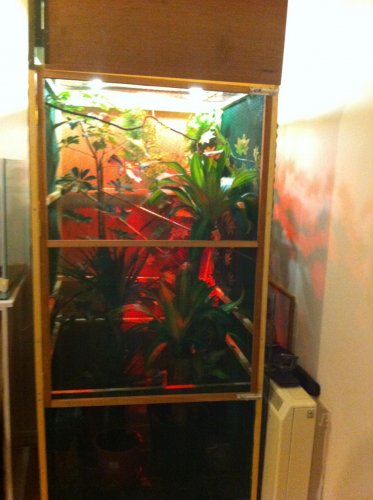
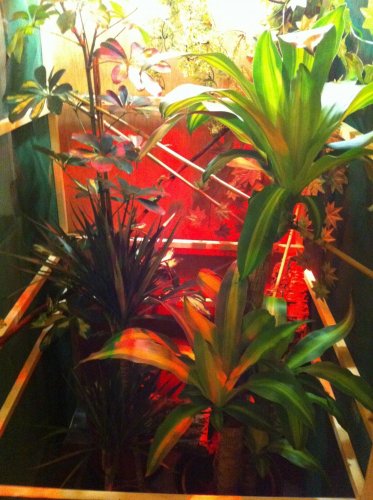
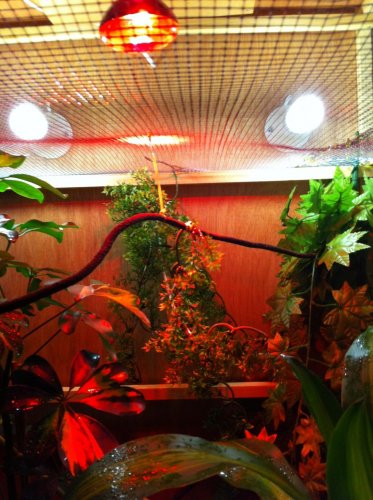
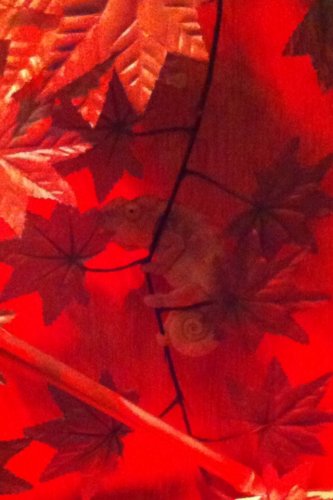
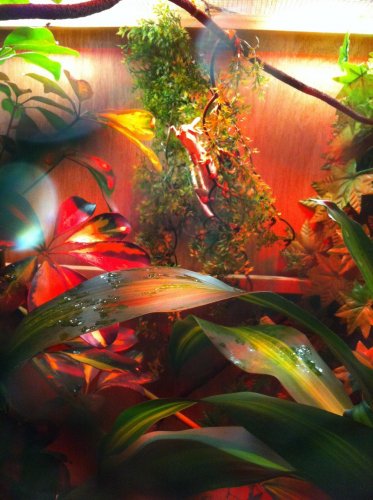
If you could post pictures of her, and her enclosure, it would be great.
I hope what I typed is coherent, Ive been up for awhile and need sleep!:eek:
Ask any questions you have, and if you need me to clarify anything I will certainly try. The things I mentioned should be addressed asap, mainly lighting. Post some pics, and we can see how her house looks:)
Again, glad to have you on the forum.
Your going to love chameleons!
hello mate, look on this site for a fellow called solid snake, this guy is great foor advice, he realy knows his stuff and is very helpfull, he gave me some good adviceas im new to it all aswell.
:p Just going to put me out there like that huh?:p
Im really glad I was helpful:)
 
Hi and thanks for your replies and input. I was extremely encouraged to use this infrared bulb, and although i spoke of my concern about it they were adamant thats what she needed. so as im now confused about the issue please can you tell me why its important to use a normal white house bulb. I really also thought the same with the 150w factor but the temps at the highest point is not over 95 f so is that a problem. at the moment UK is around -2c so it is very cold.
im still concerned about her sleeping pattern- she never sleeps during the day but does seem to rest a bit in the afternoon without eyes closing. however lately she is up at 9am walking around and basking and some days not on the move until well into midday. i dont know what im doing wrong there.. when her lights go off at 8 we do switch off all lights in room and tv is on- is it possible that is disturbing her?
shes been in her new enclosure for a week now and she really does not want to eat from us any more although she did when we first got her 2 weeks ago.. in fact im sure she hates us as soon as we go to open the cage she walks away.
Ive taken some pictures of her, will definately read about the gutloading and get on with that.
shes still eating, but again doesnt seem to 'hunt' for it just if she comes across it she'll have it.
 

Attachments

  • enclosure3.jpg
    enclosure3.jpg
    248.8 KB · Views: 93
  • enclosure1.jpg
    enclosure1.jpg
    252.3 KB · Views: 98
  • enclosure2.jpg
    enclosure2.jpg
    253.6 KB · Views: 100
  • enclosure4.jpg
    enclosure4.jpg
    149.5 KB · Views: 90
  • enclosure5.jpg
    enclosure5.jpg
    250.5 KB · Views: 88
A regular house bulb is preffered, because in their cage, it serves the role of the sun. The sun(as you well know) is not red, but in fact a bright whiteish yellow. ;)
Temps at nite can go as low as 50F with no need for a heat source. The red bulbs at nite, can keep them awake, and make them sleepy;)
 
The shop must have seen me coming as that bulb was £10 hahaha
just to make clear i never leave the lights on at night anyway and welcome the temp drop- i have the lights on 12 hours a day. Thanks I have now gone and got a regular bulb and might disconnect the second UVB bulb what do you think of the enclosure?
 
I've now changed the bulb to a clear house bulb 100wand the vine under it as in the basking area is reaching 85F

Please could anyone tell me if my set up looks ok or not thank you in advance.
 
If you have changed the red-bulb for a house bulb, I would then suggest adding more climby things. It seems a bit "sparse'.
I would add more vines, and walkways for sure.
 
Back
Top Bottom