

Time Police
New Member
Chameleon Info:
[*]Your Chameleon - Jackson Chameleon, Male, Juvenile 4-5 months, I have had him for 3 weeks.
[*]Handling - Once a week
[*]Feeding - Super worms, crickets, occasional wax worm. I alternate feeding him a super worm one day as crickets the next. I supplement only twice a week with Repti Cal (With D3), and twice a month with Herbitivite.
[*]Supplements - Repti Calcium w/ D3, Herbtivite Advanced Formula
[*]Watering - Drip/ Aquazamp Rain Dome. Turns every two and a half hours for 5 min. I'm not home to see him drink, but he urinates often and it looks healthy.
[*]Fecal Description - Brown, about the size of a Jelly Bean, moist, no complications.
[*] History - No history.
Cage Info:
[*]Cage Type - 16x16x30 Reptibreeze
[*]Lighting - Reptisun 5.0 UVB, 40 watt day Bulb
[*]Temperature - 70-80 during the day, 65-75 at night, basking spot says between 75-80
[*]Humidity - 60-80 using a drip system, Aquazamp rain done, and manual misting.
[*]Plants - Ficus plant
[*]Placement - corner of room next to bed. Not near fans or widow.
[*]Location - San Diego, California
Current Problem - So I was doing my weekly handling, and cleaning his cage when I noticed my chameleon had this gelatinous looking blister on his spine and by his legs. I rubbed and it didn't hurt him but it felt squishy and like jello. It's not filled like a blister, but it feels mushy. I have no idea what it is. I don't have a good picture because my computer crashed and I'm using my IPhone, and he keeps moving around lol.
Let me know if you all need a better picture...or if it even showed up lol.
Pictures are helpful
[*]Your Chameleon - Jackson Chameleon, Male, Juvenile 4-5 months, I have had him for 3 weeks.
[*]Handling - Once a week
[*]Feeding - Super worms, crickets, occasional wax worm. I alternate feeding him a super worm one day as crickets the next. I supplement only twice a week with Repti Cal (With D3), and twice a month with Herbitivite.
[*]Supplements - Repti Calcium w/ D3, Herbtivite Advanced Formula
[*]Watering - Drip/ Aquazamp Rain Dome. Turns every two and a half hours for 5 min. I'm not home to see him drink, but he urinates often and it looks healthy.
[*]Fecal Description - Brown, about the size of a Jelly Bean, moist, no complications.
[*] History - No history.
Cage Info:
[*]Cage Type - 16x16x30 Reptibreeze
[*]Lighting - Reptisun 5.0 UVB, 40 watt day Bulb
[*]Temperature - 70-80 during the day, 65-75 at night, basking spot says between 75-80
[*]Humidity - 60-80 using a drip system, Aquazamp rain done, and manual misting.
[*]Plants - Ficus plant
[*]Placement - corner of room next to bed. Not near fans or widow.
[*]Location - San Diego, California
Current Problem - So I was doing my weekly handling, and cleaning his cage when I noticed my chameleon had this gelatinous looking blister on his spine and by his legs. I rubbed and it didn't hurt him but it felt squishy and like jello. It's not filled like a blister, but it feels mushy. I have no idea what it is. I don't have a good picture because my computer crashed and I'm using my IPhone, and he keeps moving around lol.
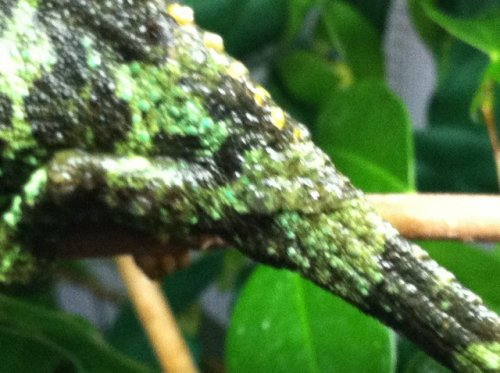
Let me know if you all need a better picture...or if it even showed up lol.
Pictures are helpful


