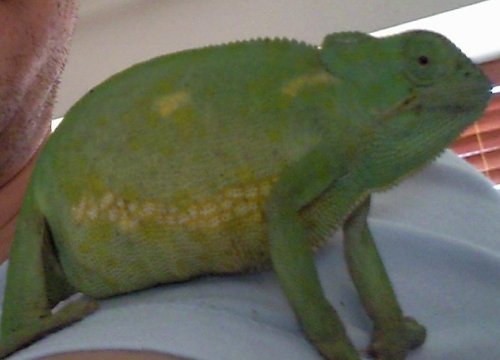
Female not laying eggs

Fidget321

New Member
I just received a common Chameleon (i think) on thursday.
It was a wild chameleon and is responding pretty well to being in the cage we built for her.
She eats well, even eats crickets out of our hands when offered.
The problem we have is that we can clearly see lumps on her belly. And her body is quite large. We didn't have any soil in the bottom of her cage until yesterday and she kept dwelling on the bottom. We asked the pet store manager what soil would be perfect for her to lay eggs and he suggested a soil that can stay moist. we Brought a pack of soil (from the petstore) yesterday morning and we placed it there immediately (The soil is about 15cm deep).
But she is still not laying eggs. What can i do, as you can clearly see these lumps in her belly.

Thanks
 
Put the dirt into a container. The container should be 12" deep and big enough for her to turn around in comfortably. I use a Rubbermaid bathroom trash can. Make sure there is access into the container from her branches. Put her into it so she knows it's there and wrap a towel or something around the cage so she has privacy. She won't dig if people are watching her.
 
Sorry, here is the rest of the info required:
Cage Info:

* Cage Type - It's a big tube shaped cage made with plastic mesh and two lids.
* Lighting - I have a 60w reptile heating lamp
* Plants - I am using live plants
* Location - Cage is in my study the lowest traffic area of my house, not near fans or anything that might cool down the temp


Chameleon Info:

* Your Chameleon - Female. Not sure what species, guessing common cham
* Handling - Only when i clean her cage.
* Feeding - I feed my cham several times a day, feed her crickets which i have only started gut loading yesterday. every second day i lighty coat one of the crickets with calcium and D3 vit powder
* Supplements - As per above
* Watering - I have a plastic cup that drips into the cage, and i spary twice daily
* Fecal Description - No idea
* History - This has been a wild Cham, we picked her up on Thursday.
* Current Problem - As per previous post
 
Ok i will try that. i think the soil (it's not dirt) is deep enough, but i will close the lower part of her cage during the day tomorrow.
I am extremely worried as to what might happen if she does not lay her eggs.

Thanks will try that.
 
Generally common chameleons only lay eggs once a year in the fall...so are you sure its a common chameleon??

Can you post a picture of it please?
 
You said..."I have a 60w reptile heating lamp"...it needs a source of UVB light. The one I use is a repti-sun 5.0 long linear tube light.

You said..."I am using live plants"..make sure they are non-toxic and well washed...both sides of the leaves.

You said.."I feed my cham several times a day, feed her crickets which i have only started gut loading yesterday. every second day i lighty coat one of the crickets with calcium and D3 vit powder"...I dust with a phos.-free calcium powder at most feedings. I dust with a vitamin powder with a beta carotene source of vitamin A twice a month and a phos.-free calcium/D3 powder twice a month. (This needs to be explained...but I don't have time right now. If you search the forum you should find posts about it.)

More later.
 
Thanks for the advice!

I am pretty sure it is a common Cham, as she doesn't have any distinctive horns or features, she just looks like an ordinary chameleon.
I am from South Africa, and fall is busy starting here. - So that's good right?
I also put her in the sun everyday (Only half of the cage, should she want shade.)

I gave har some privace by wrapping parts of her cage with a blanket. (The light and enough air still comes in) and she started digging this morning.

Should i give her calcium suppliment once a day once she has laid her eggs?
 
My Chameleon looks alot more like the Senegal, as she is usually that kind of green and also does not have the head like the common cham.

I will post a picture tomorrow i just need to take one.

Can they be overfed? (I'm sorry for the millions of questions, but as you have probably realised i'm new at this kind of thing, and i really want to take care of her in the best possible way)
:confused:

And also, i noticed the Senegal also has tiny black spots on the side of it, i know they get these black spots when they are stressed or agitated, mine has black spots on each side of her even when she is sleeping and when she is not stressed. It looks more like the skin is black rather than her changing those colours.
Is that normal?


Thanks a mil :)
 
They can be overfed but if she is going to lay eggs don't worry about it right now....she needs the extra nutrients. How much are you feeding her? Calcium is important though when they are working on eggs...helps with the shelling and the muscle contractions when it comes to laying them.

They can take on a dark dotting over the green background. Also the female can be very dark in the background with bright yellowish spots when gravid and in the presence of a male or upset.

Here's a site with information and lots of pictures...
http://www.chameleonnews.com/?page=article&id=164

Don't worry about asking questions...can't guarantee all the answers but will try.

Hope she lays the eggs for you!
Do you know how to incubate eggs? You need to get the egglaying setup done before the time you have to dig up the eggs.

BTW...you said..."I am extremely worried as to what might happen if she does not lay her eggs"...if she stops eating, sits low in the cage, seems lethargic then post about it. Hard to tell if she is ready to lay them yet or not....that's why its important to have a place in the cage for her to dig.
When getting ready to lay them they usually wander around the cage especially the lower parts and stop eating. They drink more too.
 
I'm not sure as to how much i should feed her to be honest.
here's how i fed her the last days:
Saturday: 2 crickets - with Calcium and vit D
Sunday: 5 Crickets
Yesterday : 6 Crickets - one cricket coated in clacium and vit D (gutloaded)
Sofar today 2 crickets. (gutloaded)

I feed the crickets carrot.

I'm just afraid she gets too little amount of food.

Thanks for the website, i will read through it. Though the spots i'm talking about almost looks like marks instead of her colour.

Also about the egg incubating, the pet store manager said that he will incubate the eggs for me, though i would like to do it myself incase i never see the eggs or hatchlings again (You never know with people these days).
I am prepared to buy another basking lamp for temprature etc. just not sure what exact temprature the egss have to be etc. (Infact, i don't really know much about the incubation at all :eek:)

Thanks again.
 
You said..."here's how i fed her the last days:
Saturday: 2 crickets - with Calcium and vit D
Sunday: 5 Crickets
Yesterday : 6 Crickets - one cricket coated in clacium and vit D (gutloaded)
Sofar today 2 crickets. (gutloaded)"...I think that is enough for a Senegal in that many days but you can add a couple more than that without it being a problem. You should be able to judge whether you are under/overfeeding her by her size (thin or fat?).

I dust at most feedings with a phosphorous-free calcium powder. This helps make up for the usually poor ratio of calcium to phosphorous found in most feeder insects.

I dust twice a month with a vitamin powder that has a beta carotene source of vitamin A. Beta carotene won't build up in the system like preformed sources of vitamin A can. If the chameleon needs a little preformed you can give it a bit once in a while. Excess preformed vitamin A can prevent the D3 from doing its job and push the chameleon towards MBD.

I also dust twice a month with a phos.-free calcium/D3 powder lightly. D3 from supplements can build up in the system. Exposure to UVB either from a tube light that contains UVB rays or the sunlight will allow the chameleon to produce D3 which will allow it to use the calcium. The UVB should not pass through glass or plastic.

Appropriate temperatures will aid in good digestion and thus help with nutrient absorption.

Calcium, phos., D3 and vitamin A are important players in bone health and need to be in balance. Appropriate supplements, gutloading/feeding of insects and feeding of the chameleon will keep the balance.

You said..."I feed the crickets carrot"...I feed my crickets a wide assortment of greens (dandelion, kale, collards, endive, escarole, mustard greens, etc.0 and veggies (carrots, sweet potatoes, squash, sweet red pepper, celery leaves, zucchini, etc.).


You said..."Though the spots i'm talking about almost looks like marks instead of her colour"...WC Senegals can have small black marks on them...I need to see a photo to see if I can tell what they are.

Re: eggs...Dig the eggs up carefully after the female has laid them and completely buried them and returned to the branches. Ask me more when the eggs are laid.

Re: incubating...I use shoebox sized plastic containers with lids to incubate the eggs in. I fill the container about half full of barely moist coarse vermiculite. (I only fill it half full so that the babies will have room to walk around when they hatch until they can be removed from the container.) I punch two very small holes in the lid of the container. I lay the eggs in rows about 1" apart in small dents in the vermiculite and then put the lid on. To test the vermiculite for moisture, take a fist full of it. You should only be able to squeeze a drop or two of water out of it.)
 
I know this thread is a bit old but the chameleon is most defenitely a flap neck, if you live in SA.
The only egg laying chameleon commonly found is a flap neck.

How is she doing?
 
Hi there,

I figured i'd only give an update when she had laid her eggs.
But she still has not lain any. I have placed a sort of dome like object in the bottom of her cage, and wrapped the lower pert of her cage with a blanket. She has started digging, but still no eggs. I'm not too sure what chameleon it might be.

I will post a picture in about an hour or so.

are there any other tips i can try to get her to lay her eggs?
I also think i might be a bit over anxious, how long does it take from fertilization until she lays eggs?

Thanks
 
Hi all,

As promised, here is a pic of my cham.

Fang.JPG
 
Thanks!

I think the soil is roughly 13cm deep. I have to measure the depth to be sure.
I will take a pic and show.
She has been diggin for three weeks.
 
A foot deep would be better..or even deeper won't hurt.
She's been digging for three weeks?? That's too long...is she digging a hole or just a trench?
 
Thanks.

To also answer your previous question regarding calcium intake, i dust about two crickets every second day with a calcium and vit D3 powder.

She has been digging trenches, but it might be because of the depth.
I'm going to have issues getting the soil to that depth as i have a mesh cage that won't hold this soil in. the underlining of this cage has a "container" if you will that is about half a foot in depth, i filled it until i coultdn't anymore.

I think i'll just go buy more soil and get it wet before i put it in her cage to prevent it from falling out.

Thanks for the links, it's great for comparison as she is nowhere near digging holes like those.

I also saw on one of the articles that they normally lay there eggs March to April, worse case scenario, after all the above is done and she is still not satisfied with the depth or soil or anything, will she "hold" the eggs?


Thanks

*i forgot to take a pic of her cage, i will do so on the weekend - apologies
 
I have a 65 liter rubbermaid container that has a lid that I use for an egglaying place. I fill it about half full of washed playsand that is moist enough to hold a tunnel. I put a branch in the container for the chameleon to sit on. I cut a huge hole in the lid and screen over it. I put the female in the container and put the lid on. I put a light over the screen so that the female can see and to keep her warm. She can be fed and watered while in this container...just be sure not to leave any uneaten insects inside so they won't chew on her or the eggs when she lays them. Don't let her see you watching her when she is digging.

The same thing can be done with a large garbage can.
 
Back
Top Bottom