
Navigation
Install the app
How to install the app on iOS
Follow along with the video below to see how to install our site as a web app on your home screen.
Note: This feature may not be available in some browsers.
More options
You are using an out of date browser. It may not display this or other websites correctly.
You should upgrade or use an alternative browser.
You should upgrade or use an alternative browser.
advice on cage
- Thread starter alan23
- Start date


Brad Ramsey
Retired Moderator
For type / sex of chameleon?
Brad Ramsey
Retired Moderator
Have you decided on a male or female?
The size cage you describe would be adequate to house a female but on the
small side for a male.
Personally I would like to see it a foot taller for either.
-Brad
The size cage you describe would be adequate to house a female but on the
small side for a male.
Personally I would like to see it a foot taller for either.
-Brad

Julirs
New Member
I just moved my male Veiled into a 24X24X48. It seems ideal for him and I can see why you wouldn't want to go much smaller. I have used 38 gallon Reptariums for my youngsters and have not had crickets chew through them yet, but my advice would be to get a good screen cage with a door that is easy to open. Remember that baby chameleons need to be able to find their food, so get an appropriate sized cage for their age and then move up when they are big enough.
Julirs
New Member
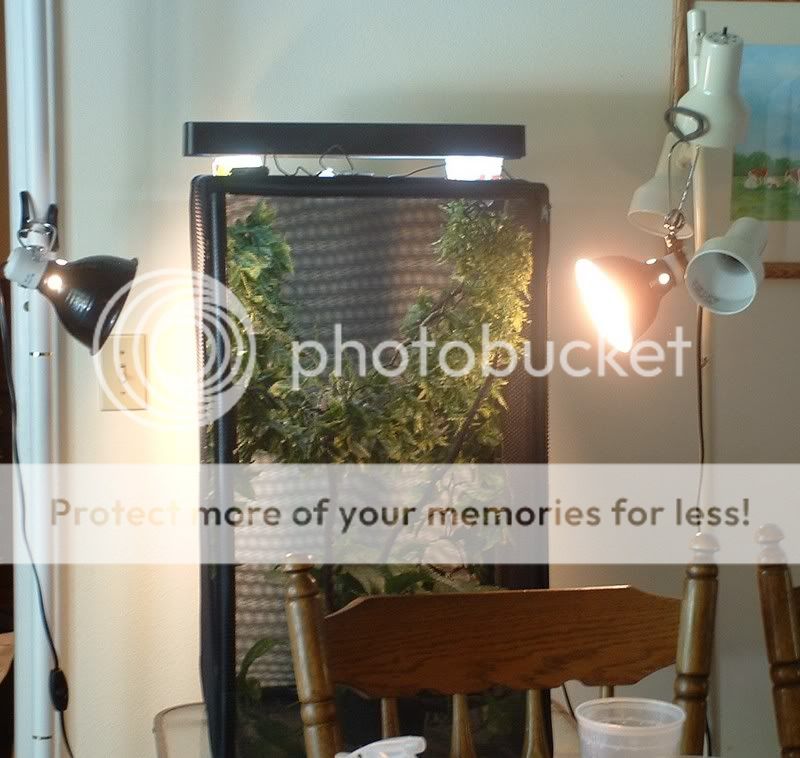
They are both basking lights. Reptariums have dark mesh so you need to use alot of light in order to see into them. My Veiled liked to hang from the top under the UVB light when he as a baby so in the picture it is propped up on cut up plastic cups. I currently am using 2 Reptariums and the lights are sitting directly on the top of them.
Julirs
New Member
I use a common handmister (spray bottle), and mist for about 2 minutes each time 3 times a day. I usually turn the lights on in the morning, mist a half hour later, then again at lunch time, and then again between 5-6. Asking questions is a good thing! I am glad that I had people to ask when I first got my Veiled.

dragonbreeder
New Member
Hello.
I used to have many veiled chameleons in the late 90’s, and for the first couple of years I had many cages that were too narrow (such as 2 feet by 2 feet by 4 feet tall). After years of building many different shapes of cham cages, and after meeting other keepers, (many from the CIN or Chameleon Information Network), I started to see that there was a better cage configuration. I have found that the best seem to be not only high, but wide. A typical veiled chameleon, just like other chameleons, likes to be high up, but also needs to move around horizontally.
So, a 24x24x36 might be suited for the smaller species, but is not best suited for an active veiled-sized cham for many reasons. It is a common misconception that height is the only important parameter. Chameleons seem more comfortable at higher levels, typically at least at human eye-level, but 2 feet by 2 feet does not provide ample space for a veiled chameleon to move around horizontally. In a 2x2 cage at the top, a cham can easily be forced to move downward to thermoregulate, instead of being able to move horizontally away from the heat source.
In the wild, chameleons do not move to the top of bushes and trees and stay there, they move around horizontally once they reach a comfortable level.
So, a great cage would be 4 feet wide, at least 2 feet deep and three feet high, with legs that put the top of the cage at about 6 feet or so from ground level. A cage like this sounds huge, but it really is not and can be built yourself and can be a fun project.
Believe me, I saw a big difference once I switched to this type of design.
Another consideration is cricket-control. Typical mesh used for cham cages will allow your feeder crickets to escape into your home. On the other hand using screen will stop that but can break your cham’s toenails if they decide to walk up it. A good solution to these issues is to use mesh on the inside and screen on the outside. The downside is decreased view of your animal. However, a solution to that is to add a glass door (to the front only), so that you will still have appropriate open-air flow around the sides, back, and top.
Good luck!
I used to have many veiled chameleons in the late 90’s, and for the first couple of years I had many cages that were too narrow (such as 2 feet by 2 feet by 4 feet tall). After years of building many different shapes of cham cages, and after meeting other keepers, (many from the CIN or Chameleon Information Network), I started to see that there was a better cage configuration. I have found that the best seem to be not only high, but wide. A typical veiled chameleon, just like other chameleons, likes to be high up, but also needs to move around horizontally.
So, a 24x24x36 might be suited for the smaller species, but is not best suited for an active veiled-sized cham for many reasons. It is a common misconception that height is the only important parameter. Chameleons seem more comfortable at higher levels, typically at least at human eye-level, but 2 feet by 2 feet does not provide ample space for a veiled chameleon to move around horizontally. In a 2x2 cage at the top, a cham can easily be forced to move downward to thermoregulate, instead of being able to move horizontally away from the heat source.
In the wild, chameleons do not move to the top of bushes and trees and stay there, they move around horizontally once they reach a comfortable level.
So, a great cage would be 4 feet wide, at least 2 feet deep and three feet high, with legs that put the top of the cage at about 6 feet or so from ground level. A cage like this sounds huge, but it really is not and can be built yourself and can be a fun project.
Believe me, I saw a big difference once I switched to this type of design.
Another consideration is cricket-control. Typical mesh used for cham cages will allow your feeder crickets to escape into your home. On the other hand using screen will stop that but can break your cham’s toenails if they decide to walk up it. A good solution to these issues is to use mesh on the inside and screen on the outside. The downside is decreased view of your animal. However, a solution to that is to add a glass door (to the front only), so that you will still have appropriate open-air flow around the sides, back, and top.
Good luck!
dragonbreeder
New Member
spraying and hydration
In addition to misting, a great method to hydrate your chams is a drip system in one area of the cage. The most basic (which provides great results) is to use a container with a pinhole on top of the cage. This allows the water to slowly drip through the mesh and onto a plant, let's say. For a veiled cham a small system is good. For a montane species, more water is required, and a larger container up top and shallow pan at the bottom of the cage keeps the cage from getting soaked, and allows the keeper to drain it at night, keeping away dangerous overly-damp conditions that cause molds.
One of my cages used to have a catch-pan outside of the cage as the bottom was mesh...
In addition to misting, a great method to hydrate your chams is a drip system in one area of the cage. The most basic (which provides great results) is to use a container with a pinhole on top of the cage. This allows the water to slowly drip through the mesh and onto a plant, let's say. For a veiled cham a small system is good. For a montane species, more water is required, and a larger container up top and shallow pan at the bottom of the cage keeps the cage from getting soaked, and allows the keeper to drain it at night, keeping away dangerous overly-damp conditions that cause molds.
One of my cages used to have a catch-pan outside of the cage as the bottom was mesh...
Similar threads


- Replies
- 0
- Views
- 2K

- Replies
- 4
- Views
- 2K

- Replies
- 4
- Views
- 665

