Will my new Fischer Chameleon need skin conditioner or lotion?

ButtercupSaiyan

New Member
I'm wondering if my new chameleon will need lotion or conditioner for reptiles, in addition to regular misting and a weekly shower. He just looks so dry. What brands are safest?
 
In case it is... We should definatly help here... DO NOT put lotion on your cham! Make sure they are recieving the proper misting cycle to keep them hydrated.... and check the poop for yellow urates..Urates are the white part that comes out connected to the brown part of the poop... If it is yellow or orange that means he is not recieving the proper amount of hydration and more mistings are called for. Please post about your setup, so we can help you make sure everything is setup as it should be. You can find more info about this in the "How to ask for help" thread.. In the Health Clinic.
 
Right before they shed, their skin looks dry and kind of greyish. It will all just come off and your cham will look much better. Just keep misting with very warm water 3 times a day for at least 5 minutes each time.
 
Buttercup,

I'm assuming that you are very new to chameleon ownership.
I'm hoping that you are not talking about human lotion, and maybe you mean a product like Shed-Aid.
Either way, you should not need to use them.
The whole fishers chameleon complex is a montane(mountain chameleon).
Montanes need low temperatures, basking should be higher then 80 degrees, they also need high humidity.
Humidity should be a constant 70-80 percent with a spike during misting sessions.
Higher humidity will soften the skin and make it easier for the animal to shed.
If your chameleon looks "dry", then it, most likely, could be in the beginning stages of shedding.
As Joe, SoCaliSon, already pointed out.
Could you fill out this form to best you can.
We need exact specs like temps, brand names, dusting regime, time, etc

Cage Info:

* Cage Type - Describe your cage construction (Glass, Screen, Combo?) What are the dimensions?
* Lighting - What brand and type of lighting are you using? What is your daily lighting schedule?
* Temperature - What temp range have you created (cage floor to basking spot)? Lowest overnight temp? How do you measure these temps?
* Humidity - What are your humidity levels? How are you creating and maintaining these levels? What do you use to measure humidity?
* Plants - Are you using live plants? If so, what kind?
* Location - Where is your cage located? Is it near any fans, air vents, or high traffic areas? At what height is the top of the cage relative to your room floor?


Chameleon Info:

* Your Chameleon - The species, sex, and age of your chameleon. How long has it been in your care?
* Handling - How often do you handle your chameleon?
* Feeding - What are you feeding your cham? What amount? What is the schedule? How are you gut-loading your feeders?
* Supplements - What brand and type of calcium and vitamin products are you dusting your feeders with and what is the schedule?
* Watering - What kind of watering technique do you use? How often and how long to you mist? Do you see your chameleon drinking?
* Fecal Description - Briefly note colors and consistency from recent droppings. Has this chameleon ever been tested for parasites?
* History - Any previous information about your cham that might be useful to others when trying to help you.
* Current Problem - The current problem that you are concerned about.
 
Unfortunately, I just started 2 days ago and could find precious little information, and the pet store couldn't even provide me with a care sheet but we researched it and got what we needed anyway. Something I read recommended a reptile conditioner for them, so I thought I would ask first.


* Cage Type


3x1.5x1.5 feet, large wire cage.

* Lighting

75W heating bulb, usually on 8 AM- 5 PM

* Temperature

The average temperature of the house ( the cage is open) is 70-80. I live in Florida. The thermostat is mounted on the wall opposite the cage.

* Humidity

I have nothing to measure humidity besides my barometer. Again, I live in Florida, so humidity goes without saying ... he also has a drip system and mister on top of the cage, we spray the cage 2-4 times daily and him about twice a day. We have an average dewpoint of 73.

* Plants

Yes, a large silly-looking Ficus tree.

* Location


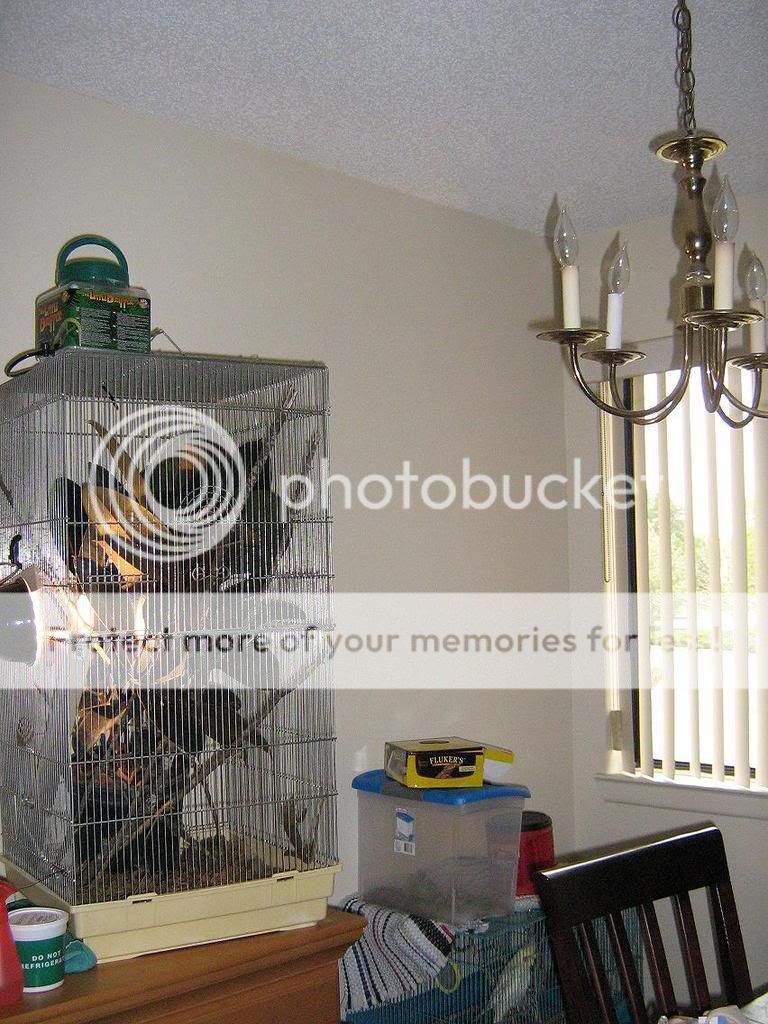
No, there are no vents on that ceiling or wall. It's located on top of a dresser ... the height is close to the ceiling, about two feet below, and it's about six feet above the floor.


* Your Chameleon

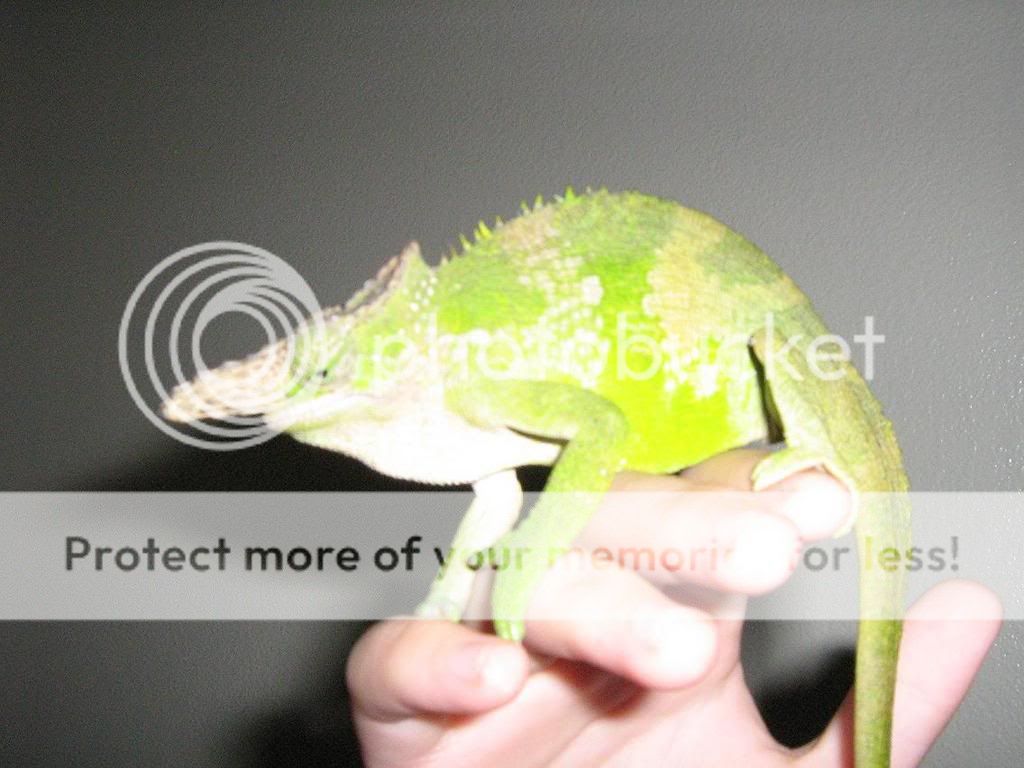
Fischer Chameleon (unsure if Giant specimen or not), definitely male with horns, juvenile, about six inches in length. He's been in our care approximately 42 hours ...

* Handling

Only when necessary to put things in the cage, and to check initially for any health problems—no missing limbs or digits, no mucus drippings, etc.

* Feeding

We buy gut-loaded crickets every four days or so for the Big-headed Gecko, and this chameleon is so spoiled, he eats out of the hand! I watched astonished as my fiance held out a cricket by the hind leg, his tongue flicked out, and he gobbled it right up ... his feeding average tonight was 6 crickets. We just bought some "Super Worms" (aka grubs) and we have nightcrawlers for the newts as well.

* Supplements

Every feeding, Reptavite powder.

* Watering

I haven't been home long enough to see him drinking, but we're using a drip system called "The Little Dripper" and mist the ficus regularly.

* Fecal Description

Not been tested yet, I have not observed any feces in the substrate yet.

* History

It was sold to the pet store last week, appears not to be afraid of humans—probably raised as a hatchling by a breeder, it was kept previously in a tiny 10 gallon aquarium obviously unsuited for it with a bowl of water and NO branches. He looks much happier now ...

* Current Problem - The current problem that you are concerned about.

His skin is very soft and dry/rough to the touch. I didn't know if this was normal or not, and the Big-Headed Gecko (Panther Gecko) uses Shed-Ease regularly if he becomes dried out ... although, now that we switched him to a vivarium, that hasn't been a problem.

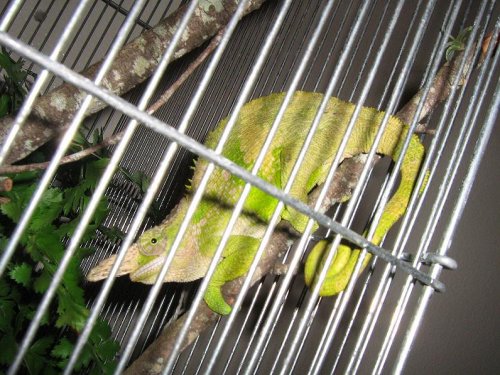
Oh, the picture below is from yesterday. We switched the fern out for a ficus after my fiance did some more reading. The potted ficus takes up nearly 1/2 the cage ...

 

Attachments

  • karma_chameleon.JPG
    karma_chameleon.JPG
    128.9 KB · Views: 274
He needs exposure to UVB light either from direct sunlight or a UVB tube/linear light so that he can produce vitamin D3 which will allow him to use the calcium in his diet.

I have kept quite a few fischer's over the years and I dust the crickets with a phosphorous-free calcium powder at most feedings because most feeder insects have a poor ratio of calcium to phosphorous.

I use a phos.-free calcium D3 powder twice a month since my chameleons rarely get direct sunlight. D3 for supplements can build up in the system and cause problems....so be careful not to overdo it.

I use a vitamin powder twice a month that has a beta carotene source of vitamin A. There is some controversy as to whether chameleons can convert beta carotene, but beta carotene won't cause any overdose like preformed vitamin A can. You can give your chameleon a little preformed once in a while if you feel it is needed. (I think Reptivite might have preformed.) Excess preformed can build up in the system and prevent the D3 from doing its job and lead to MBD.

Appropriate temperatures are important for good digestion...but you don't want to keep him too hot. Do you have a thermometer to tell you the temperature in the basking area?
 
Fischers definitley like it a little cooler so I would not be putting him outside here in Florida this time of year! I actually keep mine in a separate cooler room then my other chams. Order a Zoomed Reptisun 5.0 linear flouresent tube for UVB. Herptivite is a multvitamin/mineral supplement that you definitely don't want to use everday, get the Repcal with D3 to use sparingly and Repcal without to use lightly nearly everday as suggested above. It appears that you have a birdcage there-while not impossible, they are not the best to keep up humidity and humidity helps with shedding. Live plants will also help with humidity-Check the live plant safe list here on the forum. Is the bird cage 1.5 tall? If so I would suggest maybe switching to a normal reptile screen cage that is at least 36" tall as they like vertical height. Since you are unsure of his background I would suggest getting a fecal done to check for parasites.
 
"* Fecal Description

Not been tested yet, I have not observed any feces in the substrate yet."

Be a good Idea to get rid of the substrate too, and eliminate any possibility of becoming impacted by a less than perfect shot.;)

Paper towel is a good substitute if you feel the need for something on the bottom (makes it easier to find the poops too!)

That's a right handsome Fishers ya got there little lady!
 
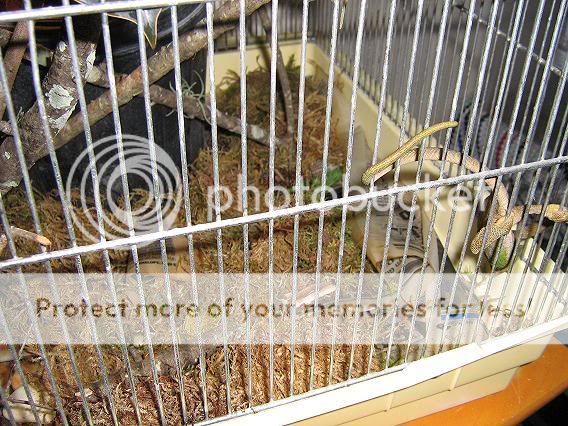
Let's see ... substrate is newspaper and some ... dried moss and a couple stones. Maybe that word doesn't mean what
I think it means, I thought it meant "stuff lying on the bottom" ...

substrate.jpg


Don't worry, Julirs, he's not outside! In Florida in July? LOL, it would be nearly 100 degrees in the afternoon, if not higher
from the humidity.

messy_room.jpg


He's placed near a window with venetian blinds, so he gets some sunlight during the day. I thought it would be
good idea not have him in direct or out of the balcony, but in the morning, the sun shines right into the dining room ...
we just keep the apartment warm and open a window occasionally to air out the room. It gets stuffy sometimes.

Glancing at the light brand, it's a ZooMed Basking Spot Lamp, providing "beneficial UVA rays" ... so, my cham needs UVB,
not UVA, right?

cage.jpg


I guess the good thing about coming here is that we won't make beginner mistakes for very long. :eek: So, basically,
what we need is:

An accurate thermometer for the cage
An accurate barometer for the cage (probably not WalMart ... *sweat*)
Zoomed Reptisun 5.0 linear flouresent tube ... this? http://www.petmountain.com/product/fluorescent/504985/zoo-med-reptisun-5.0-uvb-bulb.html
RepCal WITH D3
RepCal WITHOUT D3


karma_length.jpg
 
Nice looking Fischers! I would take out all the substrate and just leave the cage bottom bare-it will be easier to clean up. UVB does not pass through glass, so defintley get the Reptisun 5.0 ASAP ($13.99 at LLLReptile.com)! I would move that basking lamp to the top and one side for basking, and get a digital thermometer with a probe, you want that basking spot mid 80's.
 
you don't have to spend a mint on a hygrometer/thermometer combo....Walmart stuff will suffice. Also in the meantime if you need to you can put the cham out side in the cooler periods of the day say. early morning. if you have your thermometer you can monitor the temp and bring them in when it starts to get too warm.

Another note about your hygrometer/thermometer...the have ones that take temp in two areas along with the humidity. usually around 13 bucks. the probe should go in either his basking spot or his shadey area. that way you can tell if you basking spot is to hot or not hot enough and adjust as needed.

Hope that helps.

OPI
 
Back
Top Bottom