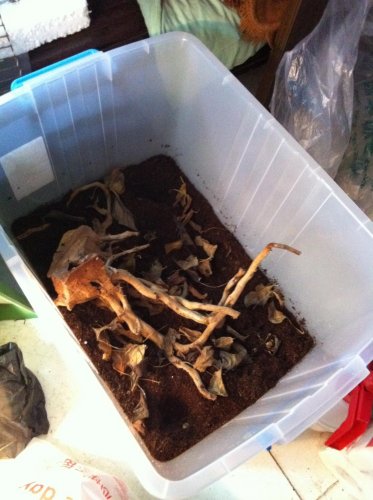
My first chameleon got too much calcium and at last she cannot lay out the eggs.
Anybody else ever hear of this one? I've never heard of this happening, and would think it would be very difficult to accomplish. Most of the 1990s I used rep-cal with d3 every feeding indoors and never had a problem from either too much calcium or too much d3. I produced thousands of veileds during those years- my experience was not limited to a handful of pets. Today I do not recommend this as maintenance for safety reasons and with good lights it is unnecessary anyway, but it would surprise me very much to hear someone caused egg binding from too much calcium from simply dusting daily... Of course rep-cal with d3 falls off of the crickets pretty quickly, so maybe other brands of calcium would remain longer so more calcium would be taken in...
I will try syringe , by the way, Did you mean any kinds of baby food is allowed to fix ?
What I had in mind are the pureed sort of gerber type baby foods- chicken or turkey would be best. I don't know what sorts of baby food are available where you live though, so maybe a quick word about the reasons for each ingredient would help and then you could locate ingredients that would accomplish the same.
The principle behind the baby food is that it is relatively easy to digest. The yogurt has calcium and beneficial live bacteria to help in the gut. And the calcium with d3 is what your lizard needs. Every few feedings a multivitamin for lizards is best substituted for the calcium with d3.
I have used this simple recipe to help many lizards that have arrived to me in bad shape over the years and although it is simple, it always worked really well for me.
Here in America there are now commercial products on the market specifically for lizards that are better. I don't know if something like this is available where you live or if you could mail order it in at a reasonable rate.
If not, the simple recipe is a good way to go, or someone else here on the forums might offer something a little better.
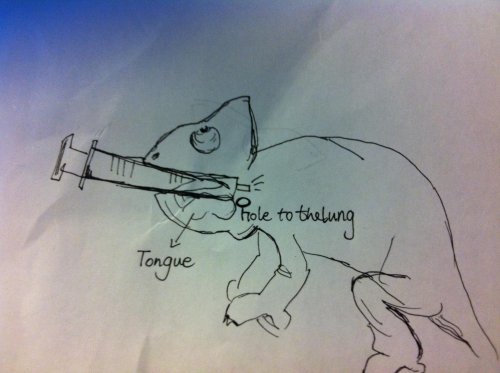
For an adult female veiled chameleon I would probably give 1-3 cc from a syringe 1x per day. If she is large enough I'd use a 3 cc syringe. If you aren't sure how much start with a little and then increase over time. Chameleons have a surprisingly wide throat inside. Tickle her nose to get her to open her mouth and then gently slide the syringe into her mouth and down her throat. Be gently do not force anything or push hard. If you have the correct size syringe and hold her properly and find the correct way to slide the syringe in it will go surprisingly far into her easily. Hold her gently, but support the sides of her head so she cannot wriggle side to side much and hurt herself. Tilt her so her head is higher than her tail. Supporting most of her weight on her shoulders, rather than her rear legs, will help this as her body weight will straighten her out for you. Do everything very gently and carefully but firmly, not timidly because that might give her a chance to move in a way that would hurt herself. The hole that takes air into the lungs for her is located at the rear of her tongue. You want to move the syringe well past that so that when you push the mixture into her she cannot choke and drown. If the syringe is not too large, it is not difficult to slide it really far in well down her throat.
If you find you cannot get the syringe in far enough or are afraid to go too far, you can feed higher up in her mouth , a little at a time so she is not overwhelmed and does not choke. But this will be more stressful and take longer as you will only be able to give her a little bit, then wait for her to swallow, then a little more. My method allows you to get all of it into her in a few seconds with a little practice, and then it is over for her.
I would give her the syringe about the same time she normally goes to sleep at night. I find this very helpful as it allows the lizard to sleep away the stress from being handled and force fed, and then live without stress and fear all the next day. If you do this earlier in the day, she will remain stressed the rest of the day.
Others here might have different advice, and that is fine. There is a lot of experience here on the forums. This is how I would deal with the situation.
It is difficult to give really good help on the internet. I could understand more in 10 seconds looking at your lizard and help you more in 5 minutes real time than all of the posts on this thread. Sorry.