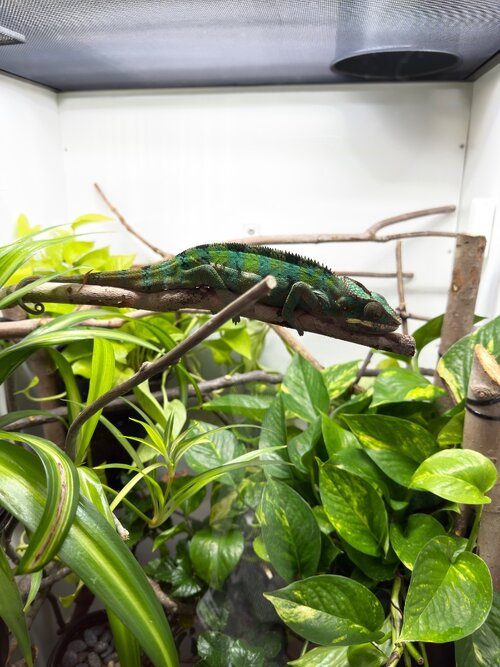
Hi all,
My question is about my Cham getting wet at night. Could there be adverse affects?
9mos old Panther male
Daily Poop is good, white/brown moist
Daytime:
85f at bask, 50-60% humidity
75f upper, same humidity
72-73f Middle, same humidity
70-72f Lower, same humidity
Arcadia uvb- 2-3UVI (Solarmeter)
Arcadia jungle Dawn
Nighttime:
64-66f, 75-85%
7am-7pm light schedule
Mist at 0730 45 sec
Mist at midnight 10sec ( sometimes)
Fog at midnight until 0600
Dragonstrand Hybrid enclosure (3 weeks in this enclosure)
5 live plants (Pothos, hibiscus, spider)
Room ambient 70-73f at 45-55%
This is my question. I’d like to mist at night but invariably he parks his butt in front of the mist nozzle. And I’m concerned with him getting wet at night.
I have 2 nozzles, mounted at the front above the door pointing back and down. There is a horizontal branch up front about 3” from the door and he likes to sleep there, on the far right of the branch, directly in line with the nozzle. There is NO cover here, it’s wide open. He got blasted the first night, slept under the Pothos the next night, and was back again the third night. Since then he goes between the two spots.
When he sleeps in the Pothos up front, he’s about a foot lower. Here he wouldn’t get wet because of the leaves.
If I saw him on the branch I started to turn off the mister at night, but let it run in the morning. In the morning he just sits there and gets wet, after a while he’s looking for food, so I feed him. Then he goes to bask.
Today I figured I would just move that nozzle. But instead of moving it, I disconnected the right side nozzle and made a “rain ring” with tees, and then a mist nozzle pointing down. Think of a circle, halfway across there is an arch, mist nozzle at the top of arch. Tested it, works great! Makes a 6-8” circle of rain come down. I put it in the middle of the top mesh. Awa y from either spot he would normally sleep in.
Tonight he parked his butt directly under that spot, hidden in the Pothos with just his head sticking out. It took me 20 minutes to find him…lol. He’s never slept there before!
Is it me or does he want to get wet at night?
He must like it in the morning, but I’m concerned with being wet all night.
What do you all think?