Vladislav: The Finest of Chameleons

MissLissa

Avid Member
After about 6 months of research, I finally picked up my first chameleon this week; a 3 month old captive bred male Furcifer pardalis (Ambilobe). While he is my first cham, I am by no means new to reptile care :)

His name is Vladislav, and he is probably the most confident cham I have ever met. The very first day home he pounded back 10 tiny crickets, and he hasn't stopped since. From my fingers, from a cup, hunting them down like a tiny stone-cold insect assassin... he don't care as long as they end up in his belly. He confidently drinks out of a syringe (as well as from his dripper and after mistings), and will even grab the tip of the syringe in his mitten-hand to hold it still. His screen enclosure is densely planted (live and fake) but he is very rarely hidden; he is too busy hunting down his crickets, silkworms and BSFL. Obviously I'm not handling him, but he has already figured out that human=crickets (did I mention he has an appetite?). He charges the door as soon as I approach his cage; if he was a bit faster I think he'd be a pretty good escape artist.

I'm super happy with him; all my previous reptiles have been sickly rehomed critters from the exotic animal clinic I worked at, and every one was a nightmare to get healthy and eating/drinking properly. While cham care is no picnic, comparatively Vladislav has been a breeze. Well, for the first week, anyways. I've probably cursed myself, now.

I'll put up one pics once I size them down some. He is unreasonably adorable.

HOWEVER: Does/did anyone else constantly stress the first while after they got their chameleon? I've taken care of some very delicate species (at home and at work) and never batted an eye, but with this guy I'm constantly worried he's just going to drop dead. I mean, he shows no sign of it- exactly the opposite, really- but I'm always worrying that his dripper went dry while I'm at work, or the crickets are all hiding and he can't find any, etc etc etc. Am I nuts? Anyone else feel this way?
 
I like the name. Where did you come up with it? Where are you from?

Welcome to the forums by the way. I never stressed too much. Maybe the first day or two, but I got over it. It was worse with my first one.

Chase
 
Thank you! It's from the movie "What We Do In The Shadows"; one of my new favourites.

I'm in central Canada.

Ugh, it's awful; I'm never really a worry-wart, but I can't seem to help myself. I've worked with lots of other sensitive species (I currently work in reptile research and conservation, and previously at an animal clinic that specialized in exotics) but I think I psyched myself up too much for my cham! I'll get over it.

Eventually.
 
HOWEVER: Does/did anyone else constantly stress the first while after they got their chameleon? I've taken care of some very delicate species (at home and at work) and never batted an eye, but with this guy I'm constantly worried he's just going to drop dead. I mean, he shows no sign of it- exactly the opposite, really- but I'm always worrying that his dripper went dry while I'm at work, or the crickets are all hiding and he can't find any, etc etc etc. Am I nuts? Anyone else feel this way?

When I catch myself overthinking a new arrival it helps to remind myself that chams have some advantages over pets such as birds...their slower metabolism. One or part of one day without food is not going to kill them, and, if they are healthy to begin with can handle a messed up dripper, a temporary power failure that shuts down a light or a misting system, won't cause irreversible dehydration. The effects can be erased pretty easily. And, a missed supplement isn't going to make that much difference either. Nutrition is cumulative over time, not instant.

Just be glad you don't keep nectivorous aviary birds. Now they can be a worry! If their daily nectar gets too warm they can end up with intestinal problems, if it gets mixed wrong they can go into shock, they carry hardly any fat or sugar reserves so you can't miss that early morning feeding, their metabolism is super high so they need some sort of food available all day, and they are very sensitive to abrupt changes in temperature (no leaving your windows open!). But, I still really enjoy them!
 
I have actually worked with nectarivorous birds- several species of hummers, honeyeaters, lories and lorikeets. I am a bird person first, the reptiles came later. I stressed a lot over the hummers, for sure! But that was at my job, where there were checks in place to make sure everyone got fed on time, etc. At home it's just me. No way would I have a nectarivore in my house; too much stress. And mess (lory poops are... artistic).

I've been very lucky to have worked with a wide variety of animals over the years :) It keeps life interesting!
 
I have actually worked with nectarivorous birds- several species of hummers, honeyeaters, lories and lorikeets. I am a bird person first, the reptiles came later. I stressed a lot over the hummers, for sure! But that was at my job, where there were checks in place to make sure everyone got fed on time, etc. At home it's just me. No way would I have a nectarivore in my house; too much stress. And mess (lory poops are... artistic).

I've been very lucky to have worked with a wide variety of animals over the years :) It keeps life interesting!

Is it true that a young bird that is hand raised will become mean after maturity? Some one is floating that information around and it seems very misleading.. We were specifically talking about macaws and parrots.
 
Whoo boy, you touched one of my soapbbox issues! Haha, prepare yourself for an epic soapbox rant.

I'm not a fan of handfeeding parrots (macaws, parrots, cockatoos... the whole shebang) for the same reason I am not a fan of handfeeding puppies or kittens. In my experience, it is more likely for a handfed parrot to have certain behaviour issues, especially sexual imprinting issues, than a bird that was raised by it's parents, or co-reared with it's parents and people. Co-rearing is where the parents are trained to allow humans to interact with their not-yet-fledged babies while the parents are caring for them. I have seen it done successfully with macaws, several species of amazons, cockatoos, caiques, and quite a few others.

Baby birds, even altricial ones like parrots, go through several stages of a type of imprinting, where they learn what they are (birds), what their rivals and competition are (birds), and what an appropriate mate is (again, birds). These stages happen at different times when they are babies/neonates and juveniles, up until fledging. The issue with human-reared parrots is that you never really know what stage the baby is at, and it's very likely that a baby parrot with learn inappropriate imprinting- that humans are appropriate mates, rivals, etc. This is a HUGE problem, as it is wildly inappropriate for a bird to think a human is an appropriate mate choice, and leads to a variety of behavioural issues. Additionally, there is significant evidence that human-raised birds (with no significant parental involvement once the eyes are open) leads to an increase in self mutilation behaviours, sterotypies, etc.

In other ways, there is also evidence that handrearing just isn't as good. Parent-raised birds (as long as the parents are healthy and fed an appropriate diet) almost always are larger, healthier, fledge earlier and wean earlier than handfed birds. If that isn't an argument for parent rearing, then I don't know what is!

In my professional opinion, there is absolutely zero benefit to humans hand-rearing parrots, unless in an emergency situation, and very likely several huge issues with it. Parent-reared birds are 100% able to be livable companions (you know, as much as a parrot is ever a livable companion- they are kind of awful pets, and this is from someone who actually likes them, works with them, and lives with them!). A parent-raised bird, taught with positive reinforcement, is just as loving and interactive, and is less likely to exhibit behavioural issues, and is most likely a more healthy individual all around.

And don't even get me started on parrots being "mean" after maturity. Parrots aren't "mean"- the simply behave as their biology and learning history directs them to. They aren't difficult just to be difficult; there is always a reason and motivator behind their actions. Even the hardest imprinted human-reared bird can be a manageable animal, given the right environment, motivation, training and handler. It's just whether that is feasible in their current situation or not, and if their families have the education and training experience to pull it off (usually, not). For more information, check out Dr Susan Freidman at Behaviour Works, Steve Martin at Natural Encounters, various resources at The Gabriel Foundation, or Barbara Heidenreich at Good Bird Inc :) (some names are probably spelled wrong. Because that is how I roll).

Caveat: any animal can show behaviour issues if improperly treated, maintained and/or trained. Parrots in particular (like all highly intelligent animals) are very sensitive to environment and handling factors, and this can significantly affect their behaviour. I'm speaking specifically about parrots raised in similar environments, where one is handreared and one is parent raised, all else being more or less equal.

Whew! :P
 
Whoo boy, you touched one of my soapbbox issues! Haha, prepare yourself for an epic soapbox rant.

I'm not a fan of handfeeding parrots (macaws, parrots, cockatoos... the whole shebang) for the same reason I am not a fan of handfeeding puppies or kittens. In my experience, it is more likely for a handfed parrot to have certain behaviour issues, especially sexual imprinting issues, than a bird that was raised by it's parents, or co-reared with it's parents and people. Co-rearing is where the parents are trained to allow humans to interact with their not-yet-fledged babies while the parents are caring for them. I have seen it done successfully with macaws, several species of amazons, cockatoos, caiques, and quite a few others.

Baby birds, even altricial ones like parrots, go through several stages of a type of imprinting, where they learn what they are (birds), what their rivals and competition are (birds), and what an appropriate mate is (again, birds). These stages happen at different times when they are babies/neonates and juveniles, up until fledging. The issue with human-reared parrots is that you never really know what stage the baby is at, and it's very likely that a baby parrot with learn inappropriate imprinting- that humans are appropriate mates, rivals, etc. This is a HUGE problem, as it is wildly inappropriate for a bird to think a human is an appropriate mate choice, and leads to a variety of behavioural issues. Additionally, there is significant evidence that human-raised birds (with no significant parental involvement once the eyes are open) leads to an increase in self mutilation behaviours, sterotypies, etc.

In other ways, there is also evidence that handrearing just isn't as good. Parent-raised birds (as long as the parents are healthy and fed an appropriate diet) almost always are larger, healthier, fledge earlier and wean earlier than handfed birds. If that isn't an argument for parent rearing, then I don't know what is!

In my professional opinion, there is absolutely zero benefit to humans hand-rearing parrots, unless in an emergency situation, and very likely several huge issues with it. Parent-reared birds are 100% able to be livable companions (you know, as much as a parrot is ever a livable companion- they are kind of awful pets, and this is from someone who actually likes them, works with them, and lives with them!). A parent-raised bird, taught with positive reinforcement, is just as loving and interactive, and is less likely to exhibit behavioural issues, and is most likely a more healthy individual all around.

And don't even get me started on parrots being "mean" after maturity. Parrots aren't "mean"- the simply behave as their biology and learning history directs them to. They aren't difficult just to be difficult; there is always a reason and motivator behind their actions. Even the hardest imprinted human-reared bird can be a manageable animal, given the right environment, motivation, training and handler. It's just whether that is feasible in their current situation or not, and if their families have the education and training experience to pull it off (usually, not). For more information, check out Dr Susan Freidman at Behaviour Works, Steve Martin at Natural Encounters, various resources at The Gabriel Foundation, or Barbara Heidenreich at Good Bird Inc :) (some names are probably spelled wrong. Because that is how I roll).

Caveat: any animal can show behaviour issues if improperly treated, maintained and/or trained. Parrots in particular (like all highly intelligent animals) are very sensitive to environment and handling factors, and this can significantly affect their behaviour. I'm speaking specifically about parrots raised in similar environments, where one is handreared and one is parent raised, all else being more or less equal.

Whew! :P

Thank you so much for taking the time to make this reply! You've definitely shined some much needed light on this subject! Great read. Thanks again!
 
I'm not a fan of handfeeding parrots (macaws, parrots, cockatoos... the whole shebang) for the same reason I am not a fan of handfeeding puppies or kittens. In my experience, it is more likely for a handfed parrot to have certain behaviour issues, especially sexual imprinting issues, than a bird that was raised by it's parents, or co-reared with it's parents and people. Co-rearing is where the parents are trained to allow humans to interact with their not-yet-fledged babies while the parents are caring for them. I have seen it done successfully with macaws, several species of amazons, cockatoos, caiques, and quite a few others.

Baby birds, even altricial ones like parrots, go through several stages of a type of imprinting, where they learn what they are (birds), what their rivals and competition are (birds), and what an appropriate mate is (again, birds). These stages happen at different times when they are babies/neonates and juveniles, up until fledging. The issue with human-reared parrots is that you never really know what stage the baby is at, and it's very likely that a baby parrot with learn inappropriate imprinting- that humans are appropriate mates, rivals, etc. This is a HUGE problem, as it is wildly inappropriate for a bird to think a human is an appropriate mate choice, and leads to a variety of behavioural issues. Additionally, there is significant evidence that human-raised birds (with no significant parental involvement once the eyes are open) leads to an increase in self mutilation behaviours, sterotypies, etc.

In other ways, there is also evidence that handrearing just isn't as good. Parent-raised birds (as long as the parents are healthy and fed an appropriate diet) almost always are larger, healthier, fledge earlier and wean earlier than handfed birds. If that isn't an argument for parent rearing, then I don't know what is!

In my professional opinion, there is absolutely zero benefit to humans hand-rearing parrots, unless in an emergency situation, and very likely several huge issues with it. Parent-reared birds are 100% able to be livable companions (you know, as much as a parrot is ever a livable companion- they are kind of awful pets, and this is from someone who actually likes them, works with them, and lives with them!). A parent-raised bird, taught with positive reinforcement, is just as loving and interactive, and is less likely to exhibit behavioural issues, and is most likely a more healthy individual all around.

And don't even get me started on parrots being "mean" after maturity. Parrots aren't "mean"- the simply behave as their biology and learning history directs them to. They aren't difficult just to be difficult; there is always a reason and motivator behind their actions. Even the hardest imprinted human-reared bird can be a manageable animal, given the right environment, motivation, training and handler. It's just whether that is feasible in their current situation or not, and if their families have the education and training experience to pull it off (usually, not). For more information, check out Dr Susan Freidman at Behaviour Works, Steve Martin at Natural Encounters, various resources at The Gabriel Foundation, or Barbara Heidenreich at Good Bird Inc :) (some names are probably spelled wrong. Because that is how I roll).

Caveat: any animal can show behaviour issues if improperly treated, maintained and/or trained. Parrots in particular (like all highly intelligent animals) are very sensitive to environment and handling factors, and this can significantly affect their behaviour. I'm speaking specifically about parrots raised in similar environments, where one is handreared and one is parent raised, all else being more or less equal.

Whew! :P

Fantastic response! I couldn't agree more! I kept cockatoos so long ago that they were parent-raised. The difference between my birds and a few hand-reared birds I knew was quite clear. They were lovely to live with, affectionate, but stable and "centered" as birds. At that time what humans understood about imprinting, effects of hand-rearing and behavioral distortion, etc. was pretty minimal. It is a terrible disservice to these wonderful intelligent creatures that we keep producing them without considering what happens to most of them. I read somewhere that pet parrots have an average of 7 homes in their lifetimes. Each change is miserable for them.
 
Is it true that a young bird that is hand raised will become mean after maturity? Some one is floating that information around and it seems very misleading.. We were specifically talking about macaws and parrots.

Its not misleading. The explanation of "mean" isn't very accurate, but it can serve as a word to the wise that potential owners need to understand what they have taken on.
 
No way would I have a nectarivore in my house; too much stress. And mess (lory poops are... artistic).

That's why I don't keep more than one pair at a time! I have one pair of purple honeycreepers in an indoor aviary now. They are tiny, so the mess is manageable! I just wish I had indoor rain to keep their aviary foliage cleaner. Can't imagine living with lories indoors though. I've heard them described as "impressionistic poopers".
 
Its not misleading. The explanation of "mean" isn't very accurate, but it can serve as a word to the wise that potential owners need to understand what they have taken on.

Omar's exotic birds is doing it right. They hand rear all their birds. And they are the nicest most friendly birds you'll ever encounter. Maybe if people interacted with their birds as much as Omar's did they wouldn't become so "mean" later on in life. And I truly believe it is different for each individual bird. You can walk into Omar's exotic birds and pick up 6-7 year old macaws with no problems at all, no biting, squealing or fuss, this truly makes me think it's got to be the care provided for each bird. Not to mention these birds are held 5 days a week from 10am-7pm year round. If everyone did that with their birds, I highly doubt they'd run into a "mean" bird.
 
Omar's exotic birds is doing it right. They hand rear all their birds. And they are the nicest most friendly birds you'll ever encounter. Maybe if people interacted with their birds as much as Omar's did they wouldn't become so "mean" later on in life. And I truly believe it is different for each individual bird. You can walk into Omar's exotic birds and pick up 6-7 year old macaws with no problems at all, no biting, squealing or fuss, this truly makes me think it's got to be the care provided for each bird. Not to mention these birds are held 5 days a week from 10am-7pm year round. If everyone did that with their birds, I highly doubt they'd run into a "mean" bird.

Yes, I'm sure the constant stimulation and activity at Omar's keep them happier, but I'm sure some birds they've had did not tolerate everything the same way, and the ones that didn't stay friendly are not at the store for obvious reasons. I have nothing against Omar's...I went there often years ago. The problems come when a bird gets a home, lots of attention and spoiling as a baby, Too much sexually-inviting play, but once that's over the bird ends up alone all day every day when it's family leaves for school, work, play, etc. If I was going to consider a hookbill bird again I would only do it if I was home all the time, had lots of family around all the time, and other birds to add to the commotion. A busy shop with bird-savvy employees would be a very happy situation for many parrots.
 
Last edited:
Keep in mind, though, Scout, that about 0% of the average human population is able to keep up that level of socialization with their birds. Once they go home, it's one family for days and days on end- no more random strangers to interact pleasantly with. Many parrot behave very differently in a home environment than a pet store- behaviour is situational and not static, after all. Also, the vast majority of people have NO IDEA how to train a prey species like a macaw, cockatoo, or other parrot. While harsh training methods may eventually be effective with dogs (thought highly, highly unethical and definitely not recommended), while you may initially seem successful with a parrot, you are going to get a whole slew of additional unwanted behaviours, right quick! They are faaaaar too smart for novice trainers. Smart does not always equal easy to train; in many cases, it's much more difficult.

Another problem with handraised birds is that the young birds are FANTASTIC; sweet and snuggly and quiet and well behaved. It's not until you get a one-on-one bond with an adult bird that the issues start shining through. A 6-7 year old macaw or cockatoo may not even be fully sexually mature yet. At the parrot rescue I volunteer at (I do free-of-charge behaviour consulting), the average age for a large macaw to start displaying hormone-related behaviour issues is 8.

Again, this is not every bird, every family. It's just a pattern I, and others, have noted (there is also a fair bit of research on it). Not every bird will show inappropriate imprinting behaviour, but in my experience the vast majority do in some way or another. Then again, my experience is skewed- nobody calls me and says "My 8 year old male Moluccan cockatoo is perfect! No problems here! Just wanted you to know!". usually it's more "My 8 year old male Moluccan cockatoo just tore my kid's lower lip off then chewed a hole in his own chest and now they are both bleeding all over the place and my vet doesn't know what to do." I generally only get called in for the extreme cases, where life and limb is in imminent danger.

Edit:
Carlton, I couldn't have said it better!
 
Keep in mind, though, Scout, that about 0% of the average human population is able to keep up that level of socialization with their birds. Once they go home, it's one family for days and days on end- no more random strangers to interact pleasantly with. Many parrot behave very differently in a home environment than a pet store- behaviour is situational and not static, after all. Also, the vast majority of people have NO IDEA how to train a prey species like a macaw, cockatoo, or other parrot. While harsh training methods may eventually be effective with dogs (thought highly, highly unethical and definitely not recommended), while you may initially seem successful with a parrot, you are going to get a whole slew of additional unwanted behaviours, right quick! They are faaaaar too smart for novice trainers. Smart does not always equal easy to train; in many cases, it's much more difficult.

Another problem with handraised birds is that the young birds are FANTASTIC; sweet and snuggly and quiet and well behaved. It's not until you get a one-on-one bond with an adult bird that the issues start shining through. A 6-7 year old macaw or cockatoo may not even be fully sexually mature yet. At the parrot rescue I volunteer at (I do free-of-charge behaviour consulting), the average age for a large macaw to start displaying hormone-related behaviour issues is 8.

Again, this is not every bird, every family. It's just a pattern I, and others, have noted (there is also a fair bit of research on it). Not every bird will show inappropriate imprinting behaviour, but in my experience the vast majority do in some way or another. Then again, my experience is skewed- nobody calls me and says "My 8 year old male Moluccan cockatoo is perfect! No problems here! Just wanted you to know!". usually it's more "My 8 year old male Moluccan cockatoo just tore my kid's lower lip off then chewed a hole in his own chest and now they are both bleeding all over the place and my vet doesn't know what to do." I generally only get called in for the extreme cases, where life and limb is in imminent danger.

Even if your cockatoo or parrot doesn't decide to bite or mutilate itself the incredible screaming can drive everyone to escape the house. And, all this does is repeat the vicious cycle of desperate need and desperate behavior.
 
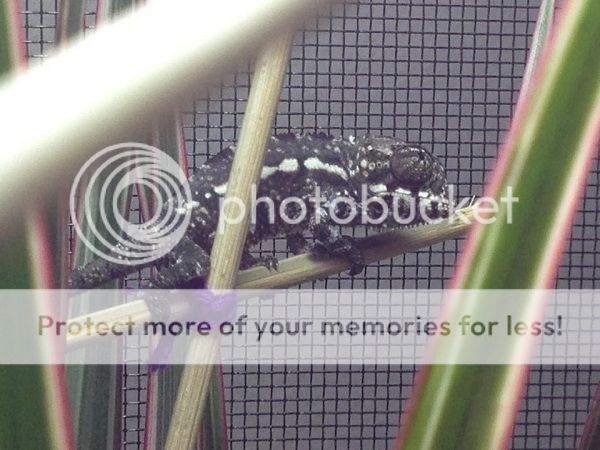
As promised, here is Vladislav. This seems to be his regular hunting colours, when he is stalking his crickets. He and two of his brothers- the three largest of the clutch- have very dark colouration. Even their sleeping colouration is quite dark. I'll try to snap a pic later tonight. I'd be worried that he was stressed all the time, except he eats like a horse, drinks well, and poops like a machine. Apparently his dad was very dark as a baby, too. (And for the nitpickers, the purple thread is hot glued in place. It looks fluffy and loose in this photo, but it's hard a rock. No way he could get a toe or tongue caught!)

vladislav.jpg


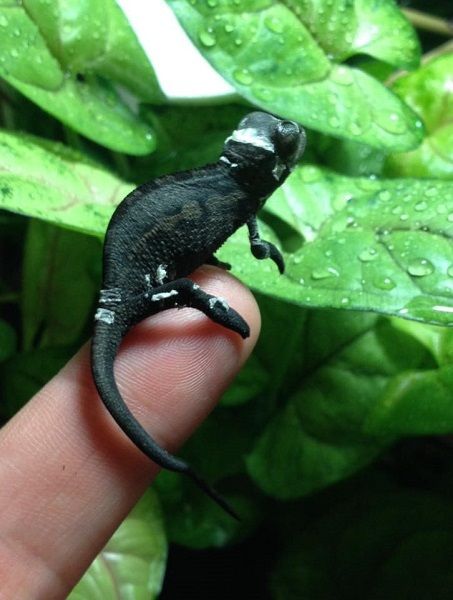
Demonstrating his "stressed" colours: this is straight out of the travel cup, when I was first putting him in his new home. He's never been this black since. The slight pattern on his sides was picked up by the camera only; I couldn't see if when I was looking at him without the camera. He just looked pure black. Within an hour of this photo he'd lightened up, and with a few more he had a drink and then started mowing his way through my cricket colony. Hasn't stopped since.

black%20vlad.jpg
 
Back
Top Bottom