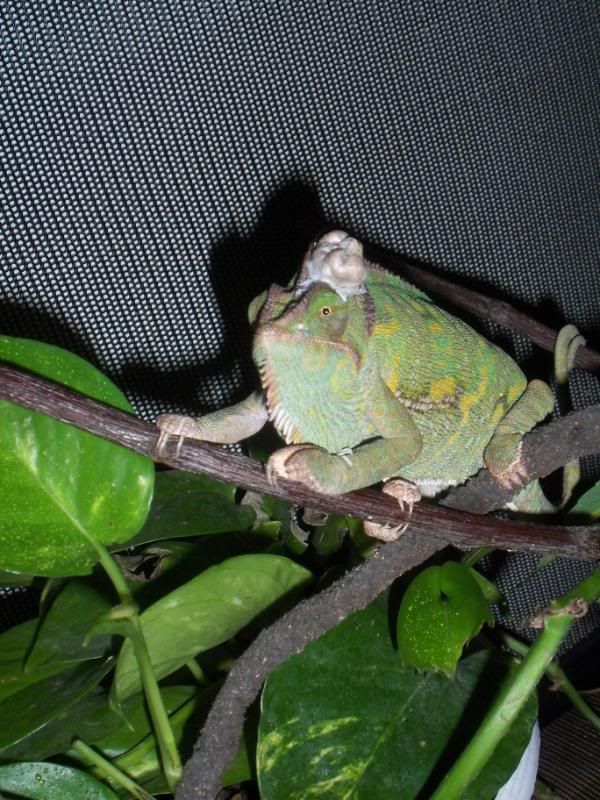
Alright, here we go.
I've looked at your image
it would have been much better to have given us several from different angles
so as well as some frame of reference to measure the growth.
I've shortened down a long story.
There are
papilloma virus's that infect chameleons.
I had it on both one female veiled as well as a male panther.
It was brought in on a infected veiled female,
I got from another breeder at a show.
She started to develop a thickened lip on one side of her fact a month or two after I brought her home.
So they do exist.
My vet called to inform me of it's being the first verified case.
(imagine my joy at hearing that on the phone).
This virus I had was spread by saliva and only infected the lips around the mouth. The virus caused thickening of the outer mouth lining with horn like projections. - it was very specific.
Transfer was by wet saliva only. The virus had not show itself to be able to survive in a dry state. So the carrier animal I got was infected by either licking a leaf, pipette or drinking from a glass used by another infected individual. I suspect that this "established breeder" sold me an animal they did not breed themselves. The veiled I got must have picked it up via being directly exposed to another carrier animal. Most likely by being kept in a "group holding bin" from a wholesaler mixed with wild imported animals.
Anyway,
In my case, simple isolation of wet materials stopped all transmission to the rest of the colony. Otherwise, the infected animals were healthy. The female veiled eventually cycled though the infection and was either without symptoms or completely eliminated the virus.
It wasn't transferrable to her offspring. The eggs hatched clean and the f1 adults show no signs of infection or did the male that mated with her.
I'm thinking that you may just have another papilloma virus causing growths on your animal.