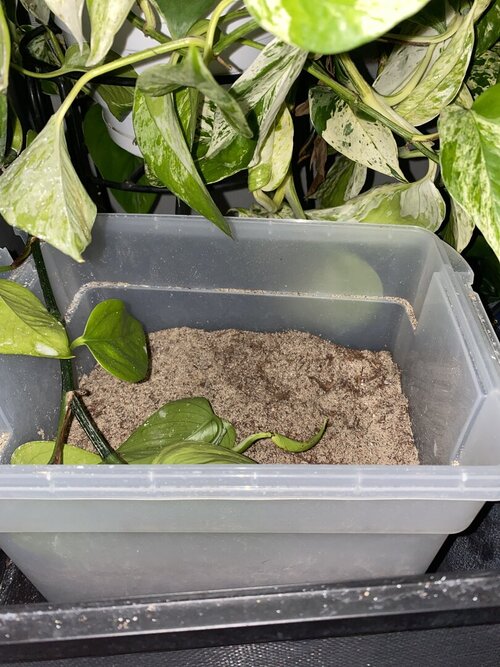
Your lay bin looks/sounds ok. I drill some tiny holes in the bottom so that it can drain excess water and not turn into a muddy mess. A little sand will leak out, but once it’s in place it’s fine. The depth of the sand only needs to be around 5-6”. They will dig all the way to the bottom and making it any deeper just gives them a lot more work. It’s ok if the bin gets misted. As your girl starts looking close to laying - colors darken/deepen, plump and/or lumpy looking, starting to get a little restless, appetite may decrease - you’ll want to make sure that the lay bin substrate is moist all the way thru. It needs to be moist enough to hold a deep tunnel without collapsing. I suggest getting in there and mixing it up to make sure.
When I suspect my girls are getting ready to lay, I cover the lower part of their enclosure with a light sheet. Be careful not to block ventilation holes if you have a hybrid enclosure. Once she starts digging, she’ll need absolute privacy. If she sees anyone, she may stop digging and could become eggbound. She may dig a few different places until she likes one. Then she’ll get to work and dig all the way down (usually on the side or a corner). When she’s satisfied with her tunnel, she’ll turn around and lay her eggs. When done with that, she’ll carefully cover whatever tunnels/holes she made. You’ll know she’s done when she’s sitting in her basking spot, looking much thinner and really dirty. The whole process usually takes a couple of days and some will sleep in their tunnel. Keep your regular light schedule. If you hand mist, don’t. Instead set up a dripper over an area that the water won’t go in the bin. No need to worry about cleaning the sand/dirt off your little lady…somehow they get themselves cleaned up in a day or two. You’ll want to feed and hydrate her very well for a couple of days after. I make sure to have silkworms and hornworms available at this time.
Since laying shortens their lives, we try to reduce it thru basking temps of 80 and controlled diet of 3-4 feeders, 3 days a week (plus occasional treats of course). It may take a cycle or two for this to take effect. You’ll want to start this diet 2-3 days after she’s laid her eggs.
You’ll want to dig up the eggs and count them. We aim for low numbers, like around the 20’s. Anything over 40 is a lot - too many. The eggs are infertile and are tossed out.
I have 2 female veileds. One hasn’t laid any eggs in over 2 years now. The other has so far laid one clutch every year. I suspect she’s been triggered by seeing my male veiled, who is her forbidden love.
You don’t need to change out the lay bin substrate unless it’s gotten soiled or nasty. Poop will happen and a little bit can just be scooped out. I’m finding some chams have their special pooping spots. If yours does, avoid putting the bin below it.






 I feed my crickets and roaches a mix of leafy greens like kale, turnip greens, mustard greens, and collard greens and carrots and sweet potatoes. I also add in a mix of spirulina, flax seed, and bee pollen as well. Silkworms are a great choice for feeders! They eat their own chow or mulberry leaves.