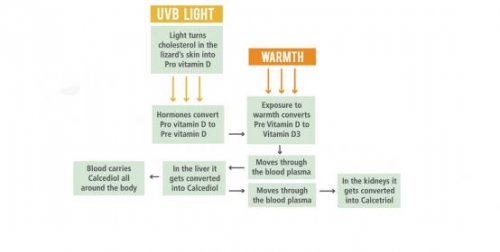
Here ya go! It is all right here including cool Graph!
Written by John Courteney-Smith from "Lighting for Crepuscular and Understory Reptiles"
And available to all seeking knowledge on the Arcadia Web-site.
 http://www.arcadia-reptile.com/the-d3-cycle/
Seriously people....
You DO NOT get this kind of REAL AND USEFUL information off the Zilly, Exo Teara or even the Zoo Mod web-sites.
This is why they had me at "hello".

Cheers,
Todd
~~~~~~~~~~~~~~~~~~~~~~~~~~~~~
The D3 Cycle Explained
We at Arcadia Reptile are passionate in our belief that through continued education and scientific research, we can improve the health and wellbeing of captive reptiles all over the world. It is safe to say that we as an industry can no longer label reptiles as simply, “Forest or Desert”, we know far more about reptiles and their complicated relationship with the sun than ever before. There are key indicators in every wild animal that will help you find and maintain the correct “life support systems”.
Reptiles rely on heat, light, UVA/UVB, food and water to sustain them and further the bloodlines. We as responsible keepers should do all that we can to replicate these wild indicators as closely as current tech allows.
At Arcadia Reptile we are proud to offer our customers access to more FREE science and emerging thoughts and tech than any other brand. We’re determined to start our “Revolution In Reptile Care” and as part of our commitment to education, thought it would be good to explain what is referred to as, ‘The D3 cycle’. Arcadia Reptile, Pure Science, Pure Care!
The D3 Cycle is a chemical and hormonal change in the body of an animal, which goes on to produce vitamin D3. This is a biological process that is dependent on many external factors including access to natural light, heat, cool and rest. A good diagram of the various processes can be easily found online, www.uvguide.co.uk is a great source of helpful information and independent scientific data. It is worth noting that although vital to the well being of reptiles, UV exposure plays many more roles in the body than just the D3 cycle. Impacts on sight, breeding and mental well being are all documented and are undergoing continued research.
This amazing process begins when a cholesterol called pro vitamin D(7DHC) is produced in the animal’s skin (it is a natural process in humans too). When this cholesterol is exposed to natural light (including light in the UVB wavelength (290-315nm)), this cholesterol is turned in the skin membrane into pre vitamin D.
After exposure to warmth, this newly manufactured pre vitamin D is converted (in the skin membrane) into vitamin D3. It is essential to have this heating up period alongside UV radiation. Vitamin D3 is then sent out into the blood plasma and is bound with a vitamin D binding protein. This is then carried to the liver where this part of this vitamin is converted to a hormone called calcediol (25-hydroxy vitamin D3).
The blood carries this calcediol all around the body and into the kidneys where some of the hormone is turned into another hormone, called calcetriol. This compound then plays an essential role in calcium metabolism and controls the levels of calcium in the blood. Calcetriol also plays a huge role in the immune system and the cardiovascular system. It has been shown to lower the risk of cancers in the body and skin.
So we can see that exposure to natural sunlight is only the start of this amazing ability in reptiles and humans alike, to turn sunlight into life saving vitamins. This D3 cycle is dependent on the completion of the D3 cycle. If part of the cycle is missed out then the cycle cannot be completed properly. Changes and reactions would also be unable to be completed properly. This would result in an under provision of essential vitamins and hormones, and if supplementation were not used, a calcium crash could happen.
© John Courteney-Smith
Taken from “Lighting for Crepuscular and Understory Reptiles by John Courteney-smith”
~~~~~~~~~~~~~~~~~~~~~~~~~~~~~
I also want to add this about UV A because it mentions Panther Chams:
UVA:
Unlike humans, who have ‘trichromatic’ vision, enabling us to see only three primary colours - red, green and blue, we now know that many reptiles, amphibians and other species, have ‘tetrachromatic’ vision. This enables them to see the shorter UVA wavelengths (320-400 nm) of the spectrum that form a part of natural sunlight. Reds are redder and greens are greener – life without UV would be the equivalent of us seeing everything in black and white, only worse. This UVA, or fourth primary, can be critical for behaviour and even affect appetite. A reluctant feeder may need UVA light to stimulate its appetite. UVA is also needed to induce reproductive behaviour. Lizards have been found to possess ultra violet reflectance patterns on their skin, which indicate reproductive glands in particular. Female panther chameleons seek out UV light when preparing to lay eggs. Depriving a reptile of UVA light would be like making it live in a darkened room.
Please click on below graph to enlarge.