According to the vets anything but sticking a needle in his spine repeatedly.
really? is that what you're going to take from what we wrote? if so, i'm not going to try to change your mind, i speak in facts, not made-up thoughts.
for others that may be more interested in anatomy and how the nervous system works; any lesion to the spinal cord (which runs through the middle of the vertebrae, well protected by bones) will affect the area
distal to the lesion. distal refers to the further points of an appendage, moving
away from the body or head. so if a human breaks their back around mid-chest level, they will be paralyzed in their legs but be able to use their arms and head just fine (paraplegic). however if the injury is higher up, say in the neck, then anything distal includes the arms and legs (and everything else below the neck), and they will be quadriplegic. what does NOT happen is that an injury occurs and moves
proximally, i.e.-
higher up the body. (with the very minor exception of a few areas that may be at the most 1-2 vertebral segments proximal; not relevant in the tail).
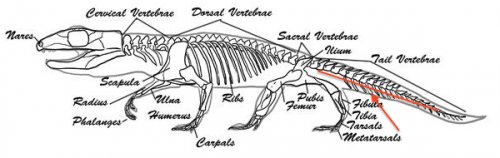
let's look at lizard tail anatomy. the spinal cord (traveling through a literal tunnel in the vertebrae on all sides) begins at the base of the skull and generally ends around the pelvis, with many fewer strands that continue down the tail (for tail sensation and movement). these last fibers are collectively known as the "cauda equina" and while they have some diferences between species, it is still a very "stringy" component of the spinal cord, not a solid cylinder as one might usually imagine (cauda equina means "horse tail", which it somewhat visually looks like). additionally these fibers are virtually impssible to sever as they are relatively loosely held together; a needle in that area generally slips through the bundle without causing any damage (like sticking a needle in the hairs of a horse's tail--it will pass between the hairs and would be almost impossible to impale even a single strand). below the vertebral bone is the ventral tail vein which is the most common blood draw site in lizards and snakes. to draw blood the needle passes through the skin, a thin layer of muscle and connective tissue, and then it reaches the vein. if we go too far through the vein, we hit bone! i couldn't possibly get a needle into the spinal cord at that level due to the
minuscule space between vertebra. if i did an "experiment" and hammered the needle through the bone and somehow managed to sever any of the cauda equina fibers, it would still only affect that area and further down to the tip of the tail!! it
would not/cannot/will not move forwards to the nerves that control the rear legs and paralyze them.
using the image in the diagram below, the site of a blood draw distal to the hemipenes would be in the area about 2/5ths down the tail. i have made a red line to replicate the vein, and an arrow showing about where blood is drawn. as you can see, the site is quite far from the region that controls the rear limbs, and more importantly we know it cannot cause damage in that proximal direction. i think it would be very fair to say that not only has no one advocated "sticking a needle in the spine repeatedly", it's impossible to stick a needle in the spinal cord at that location, and it's impossible for it to cause damage proximally even if one were to try as best they could. and that is why both ferret and i keep saying that a blood draw could not cause rear limb paralysis, it is just not doable.