Most animals evolved their skin coloration and texture to cope with UVB exposure.
For example, mankind - the highest UVB exposed spots have the blackest skin, and the lowest UVB spots have the whitest skin.
Think of dark skin as SPF. Black people for example, whether from Africa or Australia, have a natural SPF of 50. White people are more like 5 or less. This is because in northern climates with less UVB, white skin attracts more UVB radiation (we need it for vitamin d synthesis). Black skin attracts UVB in MUCH lower levels, so it takes longer to get the synthesis accomplished at optimal levels.
So although the common belief is dark attracts, white reflects light - the science behind this is opposite and has more to do with HEAT.
Dark pigmentation helps protect against UVB and skin damage, though it also attracts infrared energy (heat).
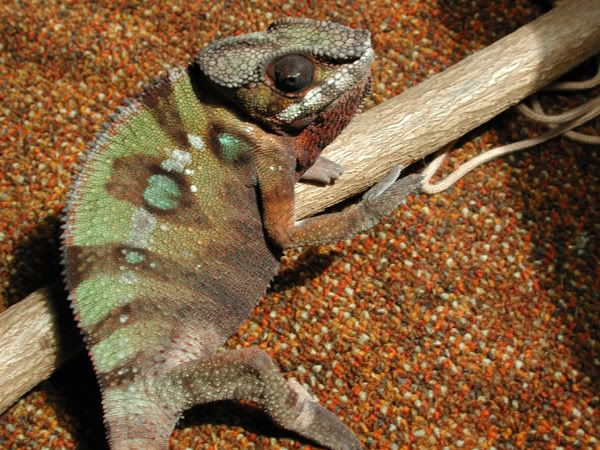
Many reptiles turn dark in the sun to help gain heat + protect against UVB radiation.
But don't worry, no matter how dark he is, he's still getting his strong dose of UVB.
Most chameleons we keep in the hobby are lighter skinned (think the Namaqua desert chameleon for comparison). The reason for this is because they come from lush rainforest areas where they get their UVB exposure indirectly, partially filtered from the jungle canopy.
Their lighter skin is to allow more UVB penetration in these areas, but they have the ability to turn dark to protect themselves from too much UVB penetration.
For comparison in humans, black skinned people need twice to three times as much time in the sun for UVB exposure to get the same benefits (d3) that white skinned people need.
Hope this all makes sense lol.
Basically your chameleon should be getting UVB exposure indirectly, and only from direct sunlight in the morning or evening if it is going to be prolonged exposure.
If you had a Namaqua chameleon, then you'd want him to be in the full Sun most of the time.
This is an interesting talk on UVB adaptation:
http://www.youtube.com/watch?v=QOSPNVunyFQ