jajeanpierre
Chameleon Enthusiast
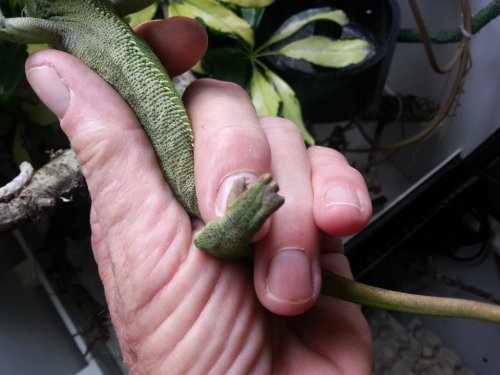
I have a 48g gracilior female that has toe injuries I'm worried about. She's been to the vet about them. The vet had a really good look at the toes under a magnifying lens and said that they were damaged to the quick but not the bone. She didn't see any infection.
I would like some opinions on how others have treated this kind of injury.
48g female Trioceros quadricornis quadricornis
Imported and purchased Feb/15. Weight at purchase 17g.
Caging: Dragonstrand Breeder with screen only on the front side and top, all other sides solid.
Hydration is good--at least 8 misting cycles a day.
Numerous fecals, finally have two that have been clear. Most recent fecal in May or June.
Treatment per vet: once or twice a day a small amount of Panalog on toes until swelling/pain subsides. Panalog is a combination of four drugs that are anti-fungal, antibacterial, anti-itch, and anti-inflammatory. The anti inflammatory drug is a corticosteroid (triamcinolone acetonide). The vet just wants to get her over the hump of pain/swelling so the toes can start to heal and she'll eat.
With her painful feet, she stopped eating. She's eating a bit now as evidenced by her very small stools. She's gained one gram from her low of 47g and has been holding at 48g.
She's also developed gular edema. I think it is from the steroid in the Panalog, which is why I want to find some other suggestions on how to treat her feet. I've used the Panalog sporadically after the first couple of weeks, using it only when I see her feet really hurt (after climbing the screen and re-injuring them one day).
Problem: I am looking for other treatments/protocols for dealing with severely damaged toe nail injuries. I'm also concerned that she is not eating well (as evidenced by her small stool). She stopped eating and dropped a couple of grams at the start, so this is an improvement. The vet said the pain from the toes was the likely cause of the poor appetite.
I would like some opinions on how others have treated this kind of injury.
48g female Trioceros quadricornis quadricornis
Imported and purchased Feb/15. Weight at purchase 17g.
Caging: Dragonstrand Breeder with screen only on the front side and top, all other sides solid.
Hydration is good--at least 8 misting cycles a day.
Numerous fecals, finally have two that have been clear. Most recent fecal in May or June.
Treatment per vet: once or twice a day a small amount of Panalog on toes until swelling/pain subsides. Panalog is a combination of four drugs that are anti-fungal, antibacterial, anti-itch, and anti-inflammatory. The anti inflammatory drug is a corticosteroid (triamcinolone acetonide). The vet just wants to get her over the hump of pain/swelling so the toes can start to heal and she'll eat.
With her painful feet, she stopped eating. She's eating a bit now as evidenced by her very small stools. She's gained one gram from her low of 47g and has been holding at 48g.
She's also developed gular edema. I think it is from the steroid in the Panalog, which is why I want to find some other suggestions on how to treat her feet. I've used the Panalog sporadically after the first couple of weeks, using it only when I see her feet really hurt (after climbing the screen and re-injuring them one day).
Problem: I am looking for other treatments/protocols for dealing with severely damaged toe nail injuries. I'm also concerned that she is not eating well (as evidenced by her small stool). She stopped eating and dropped a couple of grams at the start, so this is an improvement. The vet said the pain from the toes was the likely cause of the poor appetite.