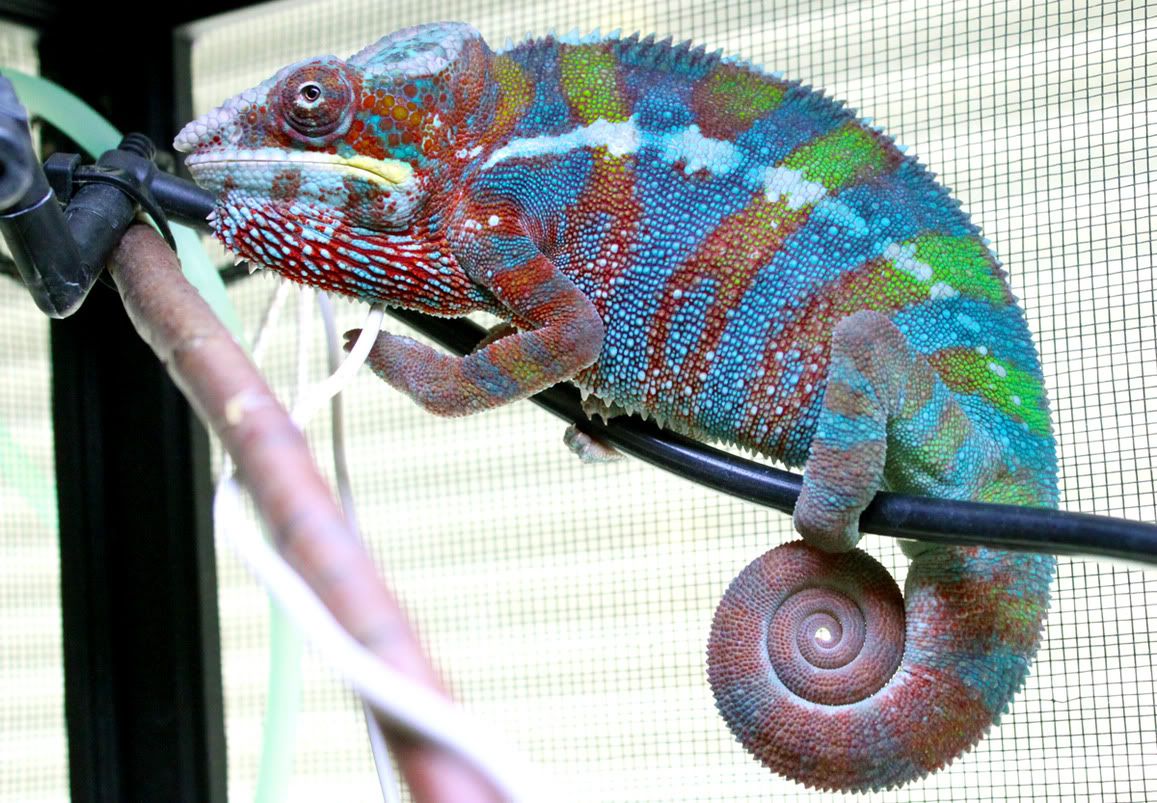
He's very pretty, and good luck with finding him a mate!
I don't think the genetics works quite that way, though that probably is how such offspring would be advertised; might be more accurate to say "offspring of Ambilobe-Ambanja cross parents". Since genes are shuffled around and recombined during any mating, offspring could end up with almost 100% Ambilobe genes, almost 100% Ambanja genes, or any mix in between (assuming an equal proportion of Ambilobe and of Ambanja genes in each of the parents, and random assortment when the gametes are being produced).
Thanks!
Though I understand your explanation completely and that's my understanding as well, I think people put way too much stock in the uniqueness or genetic diversity among locales of Panther chameleons. I can understand the drive to maintain locale bloodlines, but it also makes sense to hybridize these animals to come up with a more desirable, more colorful "breed."
As with the controlled selective breeding of any other species, the successful hybridization of a super colorful Panther chameleon can accomplished by selecting the "best" (in this case, the most colorful) breeders. Of course, genetics are hit or miss and only select offspring would be selected to continue the bloodline.
Labeling the genetic makeup of each "locale" of Panther chameleon distinctly doesn't make a whole lot of sense when you consider that literally 99.9% (or more) of their genetic makeup is identical. What makes sense for my goals is to breed based upon the best show of colors, which may or may not result in stunner chameleons. lol
I will say, though, that we'll probably keep a replacement male and female as pets for other parts of our home, just because we enjoy them so much. The others will be sold off or given away to family, labeled as who knows what - maybe simply as hybridized Panther chameleons (with both Ambilobe x Ambanja parents if a purchaser wants to know).
It's going to be a totally "new" experiment for us, but it's something my wife can focus a ton of time and attention to during the day, so I have good hope that the first batch will at least produce a few hatchlings.


 She needs her privacy