
Navigation
Install the app
How to install the app on iOS
Follow along with the video below to see how to install our site as a web app on your home screen.
Note: This feature may not be available in some browsers.
More options
You are using an out of date browser. It may not display this or other websites correctly.
You should upgrade or use an alternative browser.
You should upgrade or use an alternative browser.
Seriously worried.
- Thread starter leid
- Start date

Eric Adrignola
Avid Member


Joejackson - you dont' know things if you don't learn. Learning from mistakes is one of the best ways to learn. In my time, I've made more mistakes than most of you will ever make. Now, you can all be confident that you have the proper husbandry information, and an understanding of chameleon behavior and nutritional needs - I was figuring all this out myself, through trial and error.
Admission of past failures does not make my advice irrelevant. Would you rather take advice from someoen who's read a book on chameleon burns, or form someone who had enough experience with it, they wrote about it?
I can't see a way it coudl be a burn, as the light is a 60w. Also, the scab looks nothing like a fresh burn - sometimes, a bad burn will get some pus, and scab over afrer several days - this is what it looks like. A fungal infection, bad abrasion, or any other skin damage would likely cause a similar problem.
You sure the juice from the mandarin oranges didn't drip on him - hehe? It looks like soethign sticky that dried, be it pus or sugary syrup...
60W incandescents are not likely to cause a burn - is that a halogen bulb?
a halogen at ~6" would do it.
The burn is usually a near white color at first, unless it's very bad, in which case it's black. It usually doesnt' scab over like this for several days.
Admission of past failures does not make my advice irrelevant. Would you rather take advice from someoen who's read a book on chameleon burns, or form someone who had enough experience with it, they wrote about it?
I can't see a way it coudl be a burn, as the light is a 60w. Also, the scab looks nothing like a fresh burn - sometimes, a bad burn will get some pus, and scab over afrer several days - this is what it looks like. A fungal infection, bad abrasion, or any other skin damage would likely cause a similar problem.
You sure the juice from the mandarin oranges didn't drip on him - hehe? It looks like soethign sticky that dried, be it pus or sugary syrup...
60W incandescents are not likely to cause a burn - is that a halogen bulb?
a halogen at ~6" would do it.
The burn is usually a near white color at first, unless it's very bad, in which case it's black. It usually doesnt' scab over like this for several days.

Titan
New Member
Well with elevated levels of Vitamins and such from the shot, dustings, and gutloadings. Could have elevated his levels much higher than typically prossesed by a Chameleon, allowing the rays from the UVB to react differently to the skin, causing this reaction and possible minor sunburn.
Also those levels so high, show up in the poop as orange in excrete, and results in the Chams natural way to rid of the overlaod.
Also those levels so high, show up in the poop as orange in excrete, and results in the Chams natural way to rid of the overlaod.


leid
New Member
That isn't a heat rock. It's a little bowl to catch the water when I use a dripper, as its placed over the plants. Right now it's empty and holds my vines in place, but instances like today, where I'll be out for half the day, i use the dripper in case he wants some water.
And yes, the moment I arrive home I take the water out and wash the bowl.
Eric. I fed him Mandarin oranges days ago and he doesn't seem to have anything on him. The scabs appear to be healing, and aren't as bad as yesterday. They've actually shrunk. I'll post pictures when I get home.
Anyone else having a terrible snowstorm atm?
And yes, the moment I arrive home I take the water out and wash the bowl.
Eric. I fed him Mandarin oranges days ago and he doesn't seem to have anything on him. The scabs appear to be healing, and aren't as bad as yesterday. They've actually shrunk. I'll post pictures when I get home.
Anyone else having a terrible snowstorm atm?

Fate X
New Member
Nope. No loose feeders. My basking spot is only 80-85, and he has NO way of getting to his light since its on a clamp six inches above the cage. Ever since his shed, his skin has been very mottled. I don't know what to do in this situation. It literally looked like his skin was just peeling off! I grabbed my brother in law's digital camera. Here are two pictures:
He was JUST cleared for parasites from a fecal. What makes a chameleons skin look like this when I've been doing everything right??
looks like your chameleon got fried from the pics.im using my crappy laptop at the moment so the pic is no way as clear on my other laptp.most definalty looks like its been burnin.

Dave Weldon
Avid Member

Howdy Tara,
I'm in the "camp" with those who suggested an overdose of vitamin A. Injectable vitamin A is water-soluble. This form of vitamin A has a much higher chance for overdosing compared to the fat-soluble form such as the liquid gel-cap type that many of us have used.
From Dr. Mader's "Reptile Medicine and Surgery" 2nd Ed. (Most of this was aimed at turtles but as you can see, it hits the mark for your chameleon .)
.)
"Treatment of hypervitaminosis A is essentially identical to that of severe burns. Prognosis is dependent on many factors, the most important of which include the dosage of vitamin A, the health status before administration, and the aggressiveness of treatment….”
“Until more is known, avoidance of water-soluble vitamin A and use of fat-soluble vitamin A instead seems prudent.”
“…early retinol toxicity primarily affects the epidermis, initially causing dry flakey skin (xeroderma). Within a few days, the erythematous areas spread over the skin.”
“.”The blister, or bullae, break open and expose moist, reddened, or gray underlying tissue and eventually slough.”
“Water-soluble vitamin A produces these lesions within 10 to 15 days, yet fat-soluble vitamin A at identical doses did not, even though liver levels of vitamin A were similar.”
“Further confusing the entire issue is the fact that elevated intakes of vitamins D, E, or K may reduce vitamin A assimilation or restoring their respective adequacies. Protein deficiency may have a protective effect against hypervitaminosis A.”
EDIT: (From page 1069):
"These results usually happen at dosages of 10,000 IU/kg or higher given IM (intramuscularly) as a single injection. Treatment involves ceasing vitamin A administration, antibiotics, fluid therapy and nutritional support. The skin lesions may heal slowly, but animals managed supportively can completely recover."
I'm in the "camp" with those who suggested an overdose of vitamin A. Injectable vitamin A is water-soluble. This form of vitamin A has a much higher chance for overdosing compared to the fat-soluble form such as the liquid gel-cap type that many of us have used.
From Dr. Mader's "Reptile Medicine and Surgery" 2nd Ed. (Most of this was aimed at turtles but as you can see, it hits the mark for your chameleon
.)"Treatment of hypervitaminosis A is essentially identical to that of severe burns. Prognosis is dependent on many factors, the most important of which include the dosage of vitamin A, the health status before administration, and the aggressiveness of treatment….”
“Until more is known, avoidance of water-soluble vitamin A and use of fat-soluble vitamin A instead seems prudent.”
“…early retinol toxicity primarily affects the epidermis, initially causing dry flakey skin (xeroderma). Within a few days, the erythematous areas spread over the skin.”
“.”The blister, or bullae, break open and expose moist, reddened, or gray underlying tissue and eventually slough.”
“Water-soluble vitamin A produces these lesions within 10 to 15 days, yet fat-soluble vitamin A at identical doses did not, even though liver levels of vitamin A were similar.”
“Further confusing the entire issue is the fact that elevated intakes of vitamins D, E, or K may reduce vitamin A assimilation or restoring their respective adequacies. Protein deficiency may have a protective effect against hypervitaminosis A.”
EDIT: (From page 1069):
"These results usually happen at dosages of 10,000 IU/kg or higher given IM (intramuscularly) as a single injection. Treatment involves ceasing vitamin A administration, antibiotics, fluid therapy and nutritional support. The skin lesions may heal slowly, but animals managed supportively can completely recover."
Last edited:


Eric Adrignola
Avid Member
Hey, that sounds like it fits. Interesting stuff. I've never had to get a chameleon an "A" injection, I wouldn't have expected that sort of side effect.
How long after the shot did this happen?
How long after the shot did this happen?
I was really shocked when it happend to my female. Her skin sloughed off the sides of her head three days after the injection, just prior to a shed. I believe tara said the injection was nearly three weeks prior to this happening.
...This is interesting. My vet administered the vit A three weeks ago...
Last edited:
leid
New Member
So how should I administer my vit A for the time being? Make him eat gel capsules? Lol.
I'm also having problems with finding just a regular calcium dust. Where can I buy these? The pet stores all have them with vit A, though without d3, but I cant just seem to find straight calc powder. Any suggestions?
Luckily, Fred didn't seem to get any worse, and the blisters have shrunken, and one has completely healed since.
I'm also having problems with finding just a regular calcium dust. Where can I buy these? The pet stores all have them with vit A, though without d3, but I cant just seem to find straight calc powder. Any suggestions?
Luckily, Fred didn't seem to get any worse, and the blisters have shrunken, and one has completely healed since.
Eric Adrignola
Avid Member
just go to one of our site sponsors, and order Rep-cal with D3.
I reccomend a bunch of supplements, for maximum flexibility:
Rep cal with D3 (not repti cal, repto cal, repta cal - just Rep-Cal)
Miner-all 0, without D3 (minerall has lots of other minerals)
Herptivite, multivitamin without vitamin A(from the rep-cal people - works well, tried and true)
Reptivite (multivitamin WITH preformed vitamin A (also tried and true)
or
Fluker's multivitamin, wiht preformed vitamin A (Didn't have reptivite at the store, so I got this instead. Seems to work fine as well)
By using the different supplements, you can limit the amount of vitamins given at different feedigns or different periods of time.
USually, you go with minerall a couple times a week, for minerals. I mix minerall and rep-cal (2:1 ratio) and use that once a week, sometimes more. Rep-cal has a very high amount of D3, so cutting it wiht mineral will extend it a bit, as well as giving your animals some other trace minerals
Herptivite I give once a week, in small amounts. Usually a single bug or two.
Reptivite/flukers, I give every 1.5-2 weeks, just a tad, to make sure they're getting SOME vitamin A.
I vary this all the time - lately, I've been supplementing more often ,but with much smaller amounts.
I reccomend a bunch of supplements, for maximum flexibility:
Rep cal with D3 (not repti cal, repto cal, repta cal - just Rep-Cal)
Miner-all 0, without D3 (minerall has lots of other minerals)
Herptivite, multivitamin without vitamin A(from the rep-cal people - works well, tried and true)
Reptivite (multivitamin WITH preformed vitamin A (also tried and true)
or
Fluker's multivitamin, wiht preformed vitamin A (Didn't have reptivite at the store, so I got this instead. Seems to work fine as well)
By using the different supplements, you can limit the amount of vitamins given at different feedigns or different periods of time.
USually, you go with minerall a couple times a week, for minerals. I mix minerall and rep-cal (2:1 ratio) and use that once a week, sometimes more. Rep-cal has a very high amount of D3, so cutting it wiht mineral will extend it a bit, as well as giving your animals some other trace minerals
Herptivite I give once a week, in small amounts. Usually a single bug or two.
Reptivite/flukers, I give every 1.5-2 weeks, just a tad, to make sure they're getting SOME vitamin A.
I vary this all the time - lately, I've been supplementing more often ,but with much smaller amounts.
leid
New Member
I actually have herptivite and rep-cal, but since once contains d3 and one contains vit A without d3--and i know i can only dust so often with vit A and d3--is there nothing that is just calcium? I was told too much d3 blocks vit A, and too much vit A degenerates skin tissue. Obviously I cannot use both frequently??

Brad Ramsey
Retired Moderator
rep-cal has a calcium powder w/out d3.
LLL sells it for a very reasonable price.
-Brad
LLL sells it for a very reasonable price.
-Brad
Brad Ramsey
Retired Moderator
Here is my article on supplementation and my schedule (more or less ... often times less  ):
):
http://raisingkittytheveiledchameleon.blogspot.com/2007/12/supplements.html
I do dust a few feeders with calcium (no d3) at almost every feeding.
All of them heavily for females cycling eggs.
-Brad
):http://raisingkittytheveiledchameleon.blogspot.com/2007/12/supplements.html
I do dust a few feeders with calcium (no d3) at almost every feeding.
All of them heavily for females cycling eggs.
-Brad
Brad Ramsey
Retired Moderator
Use the coupon code RCAL at checkout on LLL site for $2 off your calcium.
-Brad
-Brad
Eric Adrignola
Avid Member
Ok, I see the confusion!
Herptivite does NOT contain preformed vitamin A.
It uses beta carotene, which may or may not work for reptiles.
so, if you are having issues, or want to supplement with preformed vitamin A, you need a different vitamin in addition to the herptivite!
you are correct, that there needs to be a balance between the vitamins in the animals' bodies. Mixing vitamins and minerals in the short term is not a problem, but long term there may be some degradation - that's why rep-cal is packaged alone.
Repcal wihout D3 is a fine product. As is minerall 0. I like the minerall as it has other minerals. minerall also has a product WITH D3, which works very well. They are the ONLY products I would use for calcium and or calcium with D3. Others may work, but I KNOW these do.
I've used both products to raise many animals to adulthood in the total abscence of UVB light. So they certainly work.
Considering the problems of maintaiing proper ratios and nutrient balance, the addition of UVB radiation greatly lessens the burden on the chameleon's metabolic systems (and the mental strain of the keeper).
Herptivite does NOT contain preformed vitamin A.
It uses beta carotene, which may or may not work for reptiles.
so, if you are having issues, or want to supplement with preformed vitamin A, you need a different vitamin in addition to the herptivite!
you are correct, that there needs to be a balance between the vitamins in the animals' bodies. Mixing vitamins and minerals in the short term is not a problem, but long term there may be some degradation - that's why rep-cal is packaged alone.
Repcal wihout D3 is a fine product. As is minerall 0. I like the minerall as it has other minerals. minerall also has a product WITH D3, which works very well. They are the ONLY products I would use for calcium and or calcium with D3. Others may work, but I KNOW these do.
I've used both products to raise many animals to adulthood in the total abscence of UVB light. So they certainly work.
Considering the problems of maintaiing proper ratios and nutrient balance, the addition of UVB radiation greatly lessens the burden on the chameleon's metabolic systems (and the mental strain of the keeper).
leid
New Member
An update:
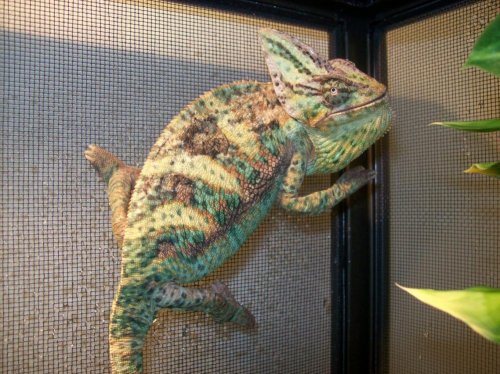
Fred is completely fine. The scabs healed before I had taken him to the vet today. There are still black spots on him but the vet said they were part of his color. His poop is no longer orange, he had a regular one as of this morning. My vet gets cuter and cuter every time i see him. He cleared Fred. Fred is fine, just going through maturity and getting some funky colors. Here's a picture taken today:
Fred is completely fine. The scabs healed before I had taken him to the vet today. There are still black spots on him but the vet said they were part of his color. His poop is no longer orange, he had a regular one as of this morning. My vet gets cuter and cuter every time i see him
. He cleared Fred. Fred is fine, just going through maturity and getting some funky colors. Here's a picture taken today:Attachments

Docility
New Member
yeah my guy has no incorporated a small amount of light brown in his natural stress free bars, and is getting his orange/white in =) he turns orange, white, lime green and its so beautiful. i need a good camera to capture it since the iphone cant withstand the lights in the cage (makes it blurry)
hes looking good though, and a lot bigger than mine. how big/ old is he again?
hes looking good though, and a lot bigger than mine. how big/ old is he again?
Similar threads


- Replies
- 6
- Views
- 2K


