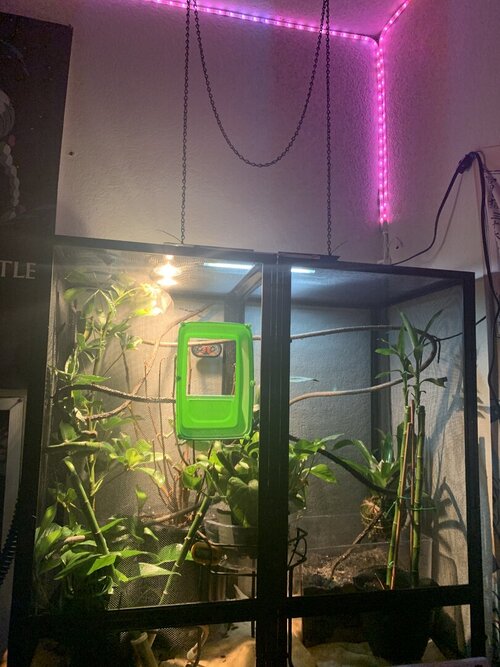
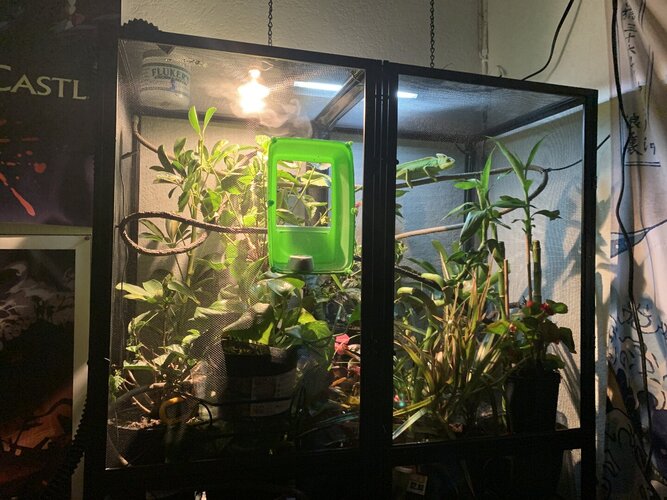
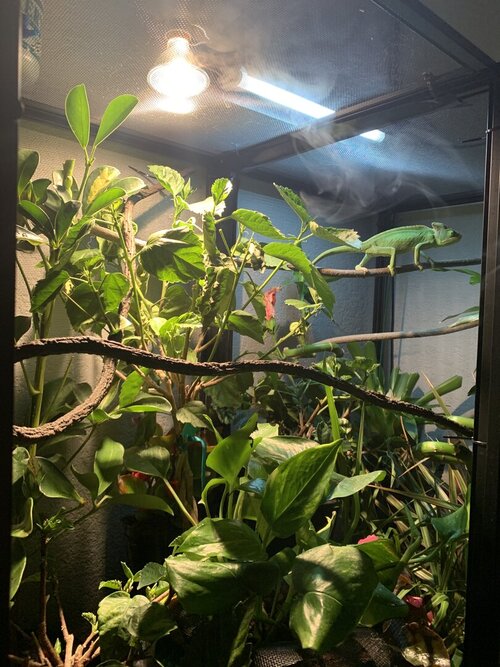
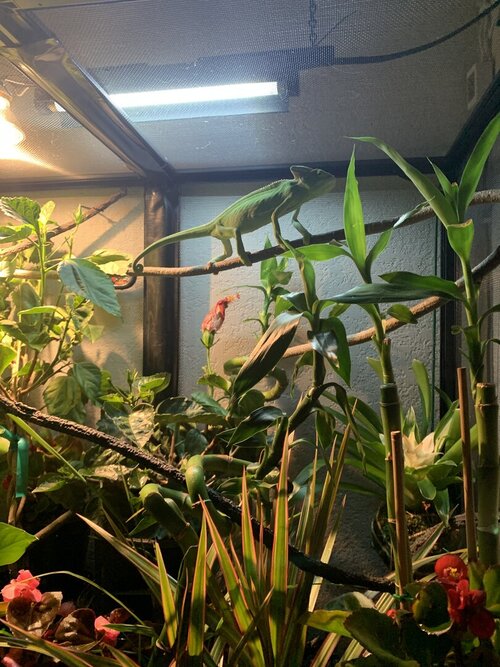
Hi! If she’s just starting to show some colors and patterns today, I’m going to guess that she isn’t gravid yet, but is instead receptive. When our little girls reach reproductive age and are ready to mate, their baby greens are accented with teal, yellow/orange and their patterns show up and they become very restless. They can be receptive for anywhere from a week to several. Not long after she’ll get plump and maybe you’ll see lumps. Her colors and patterns will change a bit (it may be quite subtle) when she is gravid.
Now is the time to make the needed changes. It is essential for proper egg production that she has calcium with and without D3 and multivitamin on the schedule already said. If you want to make things a bit easier, you can get Reptivite with D3 (multivitamin and D3 combined) which you would give one feeding every other week. Your uvb also needs to be correct. T5 with either a 5.0 or 6% bulb spanning the width of her enclosure and about 8” above her basking area is what is needed for correct uvb.
In order to reduce both number of eggs produced as well as laying frequency (both of which will shorten her life), we limit feedings and temps. Temps are much easier and consistent...no higher than 80 at basking. Feeding is a little tougher for her first reproduction phase. We don’t want to limit too much as she is still growing, but over feeding can lead to large clutches and greatly increase the risk of problems such as egg binding. But...you are over feeding at current. I would say to give her no more than 6-8 feeders daily starting now. Make sure to dust all feedings with phosphorus free calcium without D3, except on D3/multivitamin days. Avoid using things up such as spinach, which bind calcium, in feeding Your bugs. I know you already have your lay bin...just want to make sure it’s correct though. Minimum size should be no less than 12x12” length x width (bigger is always better) and filled about 6” deep. Best substrate to use is play sand. No coco coir, bark bits or ’reptile sand’. You can use organic soil mixed with the play sand if you choose. It must be kept moist enough to hold a tunnel without collapsing. They usually dig down at an angle, but one of mine also digs straight across. Once she enters her bin and starts digging, she’ll need total privacy - cover just the visible parts of her enclosure with a sheet. If she sees you, she may stop digging and get egg bound. Laying can take 1 - 2 days and she may even sleep in her bin/tunnel. You’ll know she’s done when she’s sitting on a branch, looking much thinner and her bin shows no signs of tunnels. Feed and hydrate her well. This is one of the few times I give my chams hornworms (I just hate hornworms) which are essentially bags of water. Silkworms are also excellent for not just hydrating, but for nutrition too. Feed her well for a couple of days and then reduce her feedings to 3-4 feeders every other day. A couple of months after, further reduce to 3 feeders, 3 days a week. It may take a cycle or two to notice a decrease in clutch size/laying frequency.
I hope this helps a bit. Do ask as many questions as you need.