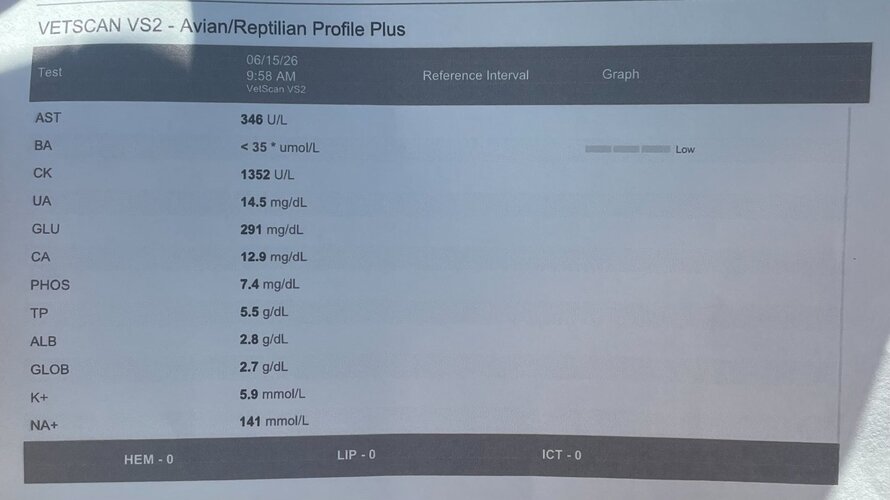
Just leaving the vet after Mel’s annual check-up. Vet said he’d lost 5grams and was looking a little pale so suggested we ran bloodwork. Here’s the results. She’s concerned about the UA levels and thinks he’s either super dehydrated or something is wrong with his kidneys.
Also, I was given this recovery stuff to sprinkle on his food. Thoughts?
Please help. Praying nothing is wrong, but I want to do everything I can to make sure Mel continues to thrive.
I did a husbandry review before, but it’s been a while so I will do a new one if someone can copy and paste the questions for me to answer.
That recovery is garbage. Just look at the first 3 ingredients, soy, sunflower oil, and sugar. The rest of it is a general multi vitamin.
In terms of "kidneys" that is normally due to protein ratios and types. Feeders fed too high of a protein diet (crickets raised on fish flakes/soy hulls for example) or the lizard only fed high protein feeders. Its kinda morbid, but i can cut a beardy's or veils life in half by feeding it a fuzzy or two a week.
Finally as just a general panacea, removing all supplements for two weeks (even plain calcium powder) cure alot of "we are not sure" issues. Yes i wouldnt do this if the lizard had known bone issues, but most lizards are over supplemented vs under. This can be due to just the surface area of the feeders. 2-3 queen dubia have a lot less surface area to powder vs 3 dozen medium crickets.
Here you go. Sorry your guy isn’t doing so well. I agree about that recovery product. While many/most exotics vets will see/treat reptiles, often their knowledge is pretty basic and lacking with regards to the very many different species. This is especially true when it comes to chameleons. Chameleon Info:
Your Chameleon - The species, sex, and age of your chameleon. How long has it been in your care?
Handling - How often do you handle your chameleon?
Feeding - What are you feeding your cham? What amount? What is the schedule? How are you gut-loading your feeders?
Supplements - What brand and type of calcium and vitamin products are you dusting your feeders with and what is the schedule?
Watering - What kind of watering technique do you use? How often and how long to you mist? Do you see your chameleon drinking?
Fecal Description - Briefly note colors and consistency from recent droppings. Has this chameleon ever been tested for parasites?
History - Any previous information about your cham that might be useful to others when trying to help you.
Cage Info:
Cage Type - Describe your cage (Glass, Screen, Combo?) What are the dimensions?
Lighting - What brand, model, and types of lighting are you using? What is your daily lighting schedule?
Temperature - What temp range have you created (cage floor to basking spot)? Lowest overnight temp? How do you measure these temps?
Humidity - What are your humidity levels? How are you creating and maintaining these levels? What do you use to measure humidity?
Plants - Are you using live plants? If so, what kind?
Placement - Where is your cage located? Is it near any fans, air vents, or high traffic areas? At what height is the top of the cage relative to your room floor?
Location - Where are you geographically located?
Current Problem - The current problem you are concerned about.
--------------
Please Note:
The more details you provide the better and more accurate help you will receive.
Your Chameleon - Male Veiled Chameleon. He's 2 years and 5 months old. I got him when he was about 7 months old.
Handling - I handle him about three times a week. I never force him out of his cage, but will lure him out with a bug.
Feeding - I was feeding him crickets and superworms but have recently switched to discoid roaches. I feed him about 10-20 every two-three days. I was using a calcium block and had cricket quencher in there, and occasionally repashy bug burger. I will now be gutloading with solely sweet potatoes and carrots.
Supplements - I use calcium without D3 every feeding, then every two weeks, I'll do one feeding with calcium with D3 and another with reptitivite.
Watering - I have a mistking that mists throughout the night (2min @8pm, 2min @ midnight, 2min @4am, 30sec @9pm, 30sec @1am, 30sec @5am, and 1min @6am). I've seen him drinking before when I occasionally spray him during the day or use a big dripper.
Fecal Description - He has solid brown poops and solid white urates with clear liquid around (which I think is because while I was waiting for a shipment of discioid roaches, I fed him a few hornworms last week). He has been tested for parasites twice (last summer and the summer before, and both tests were normal).
History - I got him from Petco (yikes), but don't know anything else.
Cage Info:
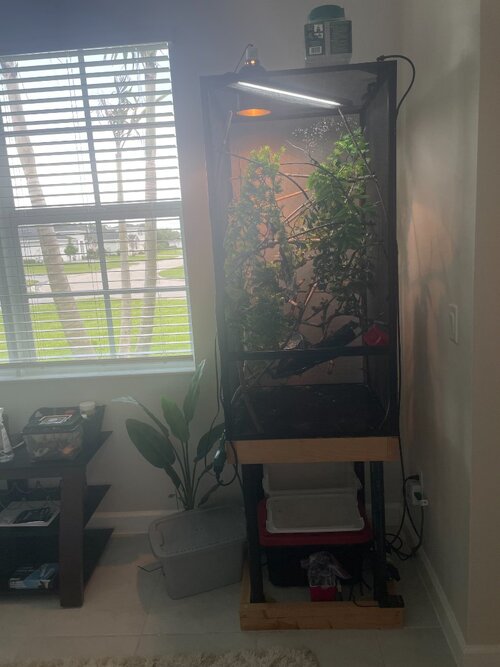
Cage Type - I have the Reptibreeze XL mesh enclosure (24 inches x 24 inches x 48 inches).
Lighting - I use a 7w watt basking bulb and a 22in T5 HO UVB. Both lights are on from 6:30am-7pm and off 7pm-6:30am.
Temperature - His basking spot has him around 82 degrees when he's sitting in it and the bottom of his cage is around 67 degrees. I haven't monitored the overnight temp, but I'm assuming around 70ish (we keep our house at 75 degrees). I have a handheld infrared thermometer.
Humidity - I don't have a way of measuring humidity. I rely on the mistking and the super occasional dripper to keep proper humidity.
Plants - I'm using fake plants (bad, I know). I didn't have a grow light and all of my real plants died. I've had horrible luck with real plants in the cage and find that fake plants provide more coverage.
Placement - My cage is hidden behind a wall in a room near our front door. This is not a high traffic area. There's an AC vent about 6 feet to the left of the cage. The top of the cage is about 6.5 feet from the floor.
Location - I am in Florida.
Current Problem - Mel is acting fine, but during his annual checkup, the vet was concerned that he had lost 5grams, was a bit pale, and had raised uric acid (UA).
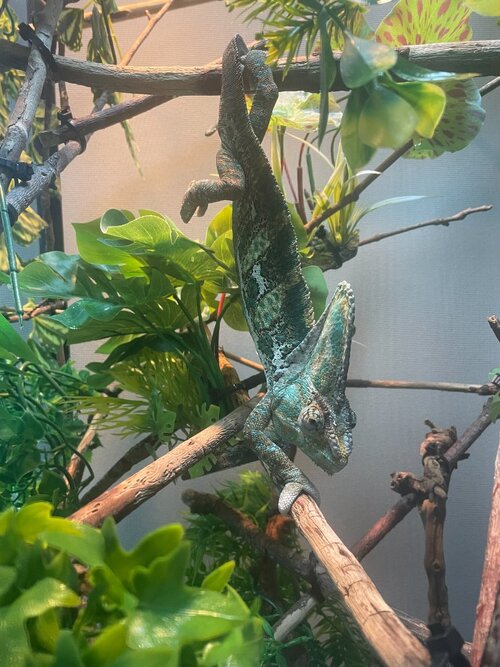
I've attached a picture his cage setup, his bloodwork from the vet, and him in his cage after the vet.
Feeding - I was feeding him crickets and superworms but have recently switched to discoid roaches. I feed him about 10-20 every two-three days. I was using a calcium block and had cricket quencher in there, and occasionally repashy bug burger. I will now be gutloading with solely sweet potatoes and carrots.
Yea i think you just need to lower the protein content of the gut load. Discoids/dubia store excess protein as uric acid just like we store excess fat as fatty acid.
Personally i just treat the roach bin as a compost heap and all the left over human veggies go in and get rotated out in a day or two. At worst i will add some Alfalfa/dog food that i ran through the mortar and pestle as a dry mix.
All of your husbandry looks good, but I have questions about your supplements. Is your ReptiVite with or without D3? Are you giving the ReptiVite and D3 the same day or week? Assuming the ReptiVite is without D3 - to simplify your life you could get it with D3 or switch to Repashy calcium plus LoD.
I don’t know if it’s a proven fact or anecdotal, but a diet high in (or exclusively of) roaches can cause gout. While I well understand the reluctance of many to use stanky crickets, you may want to get a few here and there. Other great staple feeders to add are silkworms, grasshoppers, bsfl. Many on line vendors offer species-specific variety packs of feeders. Look at the forum sponsors and also try https://lindasgonebuggie.myshopify.com/ who is based in Florida (panhandle area I think). I really encourage adding silkworms as not only are they super nutritious, but they are very hydrating too, which should help rehydrate him and help his kidney function. Do keep in mind that as with all things, moderation and variety is best. Too many silkies can cause loose poos. This morning my crew all got a couple of discoids and a couple of silkies. I try to offer two types of staple feeders for all of their meals. Once in a while, I’ll add in a superworm as substitute for a staple.
I don’t specifically gutload in the true sense. I do keep my bugs well fed a variety of fresh (preferably organic) produce and just a bit of Repashy Bug Burger at times (when lazy or rushed). Again - variety is best.
I do suggest getting a hygrometer to measure and maintain correct humidity. You may want to get a dual purpose one (digital with a wired probe end) that also has a thermometer to get a better basking temp. Your guy is a full adult, so his basking temp can be increased up to 85.
Have you tried pothos? There are several varieties of it and some are striking. The traditional type though is very easy to find and just a bit easier to grow than the fancier types. Use a good potting soil and give it adequate drainage and it should do the rest. If you place the plant on the enclosure bottom and train it to grow upwards, the leaves will grow huge.
If you are in the central Florida area, there are a couple of good vets, but unless you live in Orlando, appointments are limited. There is Dr Alfonso who has a mobile clinic and does have days at some pet stores where he does wellness visits for $50. Adding info below for one in July. Then there is semi-retired Dr Bogoslavsky in Kissimmee. Adding his info below too. Both are excellent and experienced with chams.
Thank you! The Reptivite is without D3. I give about 10 roaches with the Reptivite without D3 and 10 the calcium with D3 on the same day. Kind of a pain tbh. Just confirming, if I do the Repashy stuff (please verify this is the correct stuff: https://www.petco.com/product/repas...FX6DeIYPasug41ZxNMgw5i059i6wWXehoCQzcQAvD_BwE), I could just do 10 roaches with it every two weeks and not have to use two different supplements?
I'll order a variety pack from Linda's Gone Buggie. I'll buy the chameleon pack (bonus, it looks like she's having a BOGO rn https://lindasgonebuggie.myshopify.com/products/chameleon-value-pack-copy?variant=48899633119484). I'll plan on gut-loading all these bugs (including the 200 discoid roaches I currently have) with carrots and sweet potatoes and will stay away from the Repashy Bug burger for now.
Do you have any specific hygrometers you'd suggest? If you could link one, I'll buy it ASAP!
Should I up the wattage in his basking bulb to get up to that 85 degrees?
I did try pothos but that's when I was living in CT and my room would get cold, and I had them ziptied to a branch. I'll try pothos again. Do you think just one on the bottom of the enclosure will suffice? Hoping they'll survive this time!
I live in Southern Florida, and have been going to Sebastian Bird and Animal Hospital. Do you have any suggestions for this area? I'm not opposed to driving to the Orlando area, but would prefer not to stress Mel out driving him so far.
This is the correct Repashy - has a Jackson’s on the label. https://www.lllreptile.com/products/31050-repashy-calcium-plus-lod-3oz You’ll continue using the calcium without D3 at every feeding except one every two weeks, in which you’d use this combo product. Very easy regimen and is a fantastic supplement.
This is a decent thermometer/hygrometer. https://www.lllreptile.com/products/34330-zoo-med-digital-combo-thermometer-humidity-gauge Avoid the analog ones (usually round like a clock) as they are notoriously inaccurate.
After confirming temp with your new thermometer, you may need to get a different basking bulb. Try the next wattage up (or down if needed) basking bulb and see if that gives the desired temp. The distance between your basking branch and lights should be about 9” - provided your uvb strength is either ReptiSun 5.0 or Arcadia 6%.
Ideally you will replace all of the artificial plants with safe live ones. While it’s nice to have a tall center plant, like schefflera or something similar, if the only plant you have success with is pothos, then pothos it is. Try 1 or 2, maybe try a spider plant or wandering dude (tradescantia zebrina), both which are safe and pretty easy to grow. Provided your plants have good drainage and soil, they should stay alive. It’s not just for aesthetics that you want live plants. Our veiled friends are well known to nibble their plants and it can take just one unfortunate eaten fake leaf to cause a bowel obstruction.
I would say Dr Bogoslavsky in Kissimmee is the closest vet with great knowledge and experience with chams. I’ve driven several hours one way to take my panther girl to Dr Alfonso. We place them in a dark box and usually they will sleep. I say usually as about 5 minutes from home, I noticed my sneaky little girl had escaped her box and was just sitting on my little tote bag, hanging out.
Just going to cover these items as supplements have already been covered with you... Although the fact that he is getting far too much calcium with D3 is contributing to renal function issues. However you are feeding him way too much with the 10-20 every 2-3 days. Once they hit a year old they should get no more than 3-5 insects ever other day. Some will have to be taken down to every three days. Your boy is showing signs of obesity. You can see this with his casque and cheeks. They should not be fat the way his are. The overfeeding causes fat storage around the organs. It is simply too much for his body to handle. Obese chams tend to have issues with renal failure and/ or compromised kidney function. This causes the higher uric acid levels. These higher levels also can lead to gout.
Reduce his food intake and switch his supplements... I would do plain calcium without D3 at all feedings... I would hold off on rotating in the multivitamin with D3 for at least 4-6 weeks. These are fat soluble so they store in the tissues. It takes time for it to reduce in the body. Once you get to the 4-6 week mark then use the multivitamin only 2 times a month.
Thank you @MissSkittles and @Beman! I'll toss the calcium with D3 and Reptivite and buy the Repashy with the Jackson's on the label, but will wait ~six weeks before using it and just stick to calcium without D3 at every feeding. I ordered the bug variety pack that @MissSkittles recommended, so once those arrive, I'll begin feeding Mel 5 different feeders every three days (instead of just the discoid roaches).
I just got a call today that his white blood cell count came back normal, so hoping that I caught the problem early enough and there is no irreversible damage to his kidneys/gout. What do you guys think? My vet was concerned that he had lost 5 grams since she saw him last summer, but if he's obese, I guess that's a good thing?
Thank you @MissSkittles and @Beman! I'll toss the calcium with D3 and Reptivite and buy the Repashy with the Jackson's on the label, but will wait ~six weeks before using it and just stick to calcium without D3 at every feeding. I ordered the bug variety pack that @MissSkittles recommended, so once those arrive, I'll begin feeding Mel 5 different feeders every three days (instead of just the discoid roaches).
I just got a call today that his white blood cell count came back normal, so hoping that I caught the problem early enough and there is no irreversible damage to his kidneys/gout. What do you guys think? My vet was concerned that he had lost 5 grams since she saw him last summer, but if he's obese, I guess that's a good thing?
Not a bad thing that he lost grams... May be completely unrelated and more likely that he just has not eaten as much since last year. 5 grams is nothing. Do you know what he actually weighs?
You will be looking for his casque and cheeks to slim down. Start out with 5 insects every 2 days for a week or two then kick him to 5 every 3 days. Since he has been getting so many I would rather take his amounts down a little more gradually.
Keep a dripper going during the day to give him plenty of opportunity to drink. Won't help with the D3 build up but will help his renal system hopefully flush a little better.
I am betting he is at least 30 grams overweight right now. Granted I would need to know a total length for him to give you a better answer... For example a male that is about 15 inches tip of nose to end of tail would be considered healthy at about 130ish grams. There is some play with that number though. This is why we really look at over all body and the cheeks and casque. You dont want them so thin that they are no longer muscular in the limbs and body.
UPDATED BLOOD TEST RESULTS! Mel's UA levels have dropped, so increasing hydration, diversifying his feeder diet, swapping out calcium gutload for sweet potatoes/carrots, and using Repashy calcium plus LoD seems to be working. The vet didn't seem to have any concerns and I'll be going back to the vet for Mel's annual checkup next Summer.
However, if anyone is knowledgeable re: bloodwork and has any additional insight on these results, please feel free to let me know! Thank you!
UPDATED BLOOD TEST RESULTS! Mel's UA levels have dropped, so increasing hydration, diversifying his feeder diet, swapping out calcium gutload for sweet potatoes/carrots, and using Repashy calcium plus LoD seems to be working. The vet didn't seem to have any concerns and I'll be going back to the vet for Mel's annual checkup next Summer.
However, if anyone is knowledgeable re: bloodwork and has any additional insight on these results, please feel free to let me know! Thank you!
Yay!
Suggestion:
Live plants, lots of live trees and plants.
These guys really do absolutely need a healthy tree in their little lives.
Good job and congrats on making it actually work out for Mel's Sake.
(I thought Ol' George was a girl and egg bound, wouldn't use the sand like a Lady. Turns out, Ol' George had to poop and he's definitely a Boy and not Egg bound ) For these type of pages.







 For these type of pages.


