New Senegal Owner

EKH

New Member
HELP! I just got a Senegal Chameleon and have become very attached to him/her. While I have tried EVERYTHING I can to help him/her de-stress, I still don't think they are too happy in my new set up

Chameleon Info:

Your Chameleon - It is a senegal chameleon, not sure of the age and I've had it for 2 days.
Handling - The first hour or so I handled it quite often, now I try to leave him/her alone because I learned they don't like to be touched
Feeding - I have started feeding him/her crickets but only seen him/her eat 2 since they've been in my care.
Supplements - I'm not sure of the brand but I dusted the crickets with a calcium supplement before I fed them
Watering - I began by using a simple spray bottle to mist the cage, then tried a dripping system. My cham seemed to like the spray bottle better and I do too. I just bought a mister to see if I could help his/her humidity out some.
Fecal Description - Seems brown with a white tip

Cage Info:

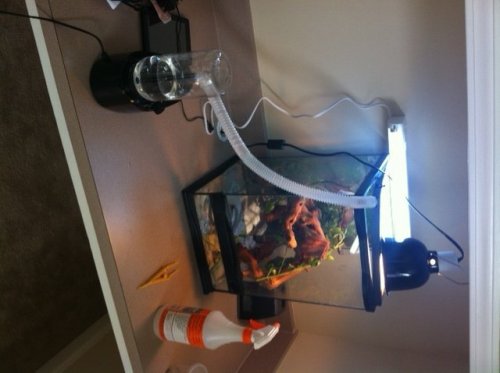
Cage Type - I have a glass reptile cage with vents on the top and vent on the sides.
Lighting - They have an 18" flourescent light and a 30 watt bulb on the top (as recommended by the cham "expert" I spoke to at the pet store)
Temperature -
Humidity -
Plants - I have hibiscus leaves throught the cage and lots of fake foliage for him/her to climb around on
Placement - It's placed on a desk in my sunroom
Location - I live in the South


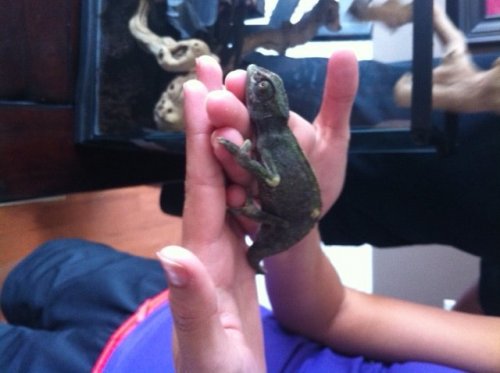
Current Problem - Pascal seems to be super dark in color and I don't know what else I can do to make him happy. When I got the hibiscus plant, I stuck him on there for a couple hours and he turned a bright green so I know he was happy there but I can't make him happy in the cage. I would appreciate any help! I would hate for this little guy to die just because his owner is misinformed :(


0


0
 
Hello, welcome to the forum. Your cham is not going to die if we can prevent it.

I am going to give you several things to change answer or consider. Please respond with questions or whatever back to me.

You live in the south and have you cham in glass,also it is sitting where the sun hits the cage. You could cook your cham. I would consider a screen cage or monitor the temp in the glass one very, very care3fully.

I may take your cham several days to a week to settle in to living with you. Give it time to adjust. It needs water (misting) food, if it will eat. And to be left along as much as possible.

What are the dimensions of his current home? A glass terrarium may be too small for him.

I will assume he is wild caught, that means a very, very good chance he had parasites. Before you check with the vet or try to treat him, Give him a month to 6 weeks to get strong again from all the stress of being move around and all the other stress he may have been under.

Sorry have to run, be back, look at this for now.
 
Supplements - I'm not sure of the brand but I dusted the crickets with a calcium supplement before I fed them
Watering - I began by using a simple spray bottle to mist the cage, then tried a dripping system. My cham seemed to like the spray bottle better and I do too. I just bought a mister to see if I could help his/her humidity out some.
Fecal Description - Seems brown with a white tip

Cage Info:

Cage Type - I have a glass reptile cage with vents on the top and vent on the sides.
Lighting - They have an 18" flourescent light and a 30 watt bulb on the top (as recommended by the cham "expert" I spoke to at the pet store)
Temperature -
Humidity -
Plants - I have hibiscus leaves throught the cage and lots of fake foliage for him/her to climb around on
Placement - It's placed on a desk in my sunroom
Location - I live in the South


Current Problem - Pascal seems to be super dark in color and I don't know what else I can do to make him happy. When I got the hibiscus plant, I stuck him on there for a couple hours and he turned a bright green so I know he was happy there but I can't make him happy in the cage. I would appreciate any help! I would hate for this little guy to die just because his owner is misinformed

0


0

We need to know the temps in the cage/tank and the humidity level. These are vital for you to know and keep track of. We also need to know the specific brand of lighting you are using. Many types of lighting sold for reptiles are pretty useless for anything other than heat. Chams need daily exposure to UVA and UVB. Any cham will be stressed for a lot longer than 2 days after a move to a new situation. I can't see any of your attachments so don't know if they are photos of your setup or your cham. Almost all Senegals are wild caught imports that have been through a huge amount of stress before they reach your hands. In addition to stress, dehydration, injuries and diseases are all possible which make it that much harder for them to destress. Your cham could be dark because it is either too cold (or trying to warm up by turning a darker color), or severely stressed by not being able to hide from your view or possibly the view of activity in your house. The reflections it sees of itself in the tank glass could also be a problem. Some chams don't seem to care about glass images but others do. It is something to check into. You need to feed your insects before offering them to the cham. Other wise they are basically empty shells with very little nutrition as most pet shops don't feed them much at all.

There is a lot of great "basic" care info for chams in sticky notes at the top of the forums and most of it will apply well to Senegals. Please compare your specific setup details with those guidelines and ask if you need more help, OK?
 
Hi there.welcome to the forum. I agree with Carlton. A couple of things I would add. First can you check the exact brand name of your calcium supplement please and you refer to your Cham using the word they. Do you have one or more than one. Pics would be good.:)
 
I only have one but I have no idea if it is a boy or girl and hate to call it "it" -- I posted 2 pictures, can you all not see them?
 
Maybe this will help the pictures?
 

Attachments

  • Pascal.jpg
    Pascal.jpg
    45.7 KB · Views: 146
  • Set Up.jpg
    Set Up.jpg
    45.8 KB · Views: 132
Yes your pics are there. Iam not familiar with breed but I'm sure someone will help soon.
 
EKH,

I have a senegal and veil. and from what i found out, it seems that senegal tend to turn dark green when they are basking. Im not 100% sure as i am still new also, but thats what i suspected. Whenever I had her out basking, she would turn a drak green. After half an hour (usually) i pick her up, and she would turn bright green. I had tried putting ,y cages inside and outside, and guess what, when i put her outside, she turned brighter green. In my opinion, wild caught senegals like to se the outside world and more comfy being placed outside rathar then inside. I noticed they are not as active when four walls are at their view. Though many might not agree, but my observation for senegals are, the more traffic or scenary, they stress less. Just my opinion.
 
EKH,

I have a senegal and veil. and from what i found out, it seems that senegal tend to turn dark green when they are basking. Im not 100% sure as i am still new also, but thats what i suspected. Whenever I had her out basking, she would turn a drak green. After half an hour (usually) i pick her up, and she would turn bright green. I had tried putting ,y cages inside and outside, and guess what, when i put her outside, she turned brighter green. In my opinion, wild caught senegals like to se the outside world and more comfy being placed outside rathar then inside. I noticed they are not as active when four walls are at their view. Though many might not agree, but my observation for senegals are, the more traffic or scenary, they stress less. Just my opinion.

I would also say that for most chams including recently imported transported Senegals that more privacy and less activity means less stress. Remember that BRIGHTER colors don't always mean HAPPIER. It can also mean the cham is excited and getting more so on it's way up the stress scale. If a cham is taken outside to a strange place and it feels exposed and vulnerable their coloration will intensify, patterns may become brighter, darker spotting show up more too. It's their attempt to look less like a solid colored prey animal and more like a pattern of leaves and shadows. Sure chams tend to darken to help them absorb heat faster, but you'll tend to see that they do this on the side closer to the heat source rather than turn uniformly darker all over their body. Watch the cham as it basks...you should see the side closer to the basking bulb darken, but the other side does not darken much. The cham may also tip itself and flatten its body (how nice to have those non-calcified ribs!) to create more flat surface that also speeds up heat absorbtion.
 
Back
Top Bottom