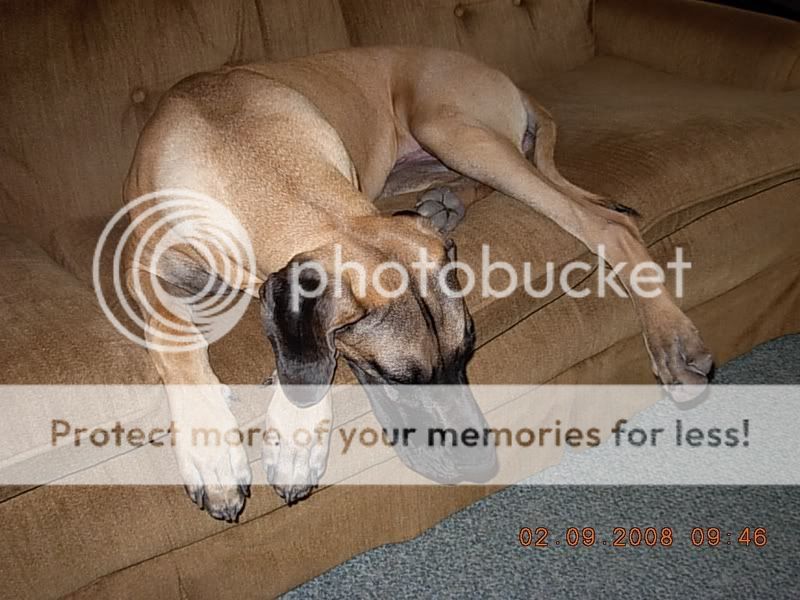
Here are some interesting facts on Merle Danes...genetics are interesting!
While merles make lovely pets, the general consensus is that they shouldn't be bred because they can produce defective pups.
Excerpts from an article by JP Yousha on breeding merles:
http://www.chromadane.com/harl2merle.htm
MERLE TO WHITE: 50% deaf (or dead) white is expected; 50% merle, with reduced litter size due to merle-related deaths.
MERLE (or merlikin) TO BLACK (or to Mantle): This is a breeding using TWO mismarked dogs. (Most of the others use at least one parent with correct markings!) Since some harl-bred blacks & mantles can carry harl genes (H-factor) unseen & merles obviously carry the Merle gene, recombining the two can occassionally produce harls. But mostly, again, this breeding produces mismarks: black with white markings & merle dogs. And the dogs used in these sort of breedings are commonly sub-standard in other ways than color.
MERLE TO HARL: This is like breeding harl to harl, except you reduce your chances of getting harls & increase your chances or getting mismarks and various defects by all reports.
MERLE TO MERLE: This is not deliberately done in Danes, although it is occassionally done in other breeds. It is universally discouraged & is against the law in some countries. Vague reports of such breedings in Danes make the rounds from time to time. From what is known, at least 25% or the litter is expected to be defective & there are anecdotal reports (in Danes & other breeds) of merle x merle litters ending in "disaster" (all lethals, all defects, absorbed litters, etc.) More on breeding merles below.
article continued:
THE "WHY" OR RATHER THE "WHY NOT" OF BREEDING MERLES:
1) Merles are a disqualification under all standards for the Great Dane--and have always been. That is enough, in many registries, for a dog to be denied "papers," so this is obviously always been thought a very poor breeding choice. (That the AKC will register a dog does not imply approval of it as a breeding choice--the AKC will register *ANY* dog with two registered parents of the same breed. Any dog.) One must assume, historically, such animals were used & the results generally not good, hence the fact they have always been disqualified. There *are* anecdotal reports that using merles in a harl breeding program not only increases the number of mismarks in a litter, but also results in a much higher number of defective puppies than in a harl to harl breeding. In other breeds which allow the merle (very few BTW), merles are not supposed to be bred to each other, to avoid the production of white merles: those defective, predominately white pups. Merles LACK the necessary genetics on their own to produce harls: noone has ever documented a merle to merle breeding that produced harls. So by all reliable reports, merles as a group do not productively contribute to the harlequin-mantle gene pool.
2) It is certainly and always the case that anyone who has not established a *sterling* reputation & can explain to the general dane fancy's satisfaction the reason to break such a general rule of breeding better be prepared to be considered unethical by most if not all others concerned about ethical breeding. This is a case where making an exception to the rule is better NOT done but for the rarest of cases where the person in question has a long track record of good practices, the production of Champions under ethical constraints, AND who has an exceptional & rare enough situation on their hands to warrant a probably once in a lifetime event. People who sell & breed merles (including so-called merlikins) as breeding stock on a regular basis can simply be generally assumed to be commercial (i.e. for-profit) breeders whose goal is cash cropping harl pups, not breed protection. These dogs are also bred in ignorance by people only casually involved with the breed. Needless to say, however well meaning, these breedings do not contribute to breed betterment either.
3) A boston merle, the most likely choice as a breeding partner to a harl, is essentially a "true" boston (i.e.Mantle), with the added problem of producing deaf white & other defective puppies, which does not occur in a Mantle to Harlequin breeding. So a Mantle is always preferable, on this account, to a merle.
4) "Merlikins," a white base-coated dog with black & grey markings, have been bred on occassion to Mantles to produce harls. But this is a risky breeding for several reasons. Merlikins may be genetic whites (MM), so then are often deaf &/or have eye defects (& without a BAEF/CERF noone can say a dog's eyes or ears "are fine"!), most (Mm) merlikins will NOT produce properly marked harls under any circumstances, & the harls they DO produce are likely the result of their Mantle (boston) mate carrying unseen the factors needed to produce harls. There is significant evidence that some (many?) merlikins are actually (MM) double merles, i.e. genetic whites. There is also a well-established theory that merlikins are simply merles which carry the Tweed gene & the Tweed gene produces that swirly-looking "merli-harl" that is a harlequin mismark. And they are disqualified under the standard. All this means merlikins are established as a poor breeding choice as a rule. So, again, a properly marked animal, in this case a show-marked Harlequin, would be preferable to the merlikin.
5) The long & the short of breeding merles (& other mismarks, for that matter) is, if you have to ask about the whys & wherefores, you probably "can't afford it;" can't afford the disaster & dishonor likely awaiting you. Unless you are dealing with a publically esteemed breed expert really caught in a corner, you can pretty much assume someone using mismarks (e.g. merles, piebalds, and other mismarks) routinely in their breeding program is less than knowledgeable & less than ethical. This *is* a case of guilty until proven innocent.



 but very happy for you. You are going to have a wonderful time with Luk.