It’s important to have only safe live plants. Our veiled ladies really seem to enjoy nibbling/eating their plants. It only takes one nibble from a fake leaf and they can get a potentially fatal bowel obstruction. I’m going to strongly suggest some sites to learn all about caring for your sweet and spicy girl, including plants. The most accurate and up to date info is here.
https://chameleonacademy.com/chameleon-basics/ Here’s the plant list and info.
https://chameleonacademy.com/plants/ If you prefer videos, chameleon academy has some on YouTube and do make sure to check out Neptune the Chameleon. She has tons of videos on so many topics. She also has a site now.
https://www.neptunethechameleon.com/
Back to plants. Pothos is probably the one that is most often used and imho the best for chameleons. It doesn’t need any special plant lighting, is very easy to care for and propagate (make more plants) and our veiled girls find it tasty. The long vines are nice additions to their ’roads’, the leaves are nice and big for drinking from and hiding under. I picked up some fairly decent pothos from Walmart recently for under $10. Just about everyone and everywhere has pothos and ask if you can have some clippings. Sit them in a glass of water until some roots form and then plant them. Similarly (and not on the list but I use them) is heart leaf philodendron. It looks almost the same as pothos and has the same characteristics, but maybe not as yummy to our girls. Spider plants are good and easy to start from the little babies they send shoots out with. Tradescantia is another super easy plant. If you can find a weeping fig tree, that would be awesome!
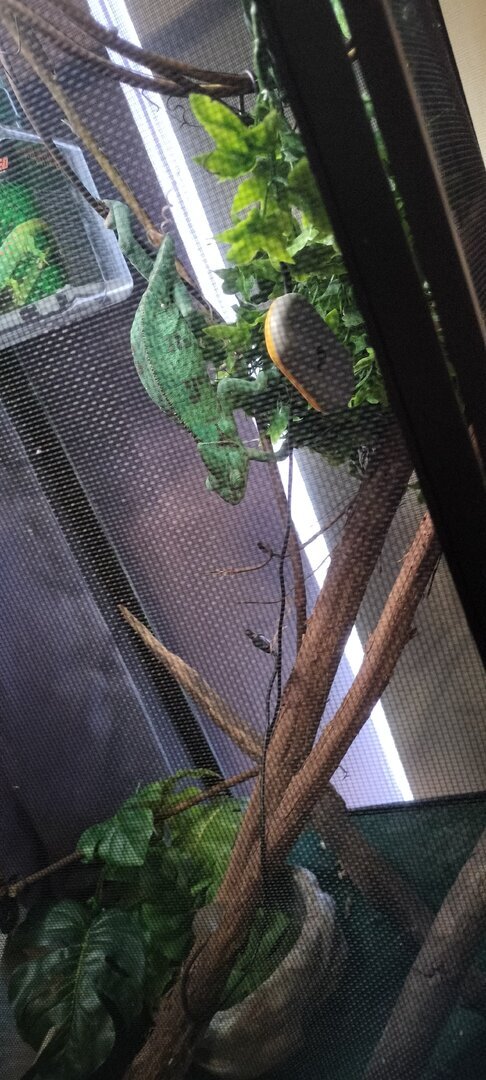
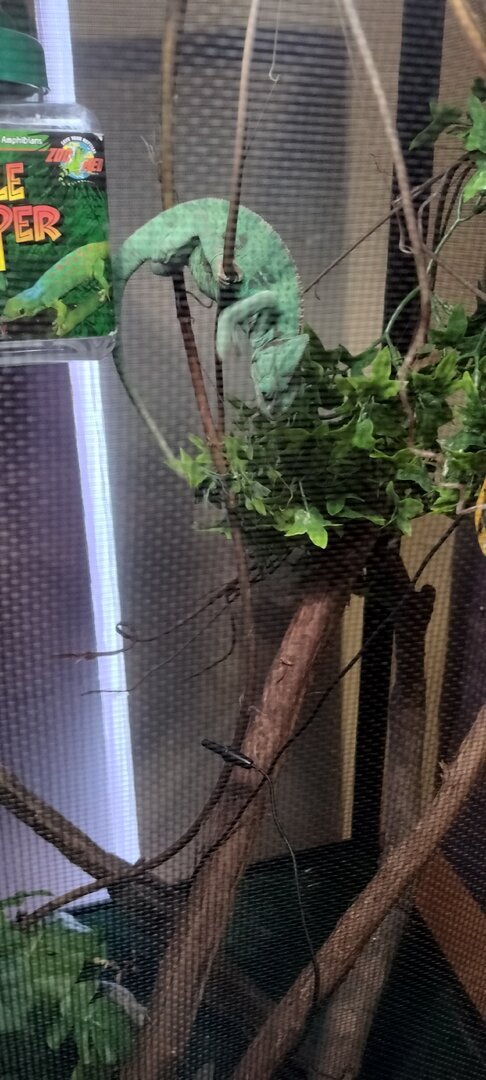
Now for branches. These are free for the gathering. Avoid ones from trees with sticky sap or strong odors, like pine/firs, eucalyptus. Oak is perfect and very commonly found. Gather some branches of different widths /diameters. Give a little scrub with soapy water (dish soap is perfect to use), rinse very well and air or sun dry. Attaching things to screen is a challenge, but not impossible. The key is that the frame of the enclosure needs to bear the weight and not the screen. Attach some straighter branches to the frame corners with thin wire or even thread and then attach another branch between them, forming an ‘H’ shape. Do be careful not to interfere with the closing of the door. Then you can attach branches and vines to these. I used some scraps of plastic garden trellis, attached to the frame and it’s strong enough to hold a couple of plants too. I’ll put a couple of pics below. Neptune the chameleon has a video on how to attach branches with some other ideas. Just make sure to give your girl lots of little chameleon roads to travel and at varied heights so she can choose where she wants to be and get some exercise.
Now for the lay bin. You need a decently sized bin of around/at least 12” long and wide. You can probably find something that will work well at one of the dollar stores. Poke some tiny holes in the bottom for extra water to drain out and fill to about 5-6” with moistened play sand. It needs to be moist enough to hold a tunnel without collapsing. Keep it in her enclosure all the time. When she needs it, it’s there and she’ll find it. Once you do see that she’s started digging in it, she will need absolute privacy. I use an old sheet that I can make peek holes in to cover the bottom half of my enclosure. You’ll know she’s done when she’s sitting in her usual basking spot and looks much thinner. The whole laying process can take a couple of days and she might sleep in her hole. She might try digging a few holes until she likes one. No need to worry about feeding her or even misting. Just use your dripper, but make sure it isn’t dripping into her bin.
Before she is even ready for laying eggs, she will first become receptive. She’ll have her colors and patterns on full display and be restless - constantly roaming her enclosure. She’s all dressed up and is looking for a boy. This can last for maybe 2-3 weeks. Then she’ll start to slowly plump up and as soon as about 30 days later, she could be ready to lay her eggs.
Laying eggs takes a lot out of our girls and shortens their lives. Plus, the more eggs they produce in one clutch, the higher the risk of complications like follicular stasis and egg binding, both of which need surgery or are fatal. The number of eggs produced is directly related to how much they eat, so we limit their food. For a girl that is at least a year old or has already laid a clutch, you’d feed her only about 3-4 feeders, 3 days a week. This is how I feed all of my adult chameleons plus I give a treat or two every weekend. Keeping the basking temp no higher than 80 helps keep their metabolism just a bit slower, so they don’t feel as hungry. When stuck to, this regimen helps reduce the number and frequency that our girls produce eggs. I had one of my girls who went three years without laying. My other girl was laying once a year, but now it’s been about 20 months since she laid last.
Also, just so you know…once a girl has developed her big girl colors and patterns, she won’t return to being just plain green again. The vibrancy of her colors will change according to mood and her reproductive state.
This is not the finished look. This is just to show attachments.
This shows how branches were attached. This is about the same size enclosure as you have.
I added a schefflera as the main plant and then more branches around it. I elevated some other plants on empty plant pots flipped upside down in the back. This was almost the completed enclosure. (Was for a baby)



 It’s always a good idea to have a fecal check for parasites.

 if there's anything else I need to buy for her I'll do it with my next allowance.. im getting it bumped up to $40 for taking care of Nana, so I'll get what I can! The uvb is the most urgent along with the correct supplements. While the supplements shouldn’t be too expensive, the uvb will require some saving up for it…usually runs around $65-70. The uvb bulbs do need to be changed periodically. ReptiSun (last I knew) needed to be changed every 6 months, while Arcadia lasts for a year. A new bulb is usually around $20-25. Do NOT get the Arcadia shade dweller 7%! It is not the same and neither the fixture nor the bulb will work for a chameleon.


