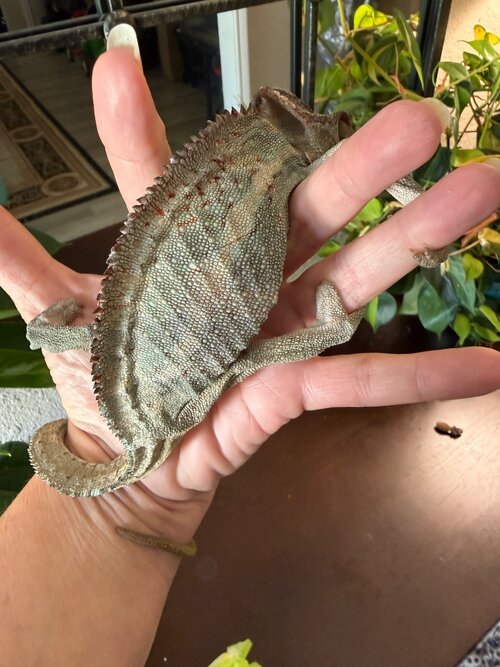
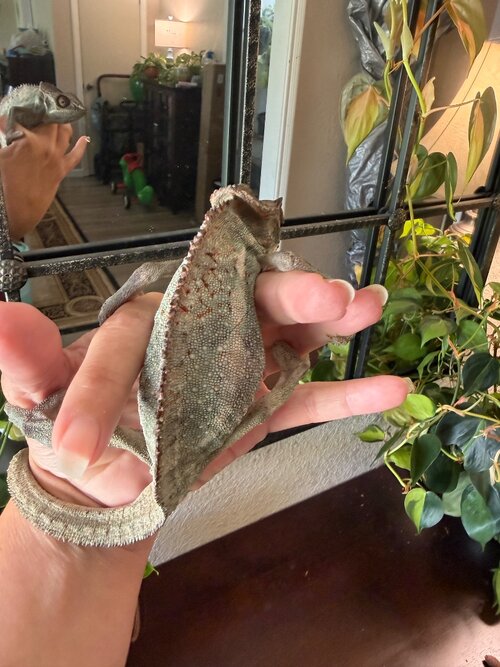
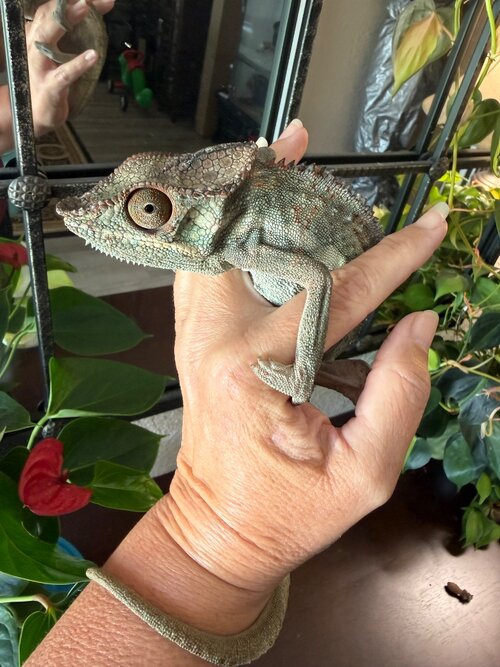
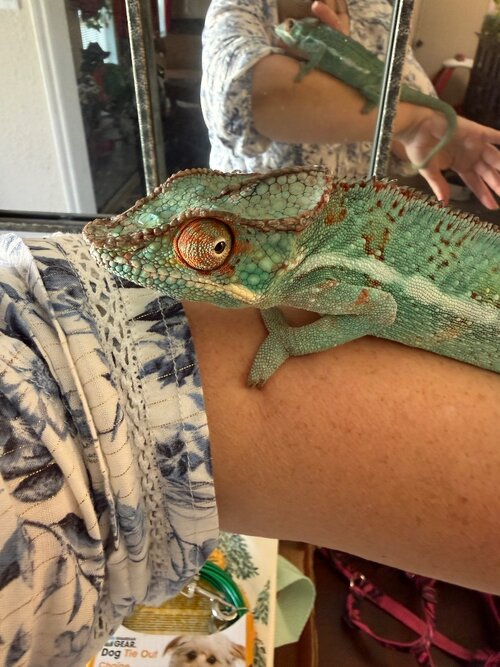
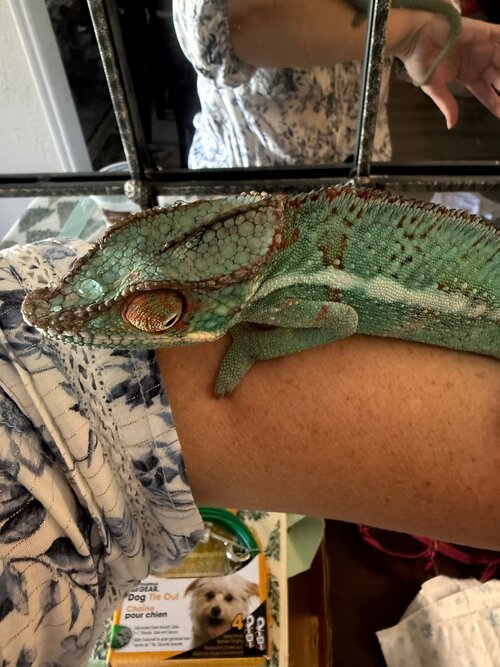
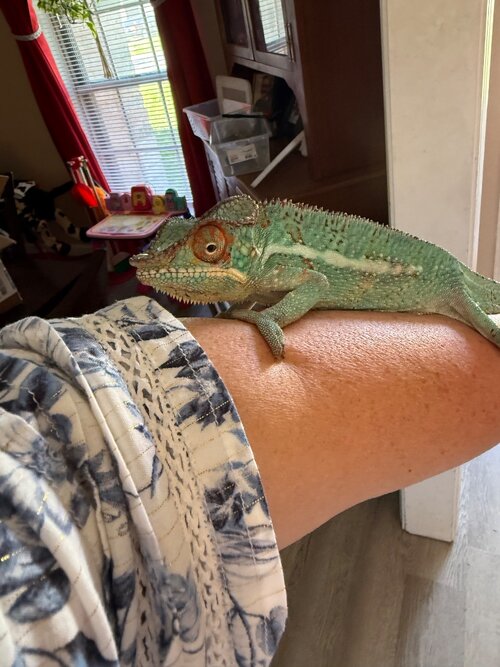
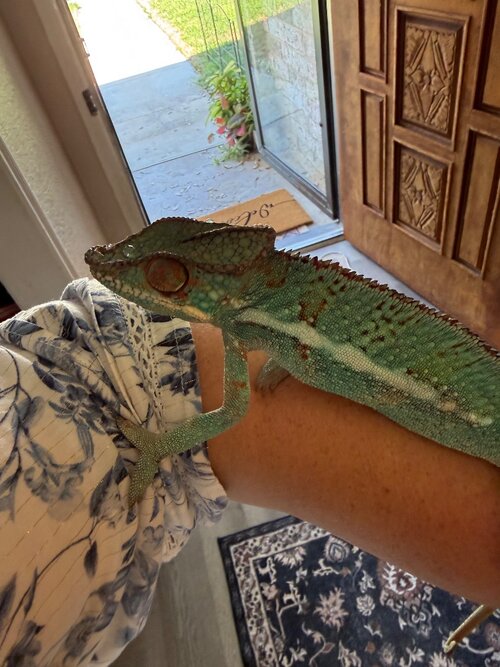
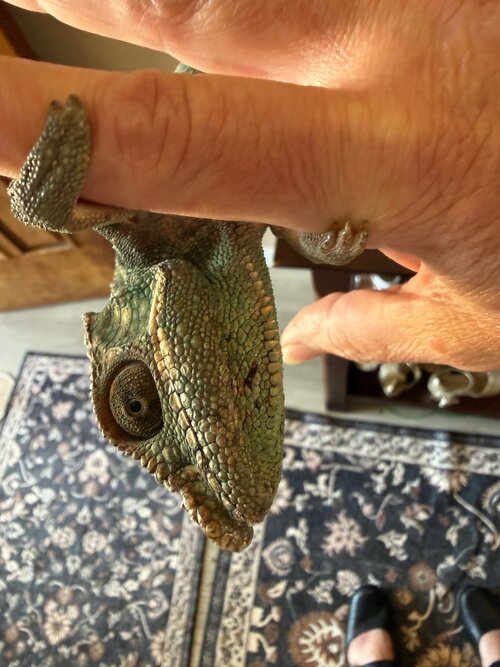
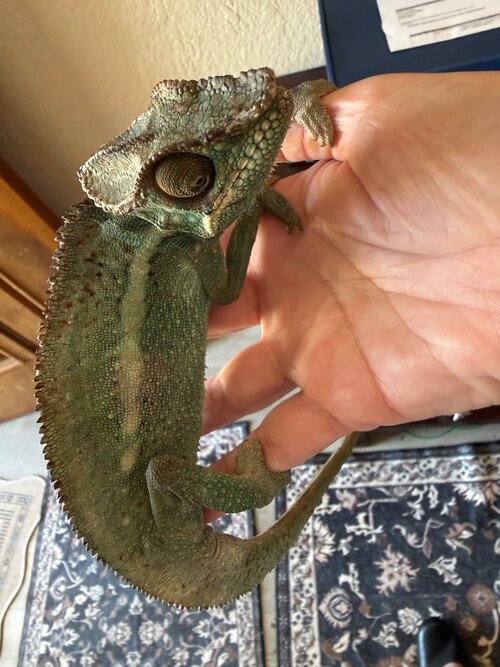
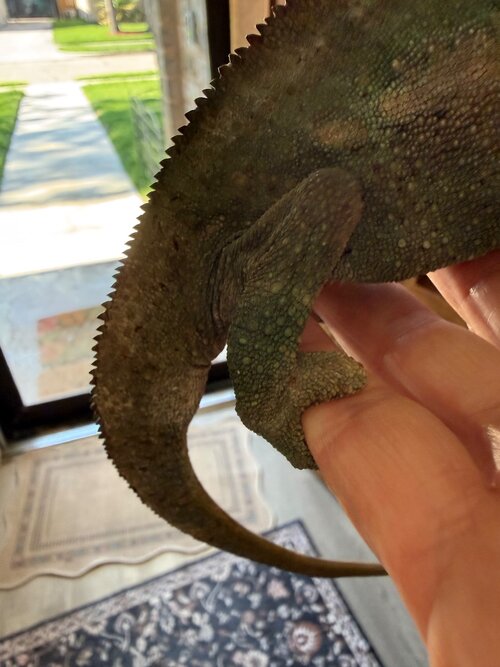
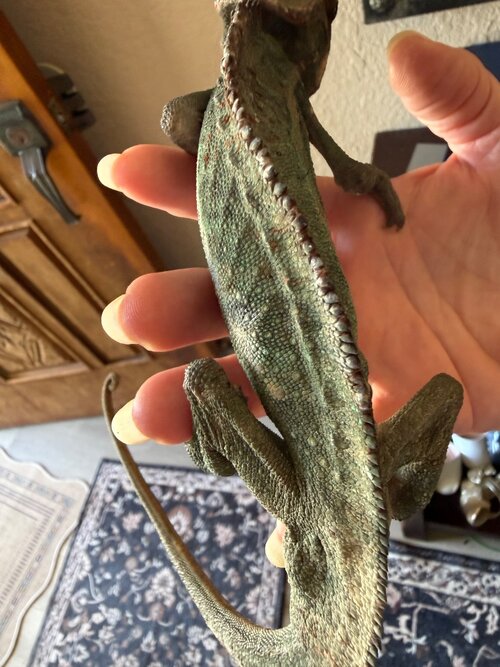
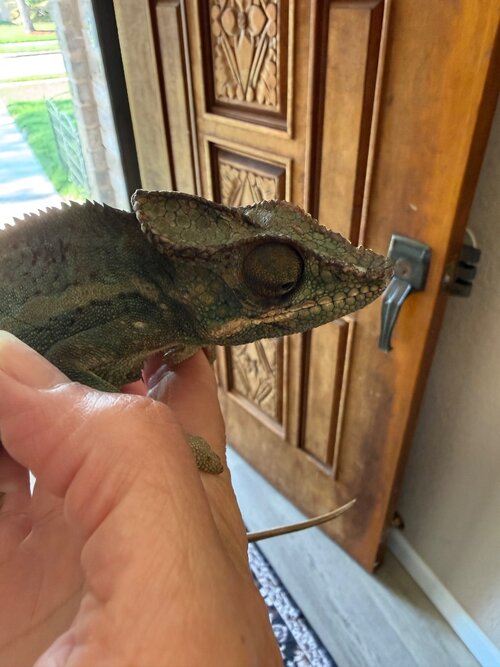
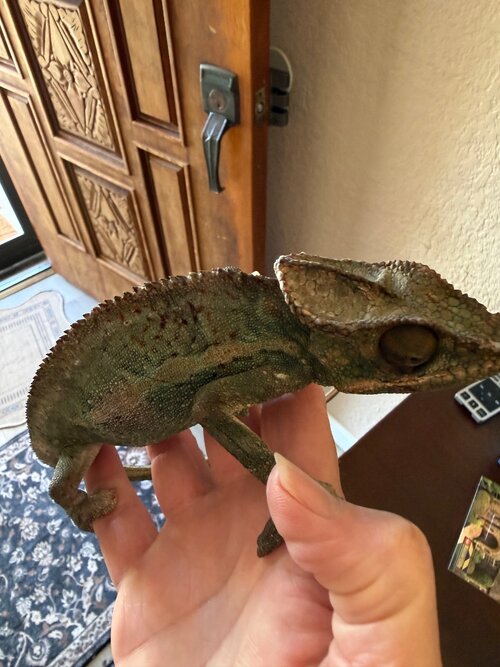
I’ve had my male panther for a year now and overall things have gone well. I got him when he was (supposedly) a year old from a breeder in Florida so he should now be 2. He’s been in great shape and vibrant until I asked the people at my reptile store if he would like flying prey, and they advised me on hatching BSFL. Oh my, he was JAZZED about having flying bugs in his enclosure and ate them preferentially over the usual dubias and crickets. I started to notice that he was looking a little skinnier but he was lively and enjoying the flies so I let that be his only food source most days (5-10 would hatch daily). Now I think he’s in big trouble. He lost his vibrant color but I chalked it up to thinking he might shed. I have his water set to drip daily while I’m at work so I haven’t observed him drinking in the last few weeks but his poops still have white urates. I am unable to spend the $500 on a fecal panel that the reptile vet quoted me about 10 months ago when he developed a respiratory infection (I didn’t know the difference between cold humidity and hot humidity but after adjusting his lights/misting and a round of antibiotics, he’s never had that problem again). I have Critical Carnivore being delivered tomorrow. He is slow and kind of clumsy with his tongue (new problem). His grip strength is still good and he doesn’t have bone problems. I faithfully gut-load crickets and dubias with daily Bug Burger and a salad mix that my reptile store makes, and dust them 1x/week with vitamin D and several times/week with calcium. His UV bulb tests good. I also offer silkworms, hornworms, and every once in awhile, wax worms. What do you recommend as far as turning this guy’s weight loss around? This is him today.

Navigation
Install the app
How to install the app on iOS
Follow along with the video below to see how to install our site as a web app on your home screen.
Note: This feature may not be available in some browsers.
More options
You are using an out of date browser. It may not display this or other websites correctly.
You should upgrade or use an alternative browser.
You should upgrade or use an alternative browser.
My Guy is in Trouble
- Thread starter Caeruleus
- Start date


MissSkittles
Chameleon Enthusiast


Hi and welcome. I’m sorry that your guy isn’t doing well. Under the circumstances, the best way to try to determine what may be happening is to do a full husbandry review. The bits you provided just aren’t enough info to go by. Copy and paste with your answers please. If you could include some pics of his enclosure, including lights and all, that is a huge help too.
Chameleon Info:
Cage Info:
Current Problem - The current problem you are concerned about.
--------------
Please Note:
Chameleon Info:
- Your Chameleon - The species, sex, and age of your chameleon. How long has it been in your care?
- Handling - How often do you handle your chameleon?
- Feeding - What are you feeding your cham? What amount? What is the schedule? How are you gut-loading your feeders?
- Supplements - What brand and type of calcium and vitamin products are you dusting your feeders with and what is the schedule?
- Watering - What kind of watering technique do you use? How often and how long to you mist? Do you see your chameleon drinking?
- Fecal Description - Briefly note colors and consistency from recent droppings. Has this chameleon ever been tested for parasites?
- History - Any previous information about your cham that might be useful to others when trying to help you.
Cage Info:
- Cage Type - Describe your cage (Glass, Screen, Combo?) What are the dimensions?
- Lighting - What brand, model, and types of lighting are you using? What is your daily lighting schedule?
- Temperature - What temp range have you created (cage floor to basking spot)? Lowest overnight temp? How do you measure these temps?
- Humidity - What are your humidity levels? How are you creating and maintaining these levels? What do you use to measure humidity?
- Plants - Are you using live plants? If so, what kind?
- Placement - Where is your cage located? Is it near any fans, air vents, or high traffic areas? At what height is the top of the cage relative to your room floor?
- Location - Where are you geographically located?
Current Problem - The current problem you are concerned about.
--------------
Please Note:
- The more details you provide the better and more accurate help you will receive.
- Photos can be very helpful.

Carlton
Chameleon Enthusiast


IMHO as a 2 year old, he was quite lean before you started feeding the flies. Look at the before photos showing his casque. It was concave, not full. Something was probably going on already. Be careful. Hoping to pin the "blame" on a new feeder is easy, but it's also simplistic...low hanging fruit.
Please flesh out more of your husbandry details.
Has he ever been tested for parasites? He could have a belly full that's been getting more out of his food than he has. What might be a tolerable parasite load can gain the upper hand on a host while it is fighting an infection (his previous RI). New and different food won't get rid of them. It will feed them. Now due to exhausted reserves, treatment may be harder on him. You may have fewer options that are safer.
Hard to imagine a fecal float would cost $500! What other testing did the vet recommend at that time? Unfortunately, so often it's a matter of pay now or pay later.
Here's hoping the experts here can help. Good luck with him, he's beautiful!
Please flesh out more of your husbandry details.
Has he ever been tested for parasites? He could have a belly full that's been getting more out of his food than he has. What might be a tolerable parasite load can gain the upper hand on a host while it is fighting an infection (his previous RI). New and different food won't get rid of them. It will feed them. Now due to exhausted reserves, treatment may be harder on him. You may have fewer options that are safer.
Hard to imagine a fecal float would cost $500! What other testing did the vet recommend at that time? Unfortunately, so often it's a matter of pay now or pay later.
Here's hoping the experts here can help. Good luck with him, he's beautiful!
Last edited:

Nal0114
Avid Member
I would take him to the vet get labs and a fecal done.I’ve had my male panther for a year now and overall things have gone well. I got him when he was (supposedly) a year old from a breeder in Florida so he should now be 2. He’s been in great shape and vibrant until I asked the people at my reptile store if he would like flying prey, and they advised me on hatching BSFL. Oh my, he was JAZZED about having flying bugs in his enclosure and ate them preferentially over the usual dubias and crickets. I started to notice that he was looking a little skinnier but he was lively and enjoying the flies so I let that be his only food source most days (5-10 would hatch daily). Now I think he’s in big trouble. He lost his vibrant color but I chalked it up to thinking he might shed. I have his water set to drip daily while I’m at work so I haven’t observed him drinking in the last few weeks but his poops still have white urates. I am unable to spend the $500 on a fecal panel that the reptile vet quoted me about 10 months ago when he developed a respiratory infection (I didn’t know the difference between cold humidity and hot humidity but after adjusting his lights/misting and a round of antibiotics, he’s never had that problem again). I have Critical Carnivore being delivered tomorrow. He is slow and kind of clumsy with his tongue (new problem). His grip strength is still good and he doesn’t have bone problems. I faithfully gut-load crickets and dubias with daily Bug Burger and a salad mix that my reptile store makes, and dust them 1x/week with vitamin D and several times/week with calcium. His UV bulb tests good. I also offer silkworms, hornworms, and every once in awhile, wax worms. What do you recommend as far as turning this guy’s weight loss around? This is him today.
MissSkittles
Chameleon Enthusiast
@Caeruleus you haven’t responded to any of us. I’m just wondering how your guy is faring? Have you taken him to a vet?
I have not compiled the complete husbandry details that you requested. The reptile vet will be in Wed through Sat this week. Hoping to catch a morning poo to take with me for the fecal float and that the problem is easily diagnosed and treatable. He drank today and was keenly following the BSF that hatched overnight, and I think I heard the sound of his tongue striking a couple of times today. He ignored the dubias, a wax worm covered in Critical Care Carnivore and a silkworm, but it was after I handled him. I didn’t have the heart to try to force feed him the CC Carnivore without knowing what’s going on with him. I don’t want to further stress ot hurt him.
MissSkittles
Chameleon Enthusiast
dust them 1x/week with vitamin D and several times/week with calcium
The main area I was curious about is your supplementation. You should be dusting lightly at every feeding with a phosphorus-free calcium without D3. Then, while there are different ways to provide them, he needs not just a calcium without D3, but also a multivitamin with both being given twice per month (or every other week if you prefer). The easiest way to do this is to use a combination product of multivitamin and D3. The two that we suggest is either Repashy calcium Plus Load or ReptiVite with D3. Both contain preformed vitamin A, which we know chameleons are able to utilize vs preformed vitamin A. So calcium every feeding except one feeding every other week or twice per month when you would use one of the combination multivitamin/D3 products.
Additionally, vitamin D3 is a fat soluble vitamin, meaning it isn’t excreted quickly and can build up to toxic levels. While I doubt that your guy has toxic D3 levels, he has been getting twice as much as he should.
As has already been said, parasites are always a concern and very suspect for your guy. Fecal checks are usually done in house and cost around $50-60 or so. They can send it out to a lab, but that should not cost anywhere close to $500. If they are adding basic blood work (CBC, CMP) to that, then I would expect a cost nearer to a few hundred $$.
I hope your vet can get it figured out and help get him recovered. Do keep us posted on how he’s doing. You can have all of your husbandry reviewed if you like - it never hurts to double check having everything correct. However, my main concern was supplements. My secondary is wondering how exactly you feed him.
Nal0114
Avid Member
My fingers are crossed for your little guy  .
.
Idk where you’re located so I know everywhere is different. When I sent labs out for my chameleon and snake it was about $250. I did pay for the most expensive panel as well. I am located in SE TN.
Some chameleons just don’t like some bugs. Like my boy won’t touch a superworm. I’d try something like hornworms. Idk what it is about them but reptiles go crazy.
. Idk where you’re located so I know everywhere is different. When I sent labs out for my chameleon and snake it was about $250. I did pay for the most expensive panel as well. I am located in SE TN.
Some chameleons just don’t like some bugs. Like my boy won’t touch a superworm. I’d try something like hornworms. Idk what it is about them but reptiles go crazy.


I made notes and took pics/screenshots of all the products I use and had Chat make these handy charts. The vet said that on a scale of 1-9, he’s at a 2-3. His weight was 88g at my house, 87g at the vet. She dx him with dehydration, poor body condition, potentially a bacterial infection (or more likely, he could develop one due to his weakened state since there were no visible signs of infection going on), and possibly anemia based on the pale color of his mouth. No injuries or deformities. She reviewed my husbandry notes and said his care is excellent. She used to be the reptile vet at the Houston Zoo if that gives her any cred so I’m comfortable with her assessment and plan. She gave him LR sub q, a vitamin D/A shot, and a shot of antibiotics. He wasn’t a good candidate yesterday for labwork and I was not able to bring a fecal sample but will be bringing that in for a fecal float once he produces a poop. She wanted me to inject dead mealworms with Critical Care Carnivore but I was unable to source any yesterday so I manually syringe-fed him 0.6 ml of CCC, gave him his oral 0.04 ml Baytril, and followed that with .3 ml of water. He was remarkably compliant. I took it really slowly of course. When I touched under his chin, he opened his mouth a bit in protest which gave me the opportunity to start administering the food, meds, and water. I just added a couple of drops each time he opened his mouth and didn’t force him. Then I put him on his basking branch and he crawled onto it and got comfy. I’ll repeat the antibiotic for the next 13 days and feed him twice daily. I restocked on little hornworms and wax worms just in case he gets interested again, and gave him a bowl of baby crickets. She said she’s very hopeful because reptiles seem to recover excellently so I’m banking on it! Once he recovers enough, I’ll consider the labwork. Thankfully the vet’s office is open 7 days a week so I can run the stool up there whenever he produces it. I’m certainly open to all expert advice at this point. Thank you 
MissSkittles
Chameleon Enthusiast
The only items in your husbandry that I see needing to be changed is that the Repashy LoD should be given just twice per month, or every other week. The vitamins A & D are both fat soluble and can build up, so we are cautious with using them.
The other is that running your Mist King for just 25 seconds isn’t nearly long enough. It should be run for two full minutes at least - once in the early AM and later in the evening before lights go off. This could account for dehydration. You could add silkworms to your staple feeders also to help maintain hydration and general good health.
While he’s on the Baytril, you most definitely want to make sure he’s kept well hydrated to help protect his kidneys from the medication. Giving him that extra bit of water after is great!
Do you know exactly what the pet store uses in their gutload? Do they use all organic, fresh, added supplements, etc? Is it a fresh moist mix, dried powder, gel?
Defintely take a fresh fecal to the vet as soon as you can get one. Even if that’s not his primary problem, if he does have any parasites, they will take advantage of his declined status and wreak havoc in his body.
Sending prayers and good vibes for thorough healing and return to optimal health.

The other is that running your Mist King for just 25 seconds isn’t nearly long enough. It should be run for two full minutes at least - once in the early AM and later in the evening before lights go off. This could account for dehydration. You could add silkworms to your staple feeders also to help maintain hydration and general good health.
While he’s on the Baytril, you most definitely want to make sure he’s kept well hydrated to help protect his kidneys from the medication. Giving him that extra bit of water after is great!
Do you know exactly what the pet store uses in their gutload? Do they use all organic, fresh, added supplements, etc? Is it a fresh moist mix, dried powder, gel?
Defintely take a fresh fecal to the vet as soon as you can get one. Even if that’s not his primary problem, if he does have any parasites, they will take advantage of his declined status and wreak havoc in his body.
Sending prayers and good vibes for thorough healing and return to optimal health.
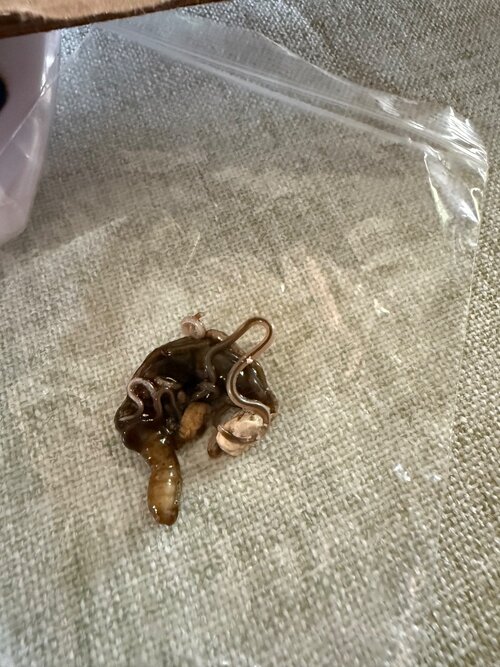
Hi all - well per my vet’s orders, I’ve been feeding my guy Critical Care Carnivore and waxworms. He has slowly improved a bit and his weight is now 100g. Two days ago, he ate 19 waxworms and yesterday he ate 8. Today when I was feeding him the CCC, he took a sizeable poop and it was full of living worms. His fecal float from 2 weeks ago showed a low (1-5) burden of nematodes, and she gave him a dose of dewormer with instructions to repeat after 2 weeks if necessary. I’m guessing when she sees this today at our appointment, she will give him another dose. My poor little dinosaur!!! The worms are very much alive and based on their black gut lines, are stealing his food. I’m curious, is it standard practice to give a periodic dewormer to our captive creatures?
Although slow, his recovery has been promising. He is now greenish, not grey, and while his tongue strength and coordination is definitely not back to normal, he laps up the wriggly waxworms from my hand held close to him. His grip strength is much better, and he bows up a little at me when he thinks I’m going to remove him from the enclosure. Before, he was entirely passive and had zero fight in him. Besides his daily 30-minute drip, I installed a Repti-Zoo continuous water fountain. I haven’t seen him drink from it but he does drink from his bowl during the daily deep drip.
What else can I do for him at this point? Thank you!!
Although slow, his recovery has been promising. He is now greenish, not grey, and while his tongue strength and coordination is definitely not back to normal, he laps up the wriggly waxworms from my hand held close to him. His grip strength is much better, and he bows up a little at me when he thinks I’m going to remove him from the enclosure. Before, he was entirely passive and had zero fight in him. Besides his daily 30-minute drip, I installed a Repti-Zoo continuous water fountain. I haven’t seen him drink from it but he does drink from his bowl during the daily deep drip.
What else can I do for him at this point? Thank you!!
Attachments
MissSkittles
Chameleon Enthusiast
OMG! I say to call your vet and show them the pic of the worms.

Motherlode Chameleon
Chameleon Enthusiast

I would go to your vet and get some type of de-wormer ASAP.
Best Regards
Jeremy A. Rich
Best Regards
Jeremy A. Rich
Carlton
Chameleon Enthusiast
In answer to your earlier question, yes, periodic parasite TESTING should be done on captive chams. It's part of routine health screening. Based on what TESTING reveals, treatment follows. And it may need to be repeated. Just a fact of life that parasites come along with an insectivore diet. A healthy cham with good body reserves can tolerate some parasites. They wouldn't survive the wild if they couldn't. The problem is a manageable parasite load can bloom and get the upper hand if the cham ends up with some other health problem. You've seen that firsthand.
Similar threads
- Replies
- 6
- Views
- 1K


- Replies
- 6
- Views
- 1K


- Replies
- 2
- Views
- 2K

- Replies
- 10
- Views
- 1K
