Back to give you a bit more info. Provided I don’t get called away by my job, I’ll give you a quick run down of husbandry basics for a female veiled.
Minimum enclosure size is 2x2x4’, or the equivalent of an XL ReptiBreeze.
Basking temp no higher than 80F. No heat needed at night provided temps are above around 60. Cool nights are desired.
Daytime humidity between 30-50%.
If temps at night are below at least 68F, you can run a fogger/humidifier and boost humidity all the way. (Adds to hydration status)
No daytime fogging - high heat plus high humidity greatly increases risks for respiratory infection.
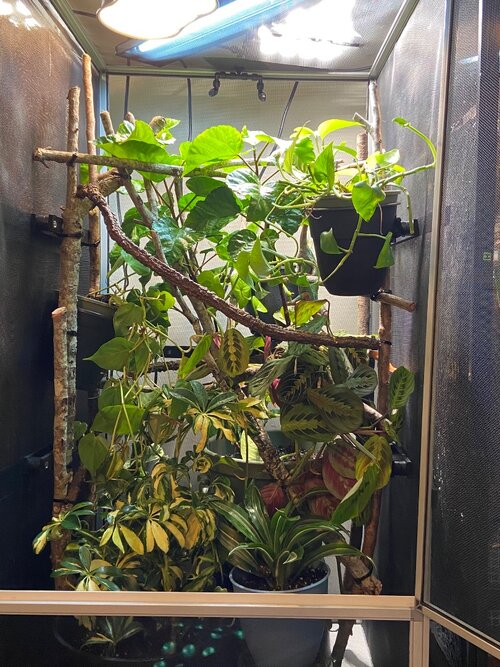
Provide plenty of little ‘roads’ for her with natural branches or vines. Varied diameter is best to fully exercise little mitten feet muscles.
Plenty of safe, clean and live plants. Our green girls from Yemen like to eat their plants. Fake plants pose a serious impaction hazard if eaten. Pothos is a must and keep propagating more from clippings.
Provide hydration thru misting/spraying water on the plant leaves for at least 2 minutes, twice a day - right before lights go on and off. If needed, can add additional 1 minute spraying mid day or use a dripper for 15-20 minutes.
Look to the urate (white part of poos) to determine hydration. All white/cream colored is perfect. Ok to have a bit of yellow or orange on one end, but if all yellow/orange, is sign of dehydration.
Always is best to have a fecal check for parasites. Vet visit required for this.
Feed a variety of live insects of appropriate size. If it’s larger than the space between her eyes, it’s too big.
Make sure to feed your bugs well. Healthy bugs are more nutritious for your cutie. Orange cubes and gel pots aren’t adequate.
She will produce eggs, regardless of if she’s even aware boys exist.
Don’t overfeed! The number of eggs she produces (when mature) directly relates to how much she is fed.
Read my blog on specifics related to egg production and laying.
https://www.chameleonforums.com/blogs/veiled-chameleon-laying-101.2488/
Our veiled ladies tend to be quite sassy, but you’ll still want to work on building and maintaining trust with her. Great blog on doing that here.
https://www.chameleonforums.com/blogs/building-trust-with-your-chameleon.2396/
Keep asking questions, keep learning.

Share your progress and pics often…we love seeing each other’s chameleons and it is truly wonderful to see how much new keepers grow.

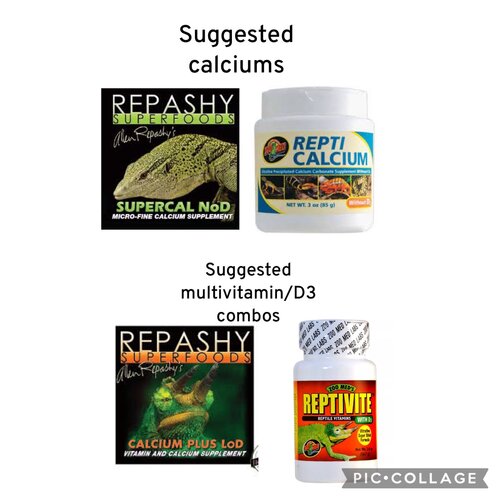
Here are some graphics that should help.
View attachment 368597View attachment 368598View attachment 368599View attachment 368601View attachment 368602


 (also she chooses to be that close to the light i can’t pry her off of there)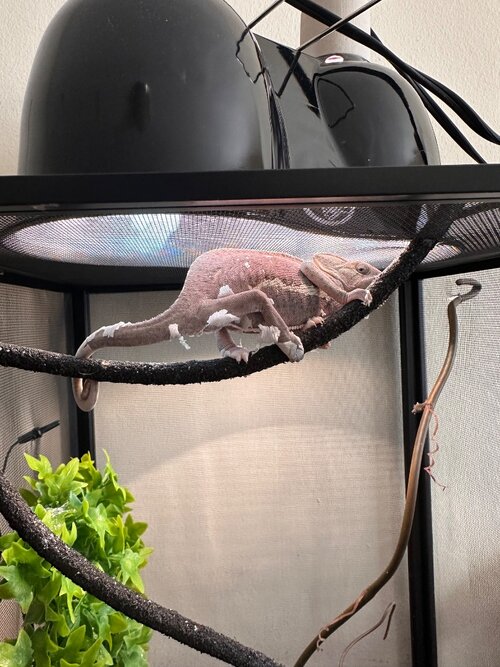


 I am going to guess that you have the ReptiBreeze chameleon kit…yes? To be the bearer of bad news, there is little that is actually useful for a chameleon in that kit and far too many people are tricked into buying it. Besides it’s many other issues, the biggest problem is the uvb is inadequate and the only way for your pretty girl to get any, is to be that close. Any farther away than just a few inches and there’s zero uvb. However, being so close puts her at very high risk for burns. The correct uvb is a T5 linear fixture with either an Arcadia 6% or ReptiSun 5.0 uvb bulb. Then she is able to have a basking area which is about 8-9” below the lights and is getting adequate uvb and almost zero risk for burns. This is the correct UVB fixture and comes with the first bulb (you would choose the 6% strength).