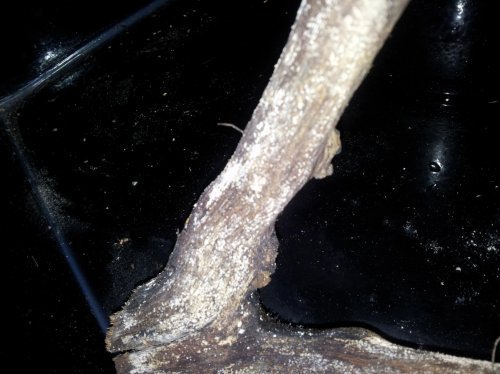
There is no answer for how bad mold is for chams. There are over 200,000 species of mold; a very small percentage of these have been studied for health affects in humans let alone chams. The primary risk in humans is immune response mediated (allergy/asthma) or, more rarely, pathogenic outcomes (infections). Other health effects are related to mold by-products which are debated. This is for humans, and humans are not reptiles.
My guess is that a little bit of mold will not be a problem. Mold is abundant in nature and a cham's exposure in its natural environment would be orders of magnitude higher than in a screen enclosure with a bit of rotting material. However, we don't know if the types of mold growing in an enclosure would be the same as those encountered naturally. Regardless, mold is not desirable and should be taken care of.
The solution is to simply get rid of the moldy wood (chuck it outside) - then prevent mold from growing in the future. Mold will grow whenever there is a carbon food source (wood, paper, cotton, dust, etc) and sufficient moisture. As a general rule of thumb mold can start growing in dead wood once it has been continuously wet for more than 48 hours. Don't let the bottom of the wood to sit in moisture. If possible elevate it slightly off the bottom cage to allow for moisture to drip off and promote drying.