
MissSkittles
Chameleon Enthusiast
Aww…happy hatch day King Jack.  I hope the hatch day fairy brought you some good yummies.
I hope the hatch day fairy brought you some good yummies. 
Follow along with the video below to see how to install our site as a web app on your home screen.
Note: This feature may not be available in some browsers.


 I hope the hatch day fairy brought you some good yummies.


Update to: The dreaded gnats...
I've mostly ridden the thrips, but a few still seem to thrive. I contacted the biological bug shop about further escalation, they provided the following:
Orius insidiosus is generally the stronger choice over Anystis baccarum for thrips in your high-humidity chameleon terrariums. Orius provides faster knockdown—up to 80% reduction in a few weeks—on both larvae and adults, addressing gaps where previous agents like Swirski mites and lacewings may have underperformed. Anystis baccarum works well long-term but is slower to act (around 40% initial reduction) and may struggle in high-moisture conditions (70–90% nighttime humidity) compared with the more resilient pirate bug.
Recommendation & Release Rates
For two terrariums measuring 2' x 2' x 4' (roughly equivalent to large greenhouse setups by volume):
- Orius insidiosus: Release 20–30 adults per terrarium (≈1 per sq. ft. surface area). Focus on early low-thrips-pressure timing to boost establishment. Repeat every 1–2 weeks if needed.
- Anystis baccarum: Skip unless Orius fails—effective but less suitable for moist, enclosed setups.
- Alternative/Complementary: Apply Steinernema feltiae nematodes in the soil/substrate at 1–5 million/m² to target pupae. This complements foliar predators without humidity issues.
Addressing Concerns
- Do Orius bite chameleons? They can bite humans (mild, temporary irritation). Their piercing mouthparts might probe a chameleon’s thin skin if stressed, but they are not aggressive toward reptiles and rarely cause issues in bioactive enclosures. Monitor first releases; if any disturbance occurs, switch to soil-only nematodes or predatory mites like Stratiolaelaps.
Usage Tips for Success
With this integrated approach, you can target the full thrips life cycle safely and expect effective control within 4–6 weeks with consistent management.
- Humidity: Reduce sprinkler volume or mist less frequently post-release. Aim for 60–80% RH to favor Orius survival.
- Shipping & Handling: cost approximately $60.00
- Boost Establishment: Provide supplemental food such as pollen. Avoid introducing new plants until predators are established.
So, I'll be trying Orius insidiosus to rid the rest. I'm also going to order Chinese praying mantis. Although; I'll be removing the chameleon from their cage, to enjoy their free roam areas, while I let the mantis roam in the chameleon cage for the day and removing them (mantis) back to their Cage for the next few days/nights. So as to keep them (cham and mantis) separate.
!!!Warning graphic content!!!
I'm a bit haunted by this video of a chameleon being attacked by a mantis.
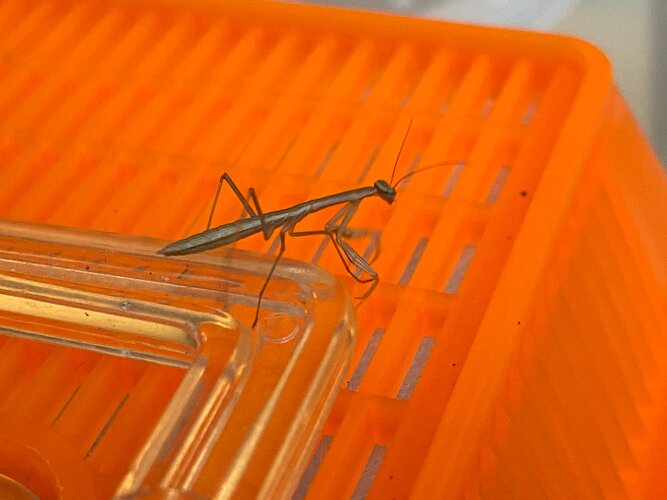
Oh yeah…the hatchlings are tiny and can’t do any damage to a chameleon. This was a Chinese mantis baby that I hatched sitting on top of a cricket keeper to give you an idea of size. It was actually smaller when it hatched. I don’t recall how many sheds it had gone thru at this time…it was a few years ago. 9 out of 10, your chams will find and eat the babies promptly. The babies seek higher ground almost immediately and you’ll see them climbing the enclosure sides. Cute little buggies.@MissSkittles this is my first experience with mantis. They're rare in Western Canada, and the only legal species is the Chinese praying mantis. I've ordered two egg sacks to hatch in a mesh laundry hamper, and thought of raising a few into adulthood. But, if I let hatchlings free into the enclosure, do you think the chams will be ok; from your experience?


I finally just took their container outside when feeding them, so that if any escaped they had a chance to survive. They are cute little buggers, but hard to corral.
Maybe I'll be able to bring my schefflera's back in!
I can see why these Orius bugs are nick named "pirate" bugs... They're all over the office, like fleas.  I see at least 2-4 on my screen/desk everyday. They don't seem to bite, like I thought they would, and the chams don't seem to mind them... at least?
From what I just read, if they start biting you, it means they’ve got little to no other food left and are just tasting you.
I see at least 2-4 on my screen/desk everyday. They don't seem to bite, like I thought they would, and the chams don't seem to mind them... at least?
From what I just read, if they start biting you, it means they’ve got little to no other food left and are just tasting you.
It’s blooming because Mr Jack has that Jackson’s magic.I haven't been able to get my Clivia miniata (bush lily), to bloom for six years. I thought I lost it completely in the pest battle..




 (he's trying to deflate, because he thinks the phone/camera might eat him.
  )
)

