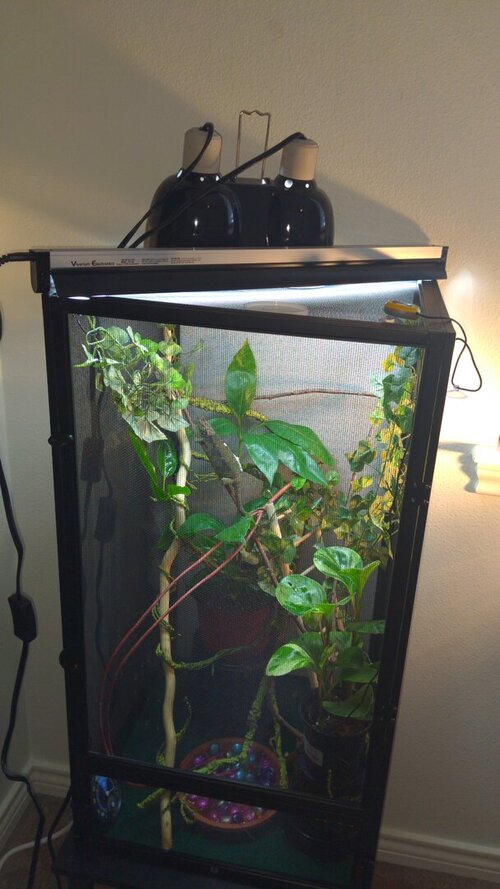
Chameleon Info:
- Your Chameleon - Female Jacksonii Jacksonii, unsure on age, she's been with us since Dec. 23, 2020
- Handling - Once/twice a week only if she steps out to us. Most handling takes place when we are cleaning cage. She was handled often at the feed store we bought her from.
- Feeding - crickets, waxworms, calciworms, gut loading with carrot slices and apples. ***She has not been eating regularly since a week after we brought her home. She's only eaten about 40 crickets and 5 waxworms in this time period.
- Supplements - What brand and type of calcium and vitamin products are you dusting your feeders with and what is the schedule? Repticalcium w/o Vit. D and Reptivite with Vit. D. ***I do not believe she was given supplements at the store, as they did not discuss this with me. She has not had much as far as supplements go since she isn't really eating regularly. However, my schedule is calcium dusting every feeding, and twice a month for the Reptivite.
- Watering - What kind of watering technique do you use? How often and how long to you mist? Do you see your chameleon drinking? She drinks from the dripper twice/day and gets hand misted 3-4x a day. I have not seen her drink from the misting, she prefers to drink from the dripper.
- Fecal Description - Briefly note colors and consistency from recent droppings. Has this chameleon ever been tested for parasites? Most recent are hard, dark poos with white urates. She has not been tested for parasites.
- History - Any previous information about your cham that might be useful to others when trying to help you. I was told she was a 3 month old male Jackson's. She was in the "kit" cage at the store no extra lighting, no dripper or mister and only the fogger on all day.
Cage Info:
- Cage Type - Describe your cage (Glass, Screen, Combo?) What are the dimensions? Medium sized screen cage from the kit.
- Lighting - What brand, model, and types of lighting are you using? What is your daily lighting schedule? The dome lighting from the kit and a 22" t5HO linear bulb for UVB. Basking bulb off to the side.
- Temperature - What temp range have you created (cage floor to basking spot)? Lowest overnight temp? How do you measure these temps? 68° to 78° during the day, 60°-65° during the night. Measured with a digital thermometer
- Humidity - What are your humidity levels? How are you creating and maintaining these levels? What do you use to measure humidity? 40-50% during the day, 70-100% at night, measured with analog dial
- Plants - Are you using live plants? If so, what kind? Live umbrella plant and peperomia, also fake ivy vine for coverage
- Placement - Where is your cage located? Is it near any fans, air vents, or high traffic areas? At what height is the top of the cage relative to your room floor? Cage is its own room upstairs next to a window. Not near a vent or fan, and not a high traffic area. Top of cage hits about 5'.
- Location - Where are you geographically located? Located in southwest Idaho.
Current Problem - The current problem you are concerned about.
She expelled two feti and a slug yesterday morning. Nothing since. She hasn't taken food for 8 days. She is drinking small amount of water in the morning. She is very stressed and dark. I'm scared she might be bound up inside. She was healthy looking and green 3 days ago. This happened very quickly.
--------------
Please Note:
- The more details you provide the better and more accurate help you will receive.
- Photos can be very helpful
So, I’ll go over your husbandry later this evening, but I’d like to offer what are admittedly intuitions/guesses. I am not a vet, and I have no scientific basis for this, other than my own reasoning.
1) Your female has too many young to support and is “making room”
2) Your female was not supplement Ed correctly before you got her, and this resulted in fetuses that are underdeveloped or otherwise no viable.
3) There is documentation of female xantholophus being able to hold on to their clutches until conditions are favourable for survival (see Tilbury in
The Chameleons of Africa: An Atlas...). Perhaps it could work the other way around too: if conditions seem unfavourable for the maturation of the fetuses, the female may expel them.
4) These could just be aberrant fetuses, and the rest might be ok.
5) Low level MBD and genetic problems resulting from a small gene pool has been noted for Hawaiian xantholophus. Both could be at issue.
I’d like to direct you to both The Chameleon Academy website:
https://chameleonacademy.com/trioceros-jacksonii-breeding-jacksons-chameleons/
And the following pages from Kaizenchameleons.com:
For better gutloading practices than you mention, see:
https://www.kaizenchameleons.com/gutloading
for information on feeders, see:
https://www.kaizenchameleons.com/feeder-insects
for species information on how I keep my xantholophus, see:
https://www.kaizenchameleons.com/about-3
For discussion of hydration techniques different from what you’re doing see:
https://www.kaizenchameleons.com/hydration
And for several different supplementation regimes, see:
https://www.kaizenchameleons.com/supplementation-schedules