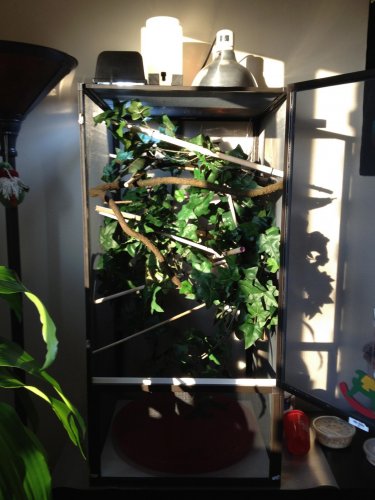
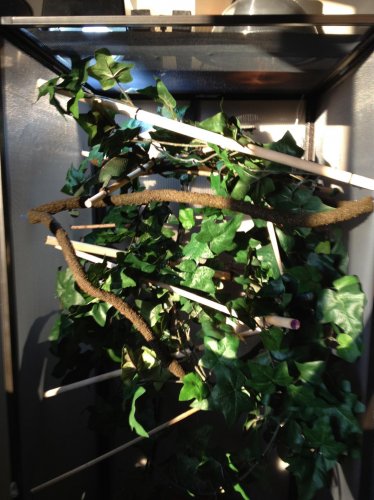
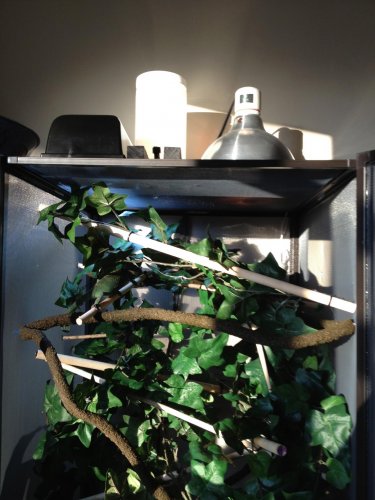
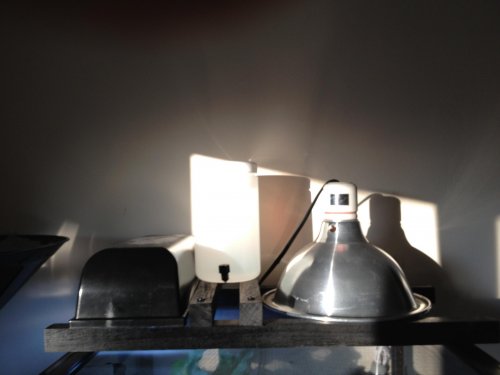
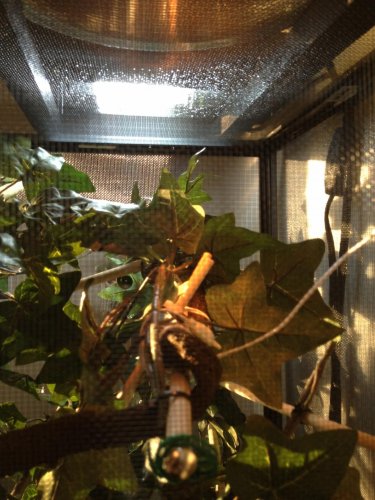
When a chameleon is outside, the temp can gradually change as it gets lower in the cage. if the light is so close to the cage, then its not going to change, and thus create the hot spot.
Really? In your yard the temperature at 6' off the ground is much warmer than 2' off the ground? In my yard it is the same. Shade and misters provide the the temperature gradient in my cages outside, not distance from the sun.
Indoors, if things are set up correctly, you can have your light right on the cage and still provide a suitable thermal gradient rather than a hot spot. I do.
For some lizards (not the arboreal species) I can even hang the lights inside the cage itself and still provide a thermal gradient. Multiple basking lights with varying wattages can also be strategically used to create a thermal gradient in some situations. The key is always the thermal gradient, not a simple hot spot.
I think in some ways we are similar in our approach (thermal gradient can also be created by raising a light off the cage, but it needs to be powerful enough to warm the area and not just a spot in order to create a thermal gradient). But different in our understanding of what is going on.
Therefore, due to breeding in captivity, they may nto be able to withstand the same temperatures as wild vields can.
I don't really think so- millions of years of adaptation to match the needs of the animal to that harsh environment are unlikely to be undone too far in 20 years of captive breeding. And do you think I only use chameleons descended from my original stock which have adapted to my conditions or do you realize that I must buy new bloodlines regularly from other breeders over the years which would be presumably kept slightly different from my own?
Its not the temperature that can cause a burn, its the intensity of the light from a heat source.
So sunlight which is the most intense light heat source compared to any light bulb should cause lots of burns on wild chameleons... Of course this is not correct but why then? Because the heat penetrates to the core of the lizard- it's core warms before it's surface burns. A hot (or warm) spot and cold cage can cause burns because a light bulb is exactly less intense and so the heat does not penetrate deeply quickly- the lizard burns it's surface while trying to warm it's core.
Think about it, if you stick your arm in the oven, but dotn touch anything, do you get burned? no.But if you touch one of those racks, you do.
Yes- if the chameleon touches the metal and it has been super heated enough to burn, it will burn. Is it probable that this chameleon pressed it's back against the metal mesh and burned without burning his head somehow?
And if that is the case- the cause would be a need to move the branch away from the top so the poor chameleon can fit without pressing his back against the mesh when basking...
If you put your arm in an oven to warm yourself for more than a few minutes in an oven- say several hours a day- you can burn. What if you had to climb inside or be chilled and somehow a fan pulled all the heat up and out of the oven so you had to choose to go into the oven to try and get yourself warm or leave the oven to go outside and be cold? What if your brain, immune system, tongue function, digestive system, etc were all linked to your ability to be warm? You would choose the oven sometimes and burn if you were a chameleon. That is what happens to your lizard if you have a small warm spot and a cool rest of the cage. I am saying turn up the oven so the lizard can stand near the oven at distances it chooses if it wants to warm and isn't forced to climb inside to find any heat. This is what happens in nature - often sunlight will cook them if they cannot move away when they want, but they can still use the ambient warmth from the sunlight...
Cage size only slightly effects this unless the cage is extremely undersized. I create thermal gradients for babies in the smallest reptariums with temps covering the full range from about 70 to about 100...
I suggested lowering the temp and raising the light to reduce the heat output on the mesh or whatever he can touch that could have heated up and caused the burns.
I think your advice for what to do now is good and have no disagreement.
In some ways we are similar in our thinking (raising the light could create a thermal gradient), but not our understanding of exactly how the environment may have caused the problem.
IMO it probably wasn't the basking temperature, but how it was provided without the creation of a true thermal gradient so the lizard wasn't forced to use the hot spot long enough to burn itself.
)not trying to sound harsh, just stating my opinion.)
Reply With Quote
Me too. And not saying anything about the success of your approach.