Hey, I’ve had this chameleon for about 5 days. Every time that I most his cage he runs and hides. He seems very skidish. I am wondering if there is any way that I can gain his trust or be able to get him out of his cage way easier, I tried tonight and I put my hand under the leaf he was on, unfortunately he swiftly walked away from me. Please help, I would like to handle my chameleon one day. I understand that they are delicate and fragile, but please help

Navigation
Install the app
How to install the app on iOS
Follow along with the video below to see how to install our site as a web app on your home screen.
Note: This feature may not be available in some browsers.
More options
You are using an out of date browser. It may not display this or other websites correctly.
You should upgrade or use an alternative browser.
You should upgrade or use an alternative browser.
Handling
- Thread starter Flacon67
- Start date

CamoChameleonsHuman
Chameleon Enthusiast
Most chams don't want to be handled and we need to respect that.

Rst_Cham
Chameleon Enthusiast
Hi, many chameleons really don't care for being held, unfortunately! But some do learn to tolerate it. Have you listened to any of the chameleon breeder podcasts yet? There are about 100 episodes and cover a huge range of chameleon topics, episode 80 in season 3 covers handling: https://www.chameleonbreeder.com/archive-season-3/
I would wait a few weeks before trying handling again, they need to settle in.
I would wait a few weeks before trying handling again, they need to settle in.


snitz427
Chameleon Enthusiast


Try hand feeding to interract with your cham. He may still hide, but if you are slow, patient, and steady, he wont be able to resist the food for long!
It is going to take your guy a long time to feel safe around you and his new home. Think of it like a kidnapping. He doesnt know who you are, where he is, or what you are going to do to him. Probably pretty scared whenever you come close! Give it time and keep offering food in your palm and slowly he’ll start coming towards your hand for food instead of running from it.
He may never warm up to being held. My girl hates being picked up but she will eagerly come near for food. My little boy is pretty adventourous now that he is comfy!
It is going to take your guy a long time to feel safe around you and his new home. Think of it like a kidnapping. He doesnt know who you are, where he is, or what you are going to do to him. Probably pretty scared whenever you come close! Give it time and keep offering food in your palm and slowly he’ll start coming towards your hand for food instead of running from it.
He may never warm up to being held. My girl hates being picked up but she will eagerly come near for food. My little boy is pretty adventourous now that he is comfy!
Try hand feeding to interract with your cham. He may still hide, but if you are slow, patient, and steady, he wont be able to resist the food for long!
It is going to take your guy a long time to feel safe around you and his new home. Think of it like a kidnapping. He doesnt know who you are, where he is, or what you are going to do to him. Probably pretty scared whenever you come close! Give it time and keep offering food in your palm and slowly he’ll start coming towards your hand for food instead of running from it.
He may never warm up to being held. My girl hates being picked up but she will eagerly come near for food. My little boy is pretty adventourous now that he is comfy!
Ok... I’ll try it. But would the cricket not jump out of my hand?Ok thanks!
Ok, so I’ll start tommorow, so if the chameleon is hiding behind some of the foliage, he should come right out and see the cricket being held by the butt, right?You can hold the cricket by the butt... but crickets gross me out. I hand feed BSFL, hornworms, silkworms etc. anything slow and squishy! superworms I put on a little BSFL lid in my palm (because they also gross me out).
snitz427
Chameleon Enthusiast
He might not take it the first 20 times you try it... and he probably wont come out. Instead shooting his tongue to eat it from his hiding spot. That’s ok! You need to very slowly build his trust... hold the cricket as still as you can for as long as you can. If he doesnt take it, try again tomorrow.
But dont just reach in and grab him if he comes out for food. You need to do this for a few weeks ... and you need to let him settle in on his own.
But dont just reach in and grab him if he comes out for food. You need to do this for a few weeks ... and you need to let him settle in on his own.
Ok thanks a lot. Snitz you have been very helpful for me and my chameleon, thanks a lotHe might not take it the first 20 times you try it... and he probably wont come out. Instead shooting his tongue to eat it from his hiding spot. That’s ok! You need to very slowly build his trust... hold the cricket as still as you can for as long as you can. If he doesnt take it, try again tomorrow.
But dont just reach in and grab him if he comes out for food. You need to do this for a few weeks ... and you need to let him settle in on his own.
Food + basic psychology.
Chameleons are naturally very skittish. When you read about their natural environment, it all becomes quite clear really. They grow fast for a reasons and they are very aware of you being there for a reason. They see us as predators, by default. When fall comes in Yemen, the protective foliage is gone. Large percentage of them are picked off by other predators. Those that survive, have first dibs on females that hatch the next season. It's a very harsh existence.
Never try to grab them from above. Hell will break loose.
If he shows aggression when you approach, do not retreat. Be calm and stay put, unless you believe you will be bitten. Only retreat once he is calm again. Hand feed his favorite snacks and make those snacks ONLY available by hand feeding. If he doesn't bite, do not leave the food behind. Eventually you'll figure out which treats he likes best. Next, slowly move up the treat from your hand up your arm, so he eventually has to step on your hand to get to it.
Be very very very very very patient. Never try to force him. That's taking two steps back. I've made that mistake. It's counter productive. Eventually after weeks, maybe even months, he will be on your hand and will join you without much stress. Once he is outside, same rules apply. Take your time. If he shows signs of stress, keep him with you and be calm until he is calm. Only put a calm chameleon back in his cage. The logic is simple. If he gets all huffy and puffy and you retreat or return him to his cage, you will reinforce this behavior. Next time, he'll think that if he gets all worked up, it will work again and you'll be gone. Instead, if you "reward" him by retreating only when he is calm, he will eventually realize that being calm gets him what he wants. Of course, at that point, he may start to "enjoy" which is really more like tolerate you.
It's all about trust. Trust takes a long time to build up.
Chameleons are naturally very skittish. When you read about their natural environment, it all becomes quite clear really. They grow fast for a reasons and they are very aware of you being there for a reason. They see us as predators, by default. When fall comes in Yemen, the protective foliage is gone. Large percentage of them are picked off by other predators. Those that survive, have first dibs on females that hatch the next season. It's a very harsh existence.
Never try to grab them from above. Hell will break loose.
If he shows aggression when you approach, do not retreat. Be calm and stay put, unless you believe you will be bitten. Only retreat once he is calm again. Hand feed his favorite snacks and make those snacks ONLY available by hand feeding. If he doesn't bite, do not leave the food behind. Eventually you'll figure out which treats he likes best. Next, slowly move up the treat from your hand up your arm, so he eventually has to step on your hand to get to it.
Be very very very very very patient. Never try to force him. That's taking two steps back. I've made that mistake. It's counter productive. Eventually after weeks, maybe even months, he will be on your hand and will join you without much stress. Once he is outside, same rules apply. Take your time. If he shows signs of stress, keep him with you and be calm until he is calm. Only put a calm chameleon back in his cage. The logic is simple. If he gets all huffy and puffy and you retreat or return him to his cage, you will reinforce this behavior. Next time, he'll think that if he gets all worked up, it will work again and you'll be gone. Instead, if you "reward" him by retreating only when he is calm, he will eventually realize that being calm gets him what he wants. Of course, at that point, he may start to "enjoy" which is really more like tolerate you.
It's all about trust. Trust takes a long time to build up.

Thehippie
Chameleon Enthusiast
no squishy for me, i'd rather the cricket!!!You can hold the cricket by the butt... but crickets gross me out. I hand feed BSFL, hornworms, silkworms etc. anything slow and squishy! superworms I put on a little BSFL lid in my palm (because they also gross me out).
OP, its best to gain their trust over a long period of time. like @iMi said
It only works on like a thread, I tried but it then put a http on itthere should be a little picture button, click it, it will say drop image or click here and click there then insert your picture from your gallery
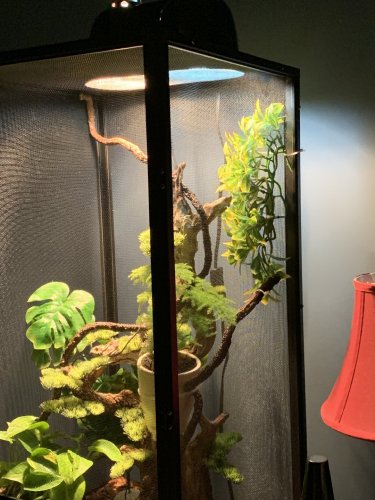
So about handling. How should I even hand feed it if when I open the cage. He will run away. There is one spot where he runs. And it will sit there until I leave. I put in some crickets but it still won’t even get them. I tried to come in slowly and slowly open the cage, he than ran. I then just went and sprayed the enclosure and put a cricket in.
As u see he is sitting there
As u see he is sitting there
Similar threads

- Replies
- 2
- Views
- 595


- Replies
- 2
- Views
- 467


