Great idea Carlton!
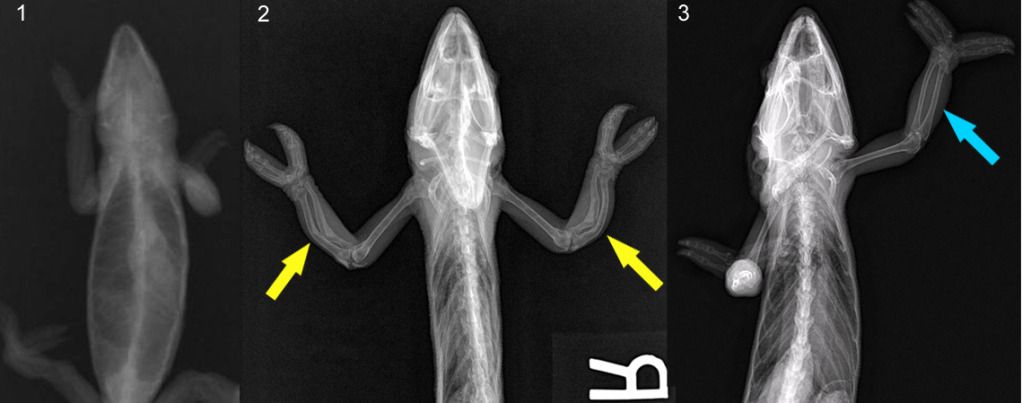
#1: Chameleon with MBD resulting in poor bone density.
#2: Chameleon with good bone density but residual damage from MBD when he was young.
#3: Normal chameleon skeleton with good bone density.
The deformities on George are indicated by the yellow arrows, where the bones are deformed and partially collapsed. Compare this to the blue arrow on #3 - that is what the arm bones are supposed to look like: straight and apart.
One of the biggest problems with MBD is the loss of calcium in the bone because it is being stripped away for various other bodily processes, such as muscle movement. This results in weak bones and on x-rays results in bones that are hardly visible. Things that are white on x-rays are mineral, like calcium in bones. When that is missing the bones do not show up very well on x-rays. If you look at the skulls of the three chameleons it is apparent how much better you can see every bone in #2 and 3. Also take a look at the arms of #1. How many toe bones can you count? I cannot even see any bones at all in the left arm, and in the right I still can't tell you how many there are. It is hard to see any of the vertebral bones and even the ribs are hard to count. The bones should look like #2 and #3 where you can see all of them with good detail and be able to count them. Lack of proper bone density is a classic indicator of calcium deficiency, and can quickly lead to pathologic fractures where the bones are so weak that they break just under the weight of the chameleon. While some x-rays can turn out poorly due to technique and can be improved by enhancing certain settings on the x-ray machine, in a case of MBD you will not be able to make the bones show up any better regardless of technique because the mineral to make them show up is simply not there.