First time owner questions!

rajon1080

New Member
I'm a first time chameleon owner and I've just gotten a 2 1/2 m.o panther chameleon. I have a few questions I hope some of you guys can help me with.

1. I work in banking, which pretty much defines business hours. I know he should be fed early so that he can have plenty of time to digest in warmer daytime temps. The problem is that I'm having trouble monitoring how much he is eating while I'm at work. I'm thinking of doing one of those feeder bottles made from those sunny d containters or something. If I were to do that, how efficient are those things at retaining the crickets so i know he's eaten them and they havn't just jumped out? Also how much should an 11 m/o panther be eating? Im seeing a wide range of answers to that question in my research I'm giving him quarter inch crickets...

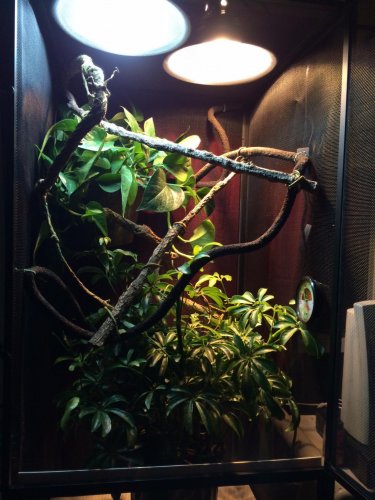
2. Secondly, I have him in an 18x18x36 repti-breeze cage. I have a dripper running constantly from the top of the cage and I mist him usually 3 times a day. Can anyone advise on a good drainage system at the bottom to avoid mold? Even if there was some sort of plastic pan/tray that would fit that size cage i could drill a hole in the bottom and use a palstic tube to drain, but that's all I've got. Anyone have any ideas?

3. I've uploaded a picture of my setup if anyone has any other advice or imput ; )


cage.jpg
 
I'm also a new owner, and I work during the day. I'm cup feeding, using a plastic cup fit through a ring that clamps onto one of his sticks. I bought the hoop/cup at the pet store, sold as a bird food or water cup. I took out the shallow bowl that came with it, and I use an plastic empty sour cream container that fits nicely in the ring. It's about 4" deep - crickets or other feeders can't climb the sides, and it's too tall for them to jump out. I can see when I get home if he ate the dozen crickets I put in there in the morning (usually they're all gone).
 
The crickets will stay in the trap for the most part, unless they're disturbed. For example, if your cham shoots his tongue out to get one and hits the trap, the others may freak out and jump out. To prevent them from jumping out, I rip off their back, jumping legs. To do this, just grab the cricket's back leg at the fat part (thigh part) and squeeze/squish it. It should fall right off. If it doesn't fall off right away, give the cricket a little shake while squishing the leg. Without their back legs, they can't jump, so all they can do it climb out of the trap. They're not able to climb out of smooth glass/plastic/acrylic so they should stay in the trap.

I'm assuming you're planning on using something like this:
http://i1.ytimg.com/vi/T1acx7nkCLg/hqdefault.jpg

Once you rip their back legs off, you can actually put them in a shallow dish, since they won't be able to jump out. Secure the dish to a plant or something.
This is a great cup:
http://www.amazon.com/Dexas-GKC1-383-Klip-Kup-Green/dp/B00843547O

And here is what one of the reputable breeders recommends for feeding/supplementing. Make sure you're properly gut loading!


Babies/Juveniles: We feed our baby/juvenile Panthers 6 days a week (excluding Sundays).

Babies: Young ones grow very rapidly and will often eat 8-12 crickets a day (quantities vary depending on individual appetites). For little ones up to 6 weeks old, we recommend crickets that are about 7 days old ( 1/8 " size). In addition to crickets, flightless fruit flies are another excellent food source.
Supplements: I do not supplement at this age.

Juveniles: From 2 - 12 months of age, your chameleon will obviously graduate to larger crickets with the key being the width of the cricket no larger than the space between your chameleons eyes. During these critical months of development, they will continue to consume an average of 8 -12 crickets, often slowing down their intake once they are over a year old. We don’t use crickets larger than 3/4” (even with our adults) because by then, the cricket’s stomach size is fully matured and holds the same amount of food that the adult cricket does. Remember that its not the cricket itself that is providing the valuable nutrition required for optimum health, but what’s inside the cricket. A properly stuffed cricket with healthy food is called “Gut Loading” That’s why a good cricket gutload is SO important! Cricket food used by cricket breeders isn’t adequate. We highly recommend Repashy’s “Bug Burger” as an excellent cricket diet along with dark greens such as mustard or turnip greens. You can also find various gut load products/recipes on the internet.
Supplements: I use Sticky Tongue’s Miner-Al indoor formula 4x/week and Reptical Calcium with NO D3 2x/week. 2x/month in place of the Miner-Al I use Reptical Herptivite. Use Miner-Al outdoor formula when your chameleons are outdoors.

Adult Males: From 13 months on, we feed our adult males on an "every other day" basis. They generally consume 12-15 per feeding. At this stage of life, they are no longer experiencing rapid growth and don't require food on a daily basis. It isn’t unusual for an adult male to go off food for a week or more.
Supplements: Miner-Al 1x/week, calcium with NO D3 all other feedings. Use Herpivite in place of calcium with no D3 2x/month. Use Miner-Al outdoor formula or calcium with NO D3 when your chameleons are outdoors.

Adult Females: For mature and actively breeding females, we maintain a 6 day feeding schedule due to the high demands associated with egg production. For non-breeding females, we feed on an every other day basis just as we do with the males.
Supplements: Miner-Al 2x/week, calcium with NO D3 all other feeding. Use Herpivite in place of calcium with no D3 2x/month. Use Miner-Al outdoor formula or calcium with NO D3 when your chameleons are outdoors.
 
Back
Top Bottom