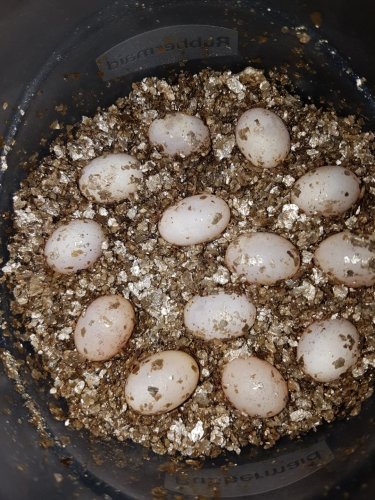
@Joseph 1233 From the look of the photo, everything looks far, far too wet. The eggs should not be shiny unless newly laid and still wet. I would make a new container with fresh vermiculite mixture for them.
I use equal parts
by weight of vermiculite and water. This is how I calculate the amount of water to add to any given amount of vermiculite. Write the weights on paper so you don't forget the weights.

1. Weigh the container;
2. Add vermiculite and weigh again;
3. Subtract the weight of the container from the total weight of the container plus the vermiculite. This gives you the weight of the vermiculite.
4. Now add the same weight of water as the vermiculite weighs to the vermiculite, mix really well.
Carefully transfer eggs into new container. I use a ziplock container without any holes. They get fresh air when I open and look at the eggs. Keep handling the eggs to a minimum and make sure your hands are really clean or you wear gloves. You don't want to damage the surface or introduce new bacteria/fungi to the eggs. When the eggs are laid, there is a thin liquid film that quickly dries that you want to keep intact. This film (it's called "bloom" in poultry eggs) has antibacterial/antifungal properties. Be very careful to keep the eggs in exactly the same orientation as they have been in the old box, i.e. keep the top of the egg stays at the top in the new box. You can mark carefully with a pencil but don't damage the surface of the egg as it has a protective coating on it.
C = weight of container
V = weight of vermiculite AND it also equals the weight of the water
T = total weight of container plus vermiculite plus water
T= C + V + V