Dark spot on my Veiled chameleons back.

mrskullface

New Member
So I all of a sudden noticed this on my chameleons back. I assumed it was him falling off his ficus tree after i got him a way bigger cage. I wanted to be safe and take care of it if it's something more serious. Is he going to die? Sorry if he looks so mad in the pictures but he HATES cameras, i dont know how he knows when i have it, but he will do anything to avoid it without even flashes, the camera is his enemy.

also what other vitamins and whatnot should i be looking into and how much, I get almost too much info regarding a ton of stuff to give him all being different. what do you think.

ohnoesq.jpg

ohnoes2.jpg

ohnoes3.jpg


Chameleon Info:

* Your Chameleon - Veiled, male, about a year and a 2 months. Been in my care forever.
* Handling - Never
* Feeding - live crickets, 10 every 2 days. Gut loading them with the green jelly squares.
* rep cal calcium with d3 once a month
* Watering - misting with distilled water 3 times a day
* Fecal Description - white and brown


Cage Info:

* Cage Type - screen and its about 4 feet tall, pretty big.
* Lighting - a red heat light for the night, a uv florescent bulb for sunlight and a basking light to get the cage about 80ish degrees F.
* Temperature - 60-70 night and 70-85 day
* Humidity - 70-80
* Plants - Ficus
* Placement - low traffic area, not in direct sunlight against wall with no heaters or anything.
* Location - san jose cali.


Current Problem - dark spot on his back.
 
that to ME doesnt look good. I am wondering if thats a burn mark? is that possible? I would suggest taking him into a herp vet ASAP!

I might be mistaken but i've personally never seen something like that!

I don't know as much about veiled's but I am pretty sure if that humidity is consistant its to high.
Also I don't believe you need heat lamp at night unless its cold and judging you live in nor cal I would say your fine.

what kinds of lights are you using? (brand and watts)

I am pretty sure you should use D3 once a week and use more suppliments every feeding...

I would sugguest a better gut load diet too.

There are other members that know ALOT more about these then I do and I would listen to them, I might be a tad off on some of my advise but that marking doesnt look good and I would assume they will tell you to take em to a herp vet asap as well.

Hope this helps
 
he has severe MBD and that black spot is a burn.

lose the light at night...

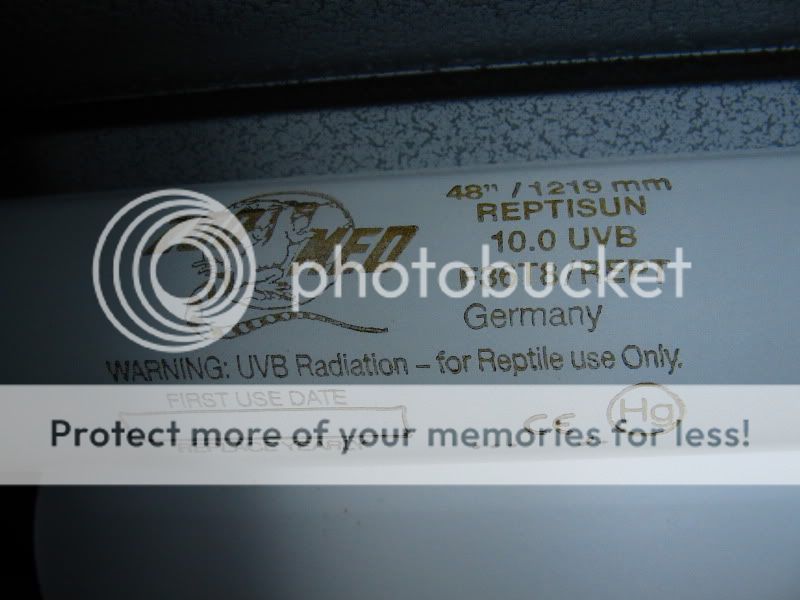
what kind of UV light? what brand? Is there plastic between the lamp and the cham? UVB does not transmit through plastic or glass. it MUST be removed if there is any.

He needs to see a vet soon so you can get treatment for the MBD. the vet can give you liquid calcium drops.

You need to supplement D3 in the diet.

Check out the raising kitty site.
 
Last edited:
the bulb i have for basking is a 50 watt zoo med. It was the lowest one cause it gets sorta humid in my apt. Its also off to the side at the top of the cage giving him a ton of space for non direct lighting and sticks under a bunch of the ficus leaves for shade. He's always a foot at least form the bulb, maybe even about 1.5 feet from the bulb at all times unless it gets pretty cold in the apt or int he shade. During the night time it has dropped to about 50s to where im freaking freezing and its even colder where the chameleon is, that's why i got a heat lamp, that is also not directly on him all the time.

I also have a UVA/UVB florescent light that runs the whole length of the top of the cage.


can it be even with area of shade and a temp of 90 max being really close to the bulb they can be stupid enough to not move and let themselves burn?
 
If it is cold and then the light comes on he will move o light for heat. if his body is cold he will stay regardless of how hot hisback is.... getting below 50 is pretty cold..... if you need to provide heat at night you should use a ceramic heater, not a light bulb. if the room drops below 50, turn the heat on.


what type of UVB are you giving him? he has MBD issues. this is very very bad. his legs can break. he needs to see a vet about the MBD.
 
I dont have the box for the light anymore: [ I will check out the local petstore to see what one i have.

is there a proper way to bring him to the vet without breaking every bone in his body? and at this point will be be damaged for ever?

and for the bulb do i need to lift it even higher? i have a thermometer in the cage and it always reads about 75-80 f.
 
I dont have the box for the light anymore: [ I will check out the local petstore to see what one i have.

is there a proper way to bring him to the vet without breaking every bone in his body? and at this point will be be damaged for ever?

and for the bulb do i need to lift it even higher? i have a thermometer in the cage and it always reads about 75-80 f.

The lamp should say the type on the tube.

This is what the zoo med looks like:

IMG_9857.jpg


What kind of temp guage? is it digital? Go to Lowe's and check in the garden center. they have a nice temp and humidity gauge fro 16 dollars. place the 'outside' probe in the basking spot to get an idea of the temp.

as for moving him..... don't pull him off of a branch. get him to walk out onto you and place him in a shoe box with padding. leave the box in the dark for a bit so he falls asleep... be sure the box is covered, but don't let it get hot. don't force him to do anything because that could cause his legs to break if they are still weak. just handle with care.

You need to address the husbandry issues. can you take pics of the setup and post them?
 
right after i took these pic i let my friend borrow my camera, i will get the pics tomorrow.

as for the light i dont have the info on the bulb, maybe the guy sold me a weaker one, i got my set up at the san jose herp convention and assumed he knew what he was selling me, maybe the transfer to the larger cage the light i have may not be enough i satisfy his uv needs. what is the recommended uv light for a a 90 inch tall cage.

and i do not have a digital gauge but will get one asap, i have a sticker one and a metal one.

i will rush to get all these things taken cared of!
 
he has severe MBD and that black spot is a burn.

lose the light at night...

what kind of UV light? what brand? Is there plastic between the lamp and the cham? UVB does not transmit through plastic or glass. it MUST be removed if there is any.

He needs to see a vet soon so you can get treatment for the MBD. the vet can give you liquid calcium drops.

You need to supplement D3 in the diet.

Check out the raising kitty site.

MBD how can you tell?
 
You said..."rep cal calcium with d3 once a month"...is what you do for supplementing...the chameleon needs to have the insects dusted with a phos.-free calcium powder at most feedings since insects usually have a poor ratio of calcium to phos.

If the chameleon has been getting proper UVB but no calcium I would expect that this is why it has MBD....but I'm not a vet.

A vet will be able to test the calcium levels, give the chameleon injections of calcium until the blood calcium levels are high enough to give it a shot of calcitonin. Your chameleon will be left with the bends in its arm and may have other permanent damage as a result of the MBD...but if its lucky it will go on to live a long life if you get it treated right away.

IMHO, you need to improve your gutload/feeding of the insects too. I give a wide variety of greens (dandelions, kale, collards, endive, escarole, etc.) and veggies (carrots, squash, sweet potato, sweet red pepper, zucchini, celery leaves, etc.).

Roa asked how you can tell its MBD...the crooked arms is the easiest way to tell. The casque is short too. Also, mrskullface said that the only supplementing did not include calcium at most feedings.
 
I agree-that certainly looks like a burn to me. Without a good digital thermometer or temp gum, you really have no idea how hot the bulbs are. He does have MBD. If you do in fact have a UVB bulb-it may be old-they need to be changed every 6-9 months and should have no plastic cover between the bulb and the cage. (Many fixtures come with a plastic cover-just remove it.) A Vet can treat the burn and give him a calcium booster. Once you start giving him calcium and proper supplementation at every feeding, he should be able to go on living a decent life. Gutloading is also very important as stated above. Welcome to the forums-we are happy to help you and your chameleon. You have come to the right place!
 
i love this place, i wish this wasn't the reason for my first visit. but I and especially my chameleon appreciates every ounce of help you guys gave.

so things to do:

-Vet visit
-new uvb lights ( i do assume mine are old and too small after the cage change from the smaller one to the bigger one)
-calcium dusting way more often
-variety in veggies for gut loading
-digital thermometer
-get ceramic heater for cold nights
-raise the light some assuming that it is in fact too close for him to get to and burn himself with.
 
i love this place, i wish this wasn't the reason for my first visit. but I and especially my chameleon appreciates every ounce of help you guys gave.

so things to do:

-Vet visit
-new uvb lights ( i do assume mine are old and too small after the cage change from the smaller one to the bigger one)
-calcium dusting way more often
-variety in veggies for gut loading
-digital thermometer
-get ceramic heater for cold nights
-raise the light some assuming that it is in fact too close for him to get to and burn himself with.

It's not that he's "stupid" enough to burn himself, but the fact that most herps don't have too many pain sensors in their skin to detect burning until the damage is done. It seems ironic, but true. Our artificial heat sources produce a focused beam of heat unlike the sun in the wild that warms the whole animal at once. The chill meant he ended up spending too much time directly under the heat trying to warm up and toasted himself. If your room gets down to 50 F at night you can use a non-light emitting heat source to keep the cage a bit warmer (heating pad, low watt ceramic heat emitter, or wrap the cage in a blanket on colder nights). What you do want is about a 10 degree drop in temp from day to night. There is a chance it is actually some sort of skin infection rather than a burn, but you would probably be seeing some swelling, reddened borders, or oozing on the discolored patch. I vote for a burn. He will probably lose the tissue in that area as it may be necrotic. A vet can give you Silvadene cream to apply to keep it moist and free of infection until the remaining tissue heals.
 
come to think of it, i think its the night heat bulb, its a 50 watt as well and he sleeps right next to it, hrmm maybe thats it.
 
I used to have to use a ceramic heater for night time heating and it worked well. I had it raised about 6" from the top of the cage and it was clipped on a slant to eliminate any type of direct basking. All you really want to do is heat the air in the cage not the cham. There supposed to naturally cool down at night, just not that cool. Its also important to dust with calcium W/O D3, calcium W/ D3, and a multivitamin. Set your dusting on a set schedule and rotate the multivitamin & calcium w/ d3. For example
WEEK 1:
Sun- off
Mon- cal
Tue- off
Wed- cal w/ d3
Thur- off
Fri- cal
Sat- off
and week 2 being the same just multivitamin replaces the cal w/ d3 Then just repeat!

doesnt have to be that exact way but something like it.

Once hes back to good health proper dusting and gut loading will def help him live a nice (camera hating) life :)
 
You said..."rep cal calcium with d3 once a month"...is what you do for supplementing...the chameleon needs to have the insects dusted with a phos.-free calcium powder at most feedings since insects usually have a poor ratio of calcium to phos.

If the chameleon has been getting proper UVB but no calcium I would expect that this is why it has MBD....but I'm not a vet.

A vet will be able to test the calcium levels, give the chameleon injections of calcium until the blood calcium levels are high enough to give it a shot of calcitonin. Your chameleon will be left with the bends in its arm and may have other permanent damage as a result of the MBD...but if its lucky it will go on to live a long life if you get it treated right away.

IMHO, you need to improve your gutload/feeding of the insects too. I give a wide variety of greens (dandelions, kale, collards, endive, escarole, etc.) and veggies (carrots, squash, sweet potato, sweet red pepper, zucchini, celery leaves, etc.).

Roa asked how you can tell its MBD...the crooked arms is the easiest way to tell. The casque is short too. Also, mrskullface said that the only supplementing did not include calcium at most feedings.


Thx for the very sufficient answer:)
 
The lamp should say the type on the tube.

This is what the zoo med looks like:

IMG_9857.jpg


What kind of temp guage? is it digital? Go to Lowe's and check in the garden center. they have a nice temp and humidity gauge fro 16 dollars. place the 'outside' probe in the basking spot to get an idea of the temp.

as for moving him..... don't pull him off of a branch. get him to walk out onto you and place him in a shoe box with padding. leave the box in the dark for a bit so he falls asleep... be sure the box is covered, but don't let it get hot. don't force him to do anything because that could cause his legs to break if they are still weak. just handle with care.

You need to address the husbandry issues. can you take pics of the setup and post them?

doesnt it has to be 5.0 ?
 
the 5.0 is preferred but if all you can find is a 10.0 it will do. the 10.0 is more the desert climate type UVA/UVB setup. The 5.0 is supposed to be for tropical climate uv levels, but i have used both in the past and have not seen any differences really.
 
Back
Top Bottom