My feedback and any questions will be in red. I‘ll also post helpful links and images at the end.
* my chameleon is 10 months old, he is a male veiled chameleon, we have had him since he was 2 months old.
* handling at least once a day
Are you forcing him to or does he want to come out of his enclosure because he genuinely wants to (and not because the enclosure makes him uncomfortable)? How do you handle him? How long is he usually out of his cage? Do you take him outside? If so, for how long (it could change your D3 supplement schedule)?
* I feed Nolan 3-4 large crickets and 5-6 wax worms daily, he also eats on occasion Dubai roaches, hornworms, strawberries, watermelon, spinach, calci-worms, and mango. He eats at around 9 am daily, and again around 6pm (food is available until bedtime). Gutloading crickets with orange crickets cubes, as well as lettuce, spinach, and carrots.
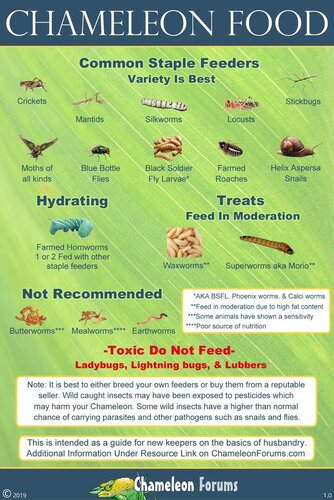
He needs insects only! No fruits or vegetables! He also only needs 2-3 appropriately sized (and properly gutloaded and supplemented) feeders every 2-3 days, as he is an adult. No feeding at night, just in the morning! Waxworms should only be used as treats and hornworms as treats and for a hydration boost. He should have a big variety of “staple” feeders. Though there should be no staples, just the healthier types of insects. Stop using the orange cubes ASAP, they hold no nutritional value, along with the spinach! Your gutload needs more variety and healthier options. Please read over the gutload and feeder charts I’m posting below.
* Using calcium powder daily when feeding, and vitamin D3 powder once every 2 weeks, as well as a vitamin supplement monthly.
Does your calcium powder contain phosphorus or D3? What brands are your supplements? A phosphorus-and-D3-free quality calcium powder should be used every feeding, except for when using other supplements. A multivitamin with D3 should be used once every two weeks. Stop the additional monthly vitamin supplement, only the multivitamin with D3 is needed. Does your multivitamin with D3 have pre-formed Vitamin A in it?
* we have a zoo med dripper for water and use a hand held mister for hydration but are upgrading to a mister within the next month. We mist the tank 3-4 times daily for about 2-3 mins. each time. The dripper goes all day until bedtime. I have only seen him drink a handful of times but he’s urates are white and I hand feed him water every other day about 1ml or until he stops drinking.
If your humidity allows it, only mist in the morning and late afternoon/night when the cage is cooler. How do you hand feed him water? Their airways are the front of their mouths, so you have to be extremely careful!
* he’s urates are white and normal. He urates daily, and poops about every other day. He has been tested for parasites and came back clear.
How many samples were checked, and how long ago was it?
* my chameleon was given to us in poor condition over the months that we had him he developed a calcium deficiency and broke his two front legs with heavy rehab he recovered in 8 weeks.
Does your vet have good, reputable chameleon experience? Did you ever do (anymore if you already have) bloodwork or x-rays? Is his grip nice and strong or does he still have issues?
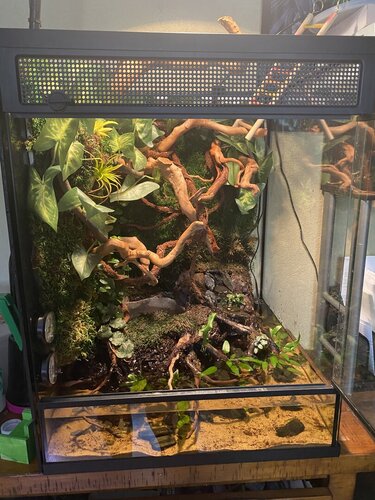
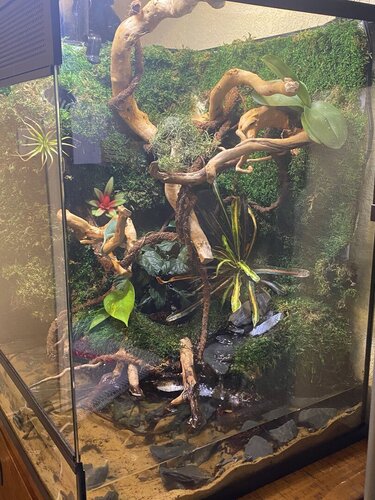
* he has a 36x24 exo terra cage
While that cage is pretty, it is not functional for him. The cage is actually a Thrive 18” x 18” x 24” tall terrarium. He needs (depending on his health), a minimum cage size of 2’ x 2’ x 4‘ tall, but preferably 4’ x 2’ x 4’ tall or bigger. Bigger is always better! Could you post recent pics of his cage from after the redo?
*he has a 9-9 schedule, we have a uvb bulb with a dual component that also works as a heat lamp, we also have an extra heat lamp due to the current cold weather, and a ceramic lamp at night to keep temperatures moderate. his lights are 7inches from the closest basking branch. His day time temps are 80-95 (80 at the bottom and 95 at the highest branch for basking), night time temps are 70-75 usually 72. To measure humidity and temperature we have a thermometer and a humidity checker in the cage mid way between the top and bottom.
He needs a linear T5 High Output fixture with a matching size linear UVB bulb ASAP! The compact coil UVB bulbs can hurt chameleons’ eyes and don’t provide the correct amounts of UVB! The fixture should be at least the length of whatever bigger enclosure size you get for him or a foot longer. The linear UVB bulb needs to be either an Arcadia 6% (general rule is to replace it once a year or sooner) or a Zoo Med 5.0 (general rule is to replace it 6-9 months or sooner). Make sure to hang the fixture the correct length away from his basking branch (as his enclosure is too short for that strength to be resting on the top of his cage)! Get a Solarmeter 6.5 UVI meter to make sure his basking levels are appropriate and to check/know when to replace his linear UVB bulbs, if you can afford it. Is his basking heat bulb a mercury vapor bulb or a blue or red reptile bulb or something else? He needs a regular white light household incandescent bulb for his heat bulb. It should be a minimum of 7-9” away from is casque. You’ll have to play around with the wattages to get the correct one. His basking temps are WAY TOO HIGH! It should be 80-85*F (85*F as the max)! His ambient temps (temps near the bottom of his cage) should be no higher than 75*F. Preferably low 70’s. Stop using the ceramic heat emitter ASAP! Chameleons prefer a temp drop at night, and veileds can comfortably handle as cold as the mid-fifties. What type(s) of thermometer(s) do you use? You need a minimum of one (if not more) digital thermometer with probe, the probe hanging where his casque/top of his back is when he’s on his basking branch, possibly a digital infrared temp gun to spot check areas, and digital thermometer-hygrometer combos to measure ambient temps and humidity levels.
* he’s humidity at night runs about 75% and 40% during the day, To measure humidity and temperature we have a thermometer and a humidity checker in the cage mid way between the top and bottom.
What type of hygrometer do you use? Humidity levels are good.
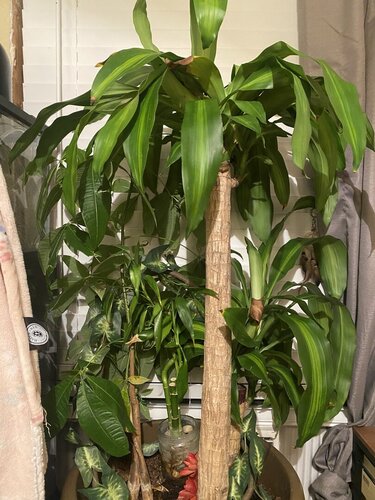
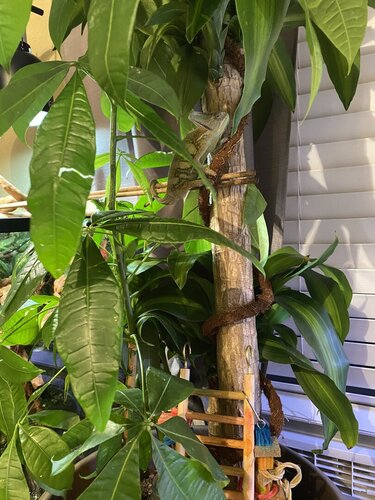
* his old enclosure had a mixture of fake and live plants but his new one now has only real plants. We have a ficus tree, dracenas, bromeliads, bird’s nest, pothos, and fern.
Could you please post an updated picture of his cage? Great job on taking out all fake plants! Did you take out the fake vines with leaves on them, too? How did you clean off his live plants? Did you cover the soil in the plant pots with rocks too big for him to eat, as well? Make sure all plants you use are chameleon safe!
* it is located on a desk next to the window. The height of the enclosure to the floor is about 3 feet.
Can he see his reflection in either the window or his current cage? Is the window energy efficient or does it let in heat and cold?
* I live in south texas.
Current problem:
His tail is not curling completely and I’m afraid it may be fractured after a recent fall, he is also on his 3rd of no food but is drinking.
Please take him to an experienced chameleon vet ASAP! Make sure to do everything I listed in your chameleon history section! Three days of no food is fine.
Here are the links and images:
https://chameleonacademy.com/veiled-chameleon-care/
https://chameleonacademy.com/chameleon-husbandry-program-getting-started-with-chameleons/
https://www.chameleons.info/en/
(link no longer valid)
https://www.chameleonforums.com/care/external-resources/