Care Questions about New WC Import

jajeanpierre

Chameleon Enthusiast
I'm buying a Trioceros q. quadricornis that arrived in the US from Cameroon (or Equitorial Guinea--wherever the "farm" was) around December 18th.

I'll be bringing him home as soon as I have my new cage set up this week.

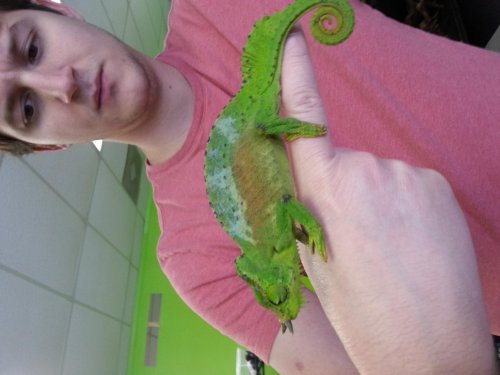
The importer has one picked for me, chosen for a variety of reasons. He was chosen basically because he seems to have a lot of red color to him and his horns are really nice. Plus, of course, he's doing very well. Today I had a quick peak at him.

As a wild caught he is a little banged up. He has black marks on his knees and elbows and black dots down his spine. I think all the black dots I see on him are little injuries.

The store owner/importer said he is eating very well, and thinks he is ready to come home as soon as I get his new cage all set up. (I'm expecting it to any day now.)

How do I treat those little injuries?

Should I take him to the vet soon after I get him? I'm hesitant to take him simply because he's had enough scary/stressful things happen to him in the last three weeks. A vet visit unless absolutely necessary might be the wrong thing to do. (My vet is an hour's drive away.) On the other hand, if those injuries need treatment, then I should get him in.

I didn't really look him over very carefully.

I will get a stool sample in right away.

I think I've managed to attach a picture I took of him on my phone in the store, and hopefully, it will show up.

Advice please. Thanks.

20141228_133331.jpg
 
I have seen a number of the animals from that import. I also have one.

The bumps and bruises will go away over about 3 sheds. No need for the vet.

The entire import is , as expected, loaded with adult parasites. You can either take my word for it or go do your own fecal. Give the animal a small drop of Panacur once every two weeks for three doses. I'm sharing this since this load is a heavy one (I've seen plenty of shipments over the years) and a heavy load can't be ignored. Make sure you always handle and care for your imports dead last if you have a collection. Wash your hands well. Make sure this animal and any waste from it doesn't come into contact with any other reptiles.

My animal ate the first day I set her up, ate well the next day. A little Panacur on her first food item got her dosed with no extra stress. Yours looks like I would expect it to. Give it a week inside a nice cage with lots of shelter for it to hide in. After about a week start getting it some unfiltered sunlight for a few hours a week in total. Be careful to not over supplement him since he's never had supplements. I like to gut feed the food items fresh veggies for imports.

These are not farm raised btw. Can tell that just by looking at them
 
Thanks so much.

I spoke to someone else in California who also has a bunch from this same group--maybe the person who set up the cooperative breeding group in California? I think the ones you got in California were quite a bit older than my little guy. Bill warned me about the parasite load, too.

As soon as his cage arrives from DragonStrand, I'll set it up and pick him up from the store. Hopefully he is home before New Years.

Are there any airborne pathogens I need to worry about? I do understand quarantine protocols--I've shown poultry before. The store owner (who imported these quads) said there wasn't any airborne diseases to worry about. I had intended to quarantine him in another room in the house, but would much rather have him in my office where I can keep an eye on him and enjoy him. I don't have a valuable collection to worry about, just two veileds.

I've bought two fairly big and bushy umbrella trees for him. He'll have a solid mass of greenery from floor to ceiling of his new cage. I bought him the large breeder DragonStrand cage, so it should be really easy to keep it clean since I'll be dealing with a heavy parasite load. I'll cover the plant's soil with paper towels so his stool never gets into the soil. I have a spare large Reptibreeze that I can use to get him outside. I usually have lots of warm and sunny days between cold fronts during the winter. I'm just worried about stressing an already stressed (and wormy) little chameleon.

I do have some Panacur, but if it is a really heavy parasite load, do I need a vet to monitor this?

Thanks for your advice. This guy is my first foray with wild caughts, so I need all the advice I can get.


I have seen a number of the animals from that import. I also have one.

The bumps and bruises will go away over about 3 sheds. No need for the vet.

The entire import is , as expected, loaded with adult parasites. You can either take my word for it or go do your own fecal. Give the animal a small drop of Panacur once every two weeks for three doses. I'm sharing this since this load is a heavy one (I've seen plenty of shipments over the years) and a heavy load can't be ignored. Make sure you always handle and care for your imports dead last if you have a collection. Wash your hands well. Make sure this animal and any waste from it doesn't come into contact with any other reptiles.

My animal ate the first day I set her up, ate well the next day. A little Panacur on her first food item got her dosed with no extra stress. Yours looks like I would expect it to. Give it a week inside a nice cage with lots of shelter for it to hide in. After about a week start getting it some unfiltered sunlight for a few hours a week in total. Be careful to not over supplement him since he's never had supplements. I like to gut feed the food items fresh veggies for imports.

These are not farm raised btw. Can tell that just by looking at them
 
if he's being treated with Panacur you should be fine. The Herp vet we had out here who did the fecal prescribed it. I personally don't like to use two meds (Flagyl and Panacur) at the same time on a fresh import. I offer that since I've been asked what I personally do.

Keep it hydrated. That and plenty of cover. Do those things and you have as good a chance with the import as I do. I see in the picture he is missing some body weight. Try and get him some silkworms or waxworms since those tend to be a bit fatty but even crickets that are gut fed fresh veggies will do.

Good luck.
 
Back
Top Bottom