
Boycotting crickets!

Good sources on how to actually breed the roaches and the silk worms.

I have a Reptile Expo coming up at the end of the week, and, will have a chance to purchase some feeders and hopefully will start my own roaches and silk worms. I want to move away from the crickets.
Roaches are super easy to breed. Get more females than males. Put them in a decently sized bin with slick sides (so they can’t climb out), add ventilation screening to the bin. They do best in a bioactive set up - organic soil mix with some small isopods and springtails, leaf litter and cork half rounds for them to climb and hide under. (They are shy). Keep them at least 90F and in a few months you’ll see itty bitty bebes hiding in the soil. Periodically mist some soil for the isopods who need some humidity to breathe.
Silkworms are a bit more of a challenge, but doable if you are patient and stubborn. You can start with either some eggs to hatch (you’ll need plenty of chow mix for raising them). Keep them somewhat warm - around at least 75-80 of indirect heat. A little humidity seems to help too. Check daily - is best to use a magnifier as the bebes are super tiny. Once you see the first Bebe, get to making some chow. For babies, I make it only 1/4 lb at a time. Provide them fresh tiny bits of food at least daily. It dries out fast and they can’t eat it then.
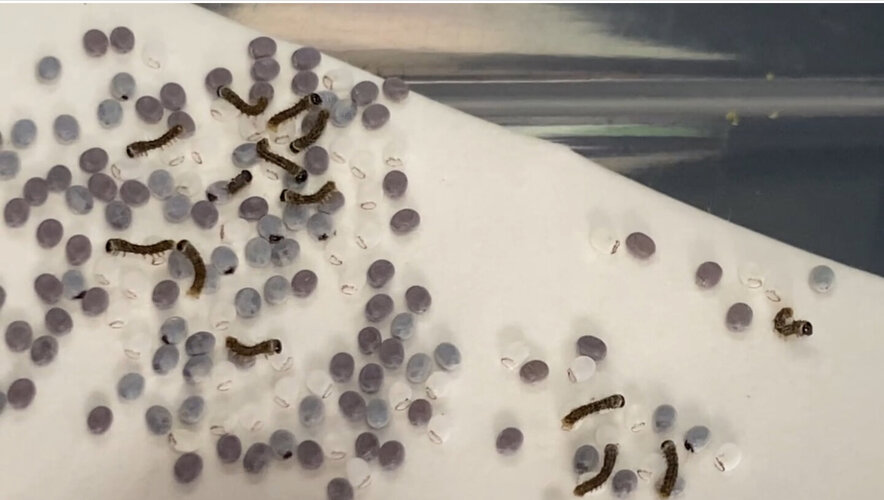
So itty bitty! 🤗 I don’t know why but the babies make me so happy.
IMG_0053.jpeg
I gave them far too much food here. I will place fresh food right next to the old dried out to make sure they find it. They aren’t the smartest of critters.
IMG_6311.jpeg
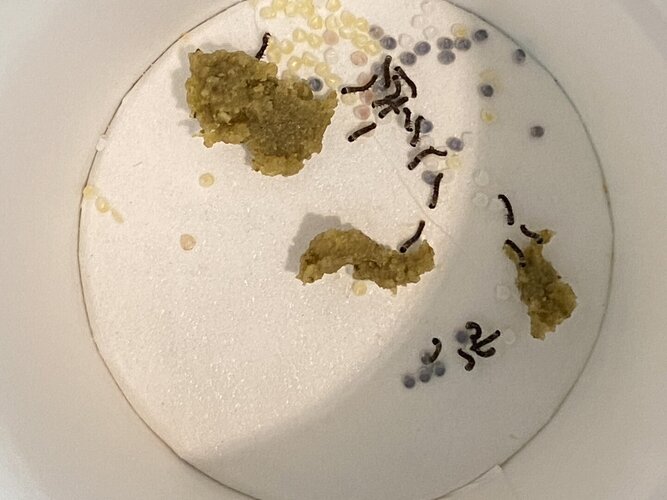
While they do grow pretty quickly, it does take about 2-3 weeks or more for them to reach feeding size. I feed them similarly like this, in separate little areas. Makes it easier to place fresh food in there. The less you move or touch them, the better. These are zebra morph. They can be a bit hardier. Not always available.
IMG_3415.jpeg

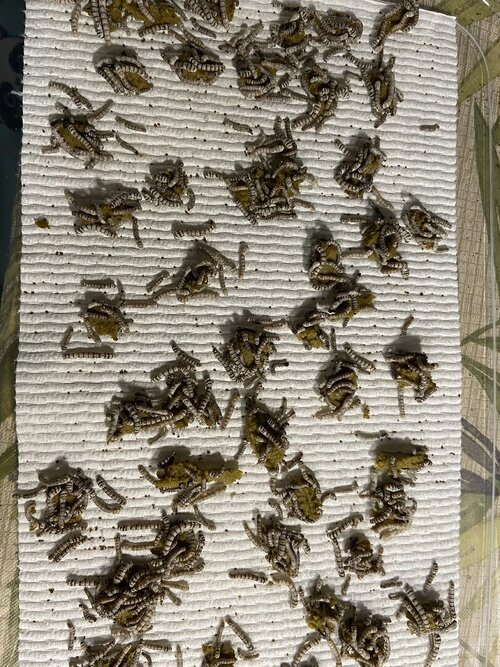
I think they’re kind of cute…for bugs.
IMG_3417.jpeg
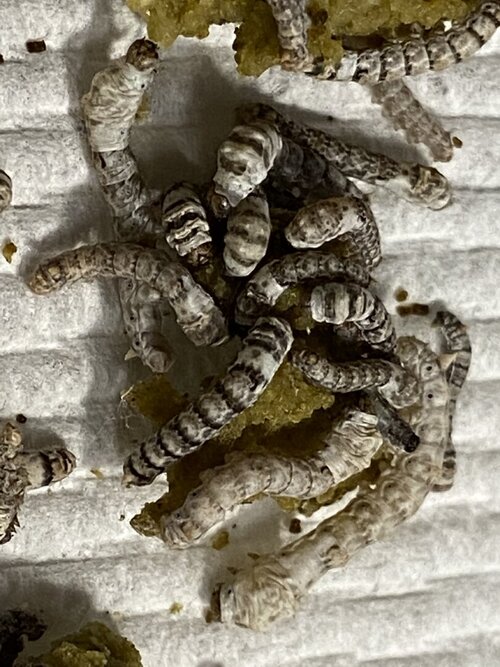
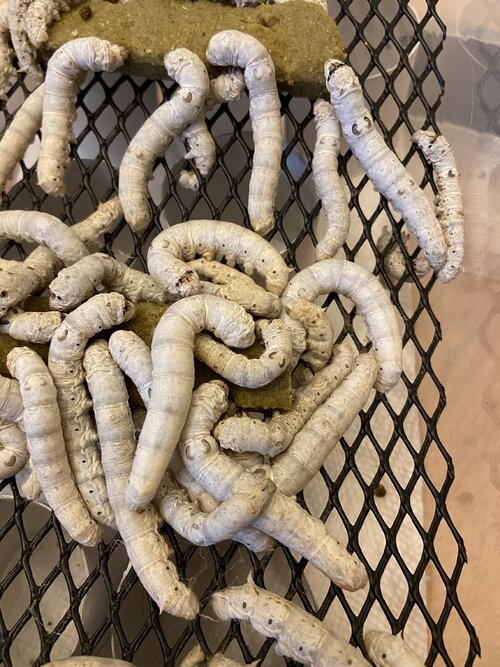
These are when they become eating machines and work on getting fat and bloated.
IMG_2675.jpeg
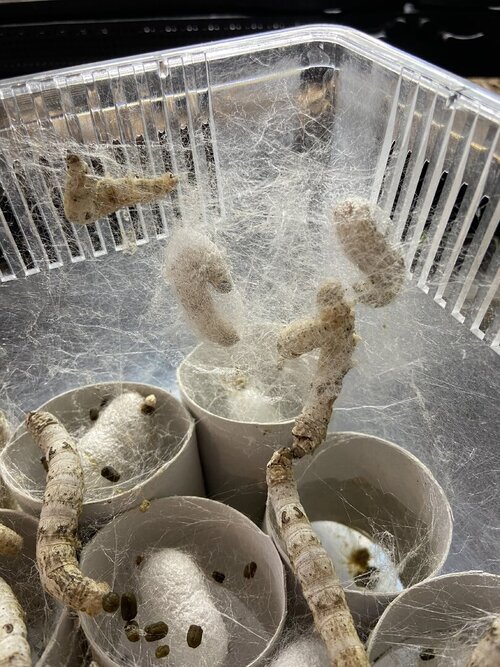
Once fat enough, they stop eating, purge (vomit) and then start spinning their cocoon. Best not to disturb them. They only have a limited amount of silk. I give them toilet paper tubes cut in half.
IMG_5326.jpeg
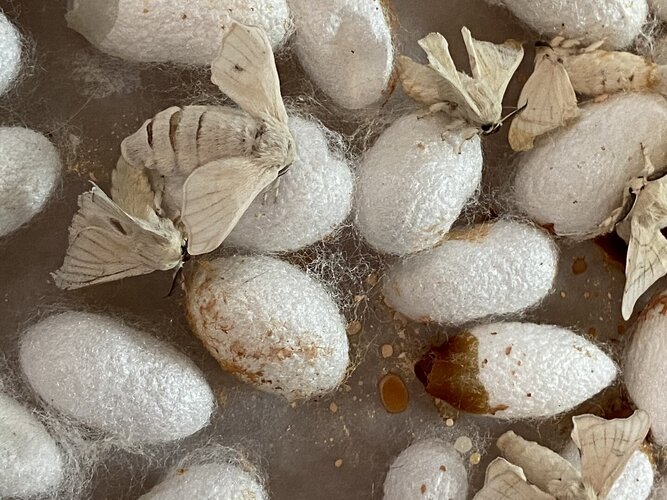
I can never remember how long before they emerge from their cocoons as moths. It’s at least a couple of weeks. They secret this iodine like substance which softens the silk so they can escape. Once out, they immediately want to mate. They will squirt their pheromones and the males will go crazy, flapping their wings super fast and spinning around, looking for a mate. They aim their butts until they find one to connect with and then make their magic. This is one of their icky messy stages, with their pheromones and iodine stuff everywhere. Putting them on wax or parchment paper will help the fluids to evaporate quicker.
IMG_5445.jpeg
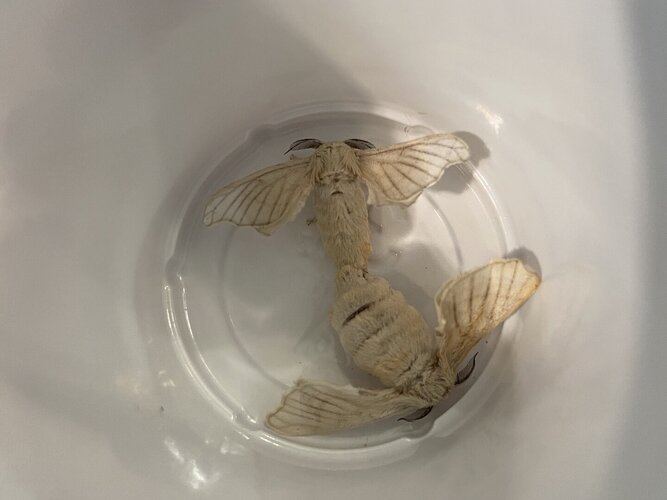
The females are much rounder and plump and usually their cocoons are much larger too. I separate the mating pairs under Dixie cups. After about a day, hopefully they’ve separated on their own and the girl can get to laying her eggs. If they are still joined, I carefully separate them. Hard to explain, but there are videos on YouTube about it. I remove the males so the females are undisturbed. As moths, their sole job and purpose is to join and mate and they will remain joined until they die sometimes. The females can’t lay her eggs if that happens. Often before she lays her eggs, she will squirt out some liquid, so be careful.
IMG_6239.jpeg

I don’t remove the eggs from whatever they were laid on. In a few days the eggs turn black and I put in the fridge to diapause for about months.
Cleanliness is very important. We’ve basically bred their immune systems out of them, so they can’t easily become sick and die. I’ve had some batches catch one of the silkworm diseases and all die off. This is where being patient and stubborn comes in. I just keep trying. I have found it harder to raise them during late fall and winter. Not sure why as I’m in Florida.
 
I have just recently ordered Dubai from down east. They should be arriving tomorrow! I’m so excited to see if Antwon will like them.
Nice, I thought Dubai Roached were illegal in Canada, no :unsure:

They would be my preferred Roach to keep, but I was under the assumption they were not available in Canada.
Woudl you mind sharing whereyou purchased them from, either in this thread or in DM?
 
Roaches are super easy to breed. Get more females than males. Put them in a decently sized bin with slick sides (so they can’t climb out), add ventilation screening to the bin. They do best in a bioactive set up - organic soil mix with some small isopods and springtails, leaf litter and cork half rounds for them to climb and hide under. (They are shy). Keep them at least 90F and in a few months you’ll see itty bitty bebes hiding in the soil. Periodically mist some soil for the isopods who need some humidity to breathe.
Silkworms are a bit more of a challenge, but doable if you are patient and stubborn. You can start with either some eggs to hatch (you’ll need plenty of chow mix for raising them). Keep them somewhat warm - around at least 75-80 of indirect heat. A little humidity seems to help too. Check daily - is best to use a magnifier as the bebes are super tiny. Once you see the first Bebe, get to making some chow. For babies, I make it only 1/4 lb at a time. Provide them fresh tiny bits of food at least daily. It dries out fast and they can’t eat it then.
So itty bitty! 🤗 I don’t know why but the babies make me so happy.
View attachment 366457
I gave them far too much food here. I will place fresh food right next to the old dried out to make sure they find it. They aren’t the smartest of critters.
View attachment 366458
While they do grow pretty quickly, it does take about 2-3 weeks or more for them to reach feeding size. I feed them similarly like this, in separate little areas. Makes it easier to place fresh food in there. The less you move or touch them, the better. These are zebra morph. They can be a bit hardier. Not always available.
View attachment 366459

I think they’re kind of cute…for bugs.
View attachment 366460
These are when they become eating machines and work on getting fat and bloated.
View attachment 366461
Once fat enough, they stop eating, purge (vomit) and then start spinning their cocoon. Best not to disturb them. They only have a limited amount of silk. I give them toilet paper tubes cut in half.
View attachment 366462
I can never remember how long before they emerge from their cocoons as moths. It’s at least a couple of weeks. They secret this iodine like substance which softens the silk so they can escape. Once out, they immediately want to mate. They will squirt their pheromones and the males will go crazy, flapping their wings super fast and spinning around, looking for a mate. They aim their butts until they find one to connect with and then make their magic. This is one of their icky messy stages, with their pheromones and iodine stuff everywhere. Putting them on wax or parchment paper will help the fluids to evaporate quicker.
View attachment 366463
The females are much rounder and plump and usually their cocoons are much larger too. I separate the mating pairs under Dixie cups. After about a day, hopefully they’ve separated on their own and the girl can get to laying her eggs. If they are still joined, I carefully separate them. Hard to explain, but there are videos on YouTube about it. I remove the males so the females are undisturbed. As moths, their sole job and purpose is to join and mate and they will remain joined until they die sometimes. The females can’t lay her eggs if that happens. Often before she lays her eggs, she will squirt out some liquid, so be careful.
View attachment 366464

I don’t remove the eggs from whatever they were laid on. In a few days the eggs turn black and I put in the fridge to diapause for about months.
Cleanliness is very important. We’ve basically bred their immune systems out of them, so they can’t easily become sick and die. I’ve had some batches catch one of the silkworm diseases and all die off. This is where being patient and stubborn comes in. I just keep trying. I have found it harder to raise them during late fall and winter. Not sure why as I’m in Florida.
Thank you for the awesome detailed write up. I will probably be referring back to it a couple times LOL.
That doesn't look to hard to accomplish.

You said that you don't remove the eggs from wherever they were laid.
I assume once they turn black and have placed them in the fridge for some time (Not sure how long you do this for), you can then move them to a new "holding container" till you are looking to hatch them?
 
Nice, I thought Dubai Roached were illegal in Canada, no :unsure:

They would be my preferred Roach to keep, but I was under the assumption they were not available in Canada.
Woudl you mind sharing whereyou purchased them from, either in this thread or in DM?
I thought so too!!! But this guy says they are only restricted. He goes by the name discoid Joe. He is on facebook. Send him a message, he is awesome to deal with!!
 
I thought so too!!! But this guy says they are only restricted. He goes by the name discoid Joe. He is on facebook. Send him a message, he is awesome to deal with!!
Joe is quite well known for his roaches. You need a permit to breed/sell them. Some sellers will give you a copy of their permit so you can be able to distribute, sell, breed the roaches as you wish.


@GreystoneExotics
https://crittersandcrawlers.com
https://piscespets.com
is located in Calgary.

https://firststrikesnakesfeeders.com/collections/insects is in Edmonton

I'm In BC myself, and mostly use cherry creek crickets https://cherrycreekcricketfarm.com/ They deliver to my local shop for free, so there's no shipping cost. I'm not sure if they service outside of BC, unfortunately. Super healthy bugs though! I accidentally ordered 500 5 week old crickets this week and didn't think they'd be so big... I had to give them to my neighbor to feed his chickens. 🤦‍♀️ There were only about 10 dead in the box though! And the BSF are the healthiest I've ever ordered! Juicy and super active, the flies always turn out huge too!
Thanks for the links.

I did contact Joe and he was very helpful, hs prices were really fair as well.
I will definitely be checking out the other links you supplied to see if I can get Dubias possible a little more local to me.
 
I second getting a discoid colony. It is an investment and will take a few months to get fully established, but is well worth it. The adults are much too large for feeding, but the nymphs don’t grow terribly fast so will be a good feeding size for some time.
I’ve found my colony produces best when kept bioactively - I mix some organic soil with coco coir, add some horticultural charcoal and a touch of sphagnum moss (to hold humidity)…add some isopods like dwarf white and springtails. I put in a small bit of cuttle bone for all the buggies health and keep one side a bit moist. (Isopods need humidity to breathe). Some leaf litter for the isopods and springtails to munch if they choose. Keep at around 90F (heat mat on the outside of the bin) and before you know it, there will be itty bitty icky bebes crawling around. The roaches do need to be able to climb, so I put in some cork bark for them, like little cave houses. So I don’t have to go digging all the time to find feeders, I every now and then sort thru and remove the nymphs and keep in a separate clean bin.
The prices of some of the feeders does seem a bit crazy until you breed your own and then understand why they are so expensive. I don’t often get hornworms because of cost and how crazy fast they outgrow feeding size. For silkworms, let a few dozen complete their life cycle and become moths to mate and provide eggs. The eggs need a diapause of about 3 months in the fridge (wine fridge is perfect, right next to the kosher wine) and then you can take out and hatch as many as you want at one time. I buy the powdered chow to make their food. They are a bit slow to get growing, but after a few weeks, they’re starting to get big enough and you’ll have feeders for at least a few weeks (depending on size you start feeding them). When your egg supply is getting low or old, repeat the process of producing eggs. They can be a challenge at times since they have basically no immune system and can easily die off, but keep at it and you’ll get the hang of it. :)
You can even breed your own superworms, but you will end up with way more than you could ever possibly need (hundreds if not more). I breed my own of just about everything I can and if I have excess, I donate to the local wildlife hospital.
That bioactive discoid setup with dwarf whites and springtails is honestly the best way to run a roach bin-zero smell, zero mould from leftover veggies, and keeping a separate sorted tub of medium nymphs saves so much digging around when it's feeding time. Plus, donating extra home-bred feeders to a local wildlife rehab is awesome; they go through tons of insects for injured birds and reptiles.
 
That bioactive discoid setup with dwarf whites and springtails is honestly the best way to run a roach bin-zero smell, zero mould from leftover veggies, and keeping a separate sorted tub of medium nymphs saves so much digging around when it's feeding time. Plus, donating extra home-bred feeders to a local wildlife rehab is awesome; they go through tons of insects for injured birds and reptiles.
It is/was…unless you live in Florida. This past year has been terrible for having the small ants (and other pests) in my home. I found they were living inside some of my bioactive set ups. After taking all of them down, I am now ant-free and the other pests are gone as well. :rolleyes: Florida! :rolleyes:
 
Back
Top Bottom