Black marks

H

hart8000

Guest
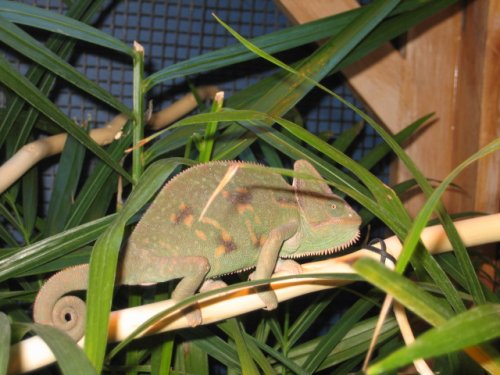
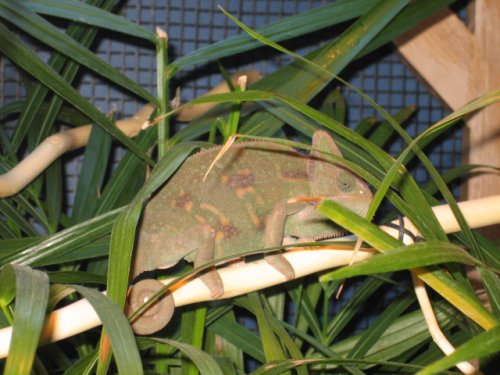
Just out of curiosity. I have a female veiled that looks to be healthy, eats well, drinks well, and moves around her cage quite well that the normal white spots on her side are usually always black. The rest of her color seems to be good.

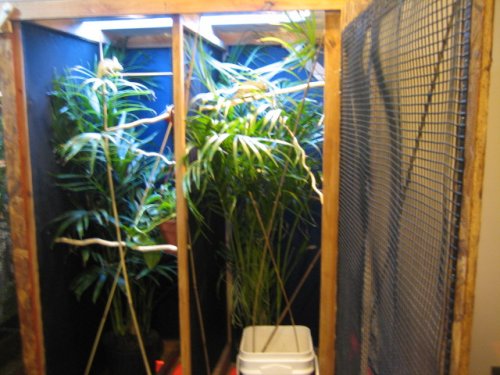
Cage is custom big, with reptiglo 5.0 light and a 40w basking. A live cat palm I believe its called, and some planting bamboo through out.

Food: about 4-5 medium crickets a day dusted at least 3 time a week with rep-cal herptivite and 2 times a month rep-cal phos free with D3. I use a misting system hooked into my plumbing to mist about 25-30 oz of water daily.

I have a lay bin in the cage now, although I believe she is still to young to be gravid. I put my Male veiled in her cage the other day and she went black and yellow and gaped. Not exactly sure on her age, the guy I got her from thought 7 months two months ago.

I rarely handle her, though I would like to work up to that every so often, but she doesn't like close contact, but she will eat a cricket from my hand.

Her name is TK, and I feel like these pets are the best and rewarding pets I have ever worked with.
 

Attachments

  • IMG_5072.jpg
    IMG_5072.jpg
    132.5 KB · Views: 130
  • IMG_5069.jpg
    IMG_5069.jpg
    139.2 KB · Views: 181
  • IMG_5067.jpg
    IMG_5067.jpg
    132.8 KB · Views: 133
the black spots are usually a warning, anger, scared, spooked, etc.

from the looks of her, she's a little puffed up, so might be hostility towards you.

because you dont handle her much, this is the reason for it all.

you shouldnt really mix them, dont put a male in with her, they will both attack each other if they dont have anywere to go.

best way to start handleing her is with food. Wax worms are great, place them on your hand, keep it at a distance that she can reach it, and let her eat, day by day get closer.

also try spraying the cage or placeing food in the cage, and placing your hands inside the cage, or near her, this way she will soon get used to you beign in the cage.
 
Ya, I have been putting crix in a cup and feeding her that way, with me holding the cup. She is in my office at my shop so not much traffic just me and my nephew who works for me. I only put the male in her cage for about 30 minutes with close supervision to see if I could get a read on her gravid colors and such.
 
Do you have some kind of cover thing between the cages? She may be stressed from the other chameleon
 
Ya, my set up has 3 chams in it all under the same lighting set ups, but they are separated by a black canvas, waterproof fabric that I make rhino tops out of. They can't see through it, but can they sense the others next door? Should I make a thicker partition?

Do you have some kind of cover thing between the cages? She may be stressed from the other chameleon
 
if you can see through it, they will be able to see the each other on the other side.

I used to have 2, vivs next to each other, had a large paper in between them, they couldnt possibly see each other, but they knew they were next to each other, as the male would constantly try to look over the paper. lol so i eventually had to move them into diffrent rooms.
 
First of all your female is showing mustard spots so she is old enough to produce eggs. Her reaction to the male also indicates that she is non-receptive so she is producing eggs.

You said..."dusted at least 3 time a week with rep-cal herptivite and 2 times a month rep-cal phos free with D3"...herptivite is a vitamin and should only be used a couple of times a month. You have it right with the calcium/D3 but you need a phos.-free calcium powder to use at most feedings or you will likely end up with egg problems and MBD.

Once she starts digging, make sure that she doesn't see you watching her or she can abandon the hole. If it happens often enough, it will push her towards eggbinding.

Can you describe the egglaying container you have in there? Size? Depth? Contents?
 
I don't think he mentioned having an egg laying container for her. She does seem to need one.

From what I've read on this forum washed play sand (which you should be able to get from Home Depot or Lowe's) which is moist enough to hold a tunnel is the material of choice. (if you can find unfertilized dirt, that would probably be a good option but it does need to be unfertilized and it does need to be moist enough that she can dig out a tunnel which holds it's shape) The container needs to be deep enough that she can dig a tunnel and get just about all the way in it. Though, they don't quite dig straight down. It should be big enough around that she can pace comfortably.
 
Last edited:
First of all your female is showing mustard spots so she is old enough to produce eggs. Her reaction to the male also indicates that she is non-receptive so she is producing eggs.

You said..."dusted at least 3 time a week with rep-cal herptivite and 2 times a month rep-cal phos free with D3"...herptivite is a vitamin and should only be used a couple of times a month. You have it right with the calcium/D3 but you need a phos.-free calcium powder to use at most feedings or you will likely end up with egg problems and MBD.

Once she starts digging, make sure that she doesn't see you watching her or she can abandon the hole. If it happens often enough, it will push her towards eggbinding.

Can you describe the egglaying container you have in there? Size? Depth? Contents?

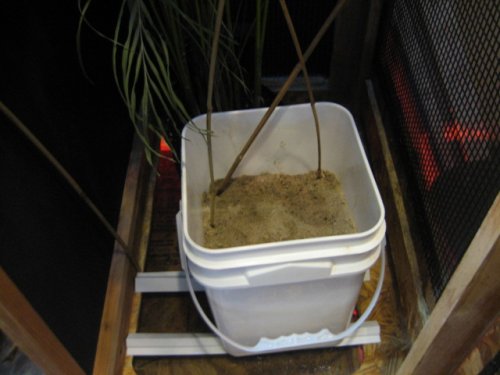
I do have a lay bin for her, its 13 tall 9 x 9 at the top. I filled it with play sand. I keep it just moist enough though out the top 8 inches or so to hold a tunnel, at least it will hold a finger hole really well. It's white in color, should this or the size be changed?
 

Attachments

  • IMG_5070.jpg
    IMG_5070.jpg
    93.3 KB · Views: 152
I would use my dust schedule just to reasure you. and thats a nice laying. Idk if it needs be bigger
 
Back
Top Bottom