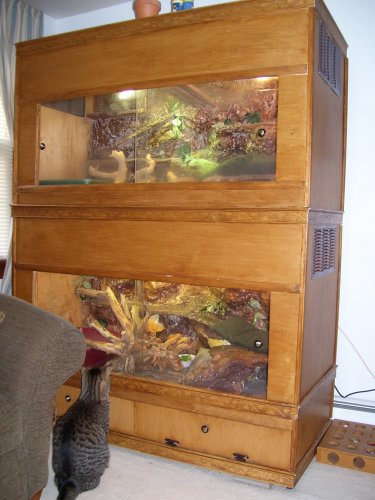
A few thoughts to confirm what others have said and to add a couple of notes of my own-
but how can he suddenly be sick when he was doing perfectly well before we baught him? :S
Young dragons under 8" or so in length can sometimes go downhill very fast (within 24 hours) after appearing outwardly to be healthy. They can have pre-existing conditions (like parasites or somewhat deficient diet) kept in check by an active immune system, and then the stress of being moved to a new home, or stress of a new cagemate could cause them to crash. The older/larger the dragon is up to about 12" in length, the better. Unfortunately, the trend on the buyer, whether dealer or new pet owner, has nearly always been to buy them as cheaply as possible. As a breeder I find this very frustrating. I'm not pointing fingers at you- it is an industry wide problem and I believe most buyers really don't know the benefit vs the risk or even that slightly older animals are a better way to go. I've heard some kind of silly ideas about "bonding". Dragons aren't mammals and older ones will relate to you just as readily over time.
Unfortunately I guess I should give him back then I really don't think he's sick, I think he feels stressed and not well because of Noopy who has certanly already made the place his home.
Well, if you have had noopy for a few months and this new one is only a few weeks old, noopy should now be much larger than the new one. That is stressful for the new one, and dangerous as well. Smaller individuals start to look like tempting snacks to larger ones, and loss of limbs or tail can be the result.
I go through and measure each and every young dragon I have and sort them into groups them according to size every week until they are sold or matured and put into breeding groups here. This week I'll have to do this with a few hundred. My dragons sometimes grow over an inch a week. But- what happens with these groups is very interesting. Each week as the groups are re-formed, in each group a few new dragons become dominant and these individuals grow faster compared to the rest. When dominant animals are removed from the groups, previously sub-dominant animals take their place in the pecking order and they then grow faster than the others.
I did an experiment a couple of summers ago where I fed small insects every few hours to each of several groups. I was able to overcome this trend among the 100 in my experiment and grow my babies out at what I would have previously thought an unbelievably uniform rate over the summer to near maturity, and didn't have to sort them. But in the process I ended up seriously depleting my roach colonies - I fed out over 750,000 over the course of the summer months to grow out that 100 lizards!
So- 2 suggestions- seperate your young dragons if they have a significant size difference (I keep mine in groups that are within an inch in length). This will help prevent stress and aggression. Otherwise, raise your pair seperately until they are at least 6" snout to vent. Over the years from experience I have learned this length is a safe size to add new breeders to established groups as long as it is outside of breeding season- I don't want them breeding until they are much larger (7.5" snvl). Nowadays I go the extra time and wait until they are 7" svl before adding to an established group or forming a new one.
If you end up with 2 males. Always keep them seperate once they reach that 6" svl. Under that size, if they are within an inch in size from each other they can be raised together.
If for some reason your smaller animal catches up with your larger one before this size, you may be able to keep them together until they grow if you can get their growth rate matched up. You may be able to give a good solid try by repeating my experiment- lots of smaller insects rather than fewer large ones, and smaller meals more often (3 or more x per day) rather than a single large one. I believe the reason this works is that the dominant lizards fill up and then the less dominant get new opportunities to feed when food is first placed in during times when the full dominant animals ignore the food. Less dominant animals wait until the dominant ones ignore the food and feeding response is greatest when food is first put in, so merely adding more food so some is left over is not effective for triggering optimal feeding of sub-dominant animals- adding fresh feedings does the trick. That is what I think was going on with my groups anyway.
With adult males over 6" svl- Usually outright aggression isn't the problem, instead one male will do really well while the other slowly looses weight and does worse over time. Some books came out in the 90s that mentioned breeding groups of 2.3 being most effective. That is because the lizards were kept in really large (8'x8' or larger) outdoor enclosures and the dominant male becomes more territorial/interested in breeding at the sight of the other male. It isn't necessary and in smaller enclosures the other male always suffers. (I tried back in those days and the second male had to be removed after a few months every time because it just wouldn't thrive and would steadily loose weight).
2 adult females- I've never had a problem that way, even long term without a male present. They do establish a pecking order, but both gain weight and maintain it and behave normally. Not saying problems are impossible, as with any lizards kept together, only saying according to my experience it must be pretty unusual for a problem between 2 females to occur. And not saying they do not have a pecking order- they do, and normally when a male is present when there is a social display confirming this order is going on, he will run over and lick the dominant female to end the display, taking care of the sub-dominant female and asserting his role as head of the group all in one step.
Normally I keep groups of 1 male with 2 females and they are permanently housed together year round. A couple of times I have had females become the dominant animal in the group outside of breeding season- even down to where they behave like a male - black beard, head bobbing neck biting and everything. But during breeding season the males always became dominant and the females laid eggs confirming their sexual identity.
In my experience (hundreds of breeders since 1994) males will not "breed females to death" or stress them much. Assertion of dominance does sometimes include behavior that appears to humans to be very similar to breeding or aggression with head bobbing, neck biting, followed by side to side shaking of the female and pressing her body to the ground but it is not followed up with actual copulation. Instead the male lets go and sits up and looks around. In spite of this behavior which may seem rough to humans, the females will maintain excellent weight and health. Normally the females deal with the males and discourage such behavior by arm waving and pressing their bodies to the ground for a few minutes when they see the males start to bob and run around. Often when they do this the male will be satisfied and not feel the need to continue. This behavior on the males' part typically occurs only a few minutes and only on some days- usually in the evening, and just long enough to make sure the pecking order is kept in tact. These events may occur on a single day or several days in a row and then go weeks without this behavior before it is repeated. During breeding season these displays as well as actual copulation are much more frequent and can be a daily affair- usually more active during the afternoon and evenings. As the season goes on, they become less and less frequent.
BUT- new males under a couple years old are occasionally very antisocial and not suitable for use as breeders yet because their hormones are sometimes so active that they are more interested in dominance than in breeding, and such males will hurt females by excessive biting and driving on her in dominance displays. Such males typically tend to bite tails, legs and sides rather than the usual neck and shoulders- areas of attack that are signs of aggression, not mere assertion of dominance. Such males typically mellow out of this after they reach 3 or 4 years of age. In the meantime they have to be kept isolated or they will harm their cage-mates. Such males are maybe 1 in 100 or even less. They are not typical.
Anyway, this is much longer than I intended- sometimes I don't know how to explain things briefly without explaining all the whys- sorry if everyone fell asleep by this point. Maybe someone will find it interesting.

If to OP is just skimming all this blah blah blah-
The point is- you probably need to seperate the lizards and if you want them both raise them seperately until they are 6" svl or better yet 7". And then if you have 2 males you should keep them seperately. If you have a male and a female, you might put them together as I do, or keep them seperate outside of breeding. If you have 2 females, I think it is pretty safe to keep them together once they are 6" svl or larger.
Others may disagree, that's fine. I'm just sharing my experience and what has worked for me.
Here are some of my breeder enclosures. I have 64 cages of breeders 1.2 adults per enclosure. I have been keeping and breeding them since 1994 over many generations. My oldest are at least 12 years old now (I'm not the greatest record keeper, but I know my oldest were full grown adults who had at least one breeding season behind them before I moved to my present home in 2001). My enclosures are slightly modified 4' long x 29" x 29" reptariums. It's a love/hate thing with these cages for the dragons. I patch them constantly and my goal is to replace them outdoors with in-ground enclosures the next couple of years.