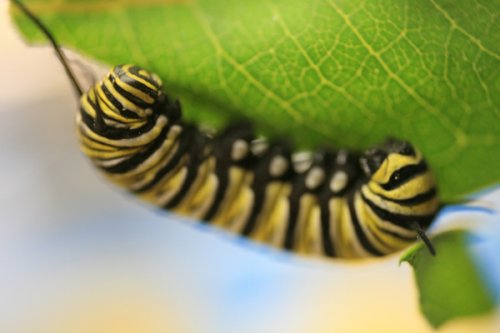
When you feed wild bugs, you have to be cautious. I do a lot of research on any bugs that I catch that I am not familiar with. There are a lot of things to consider in your decision to feed them, also. If you live in an area where pesticides are used, you may want to avoid it all together. Also, you never know what your wild bugs have been eating. Grasshoppers, etc. eat plants that are fine for them, but may be toxic for your chameleon. Where I live, you see wild hornworms on occasion, but they like to eat tomato plants which have a high toxicity. In addition, a lot of wild bugs are just poisonous. Basically, when I gather wild bugs, if the bug has bright warning colors like yellow or red, I don't feed it until I have done the research to find out if it is toxic or not. The catepillars you are referring to.. I would do some research online first, because 1) you don't know what they have been eating, and 2) they have bright yellow on them. If it turns out that they aren't poisonous, then you can always gutload them for 24 hours or so with known foods before you feed them to your chameleon.
I know that black crickets are available in Europe as a live food item, but I have read that wild ones can take pretty high doses of pesticides and still live. That would worry me. Plus, they are supposed to be a lot more aggressive than brown crickets. As I am sure you are aware, brown crickets have been known to chew on chameleons. If you do decide to feed them, you may want to just put in one at a time, make sure it is eaten, and then put in another. I wouldn't leave them loose in the cage with your chameleon.
My chameleon LOVES grasshoppers. I really, really wish locusts were available for sale in the US, or that I could find someone willing to break international laws and mail me a breeding colony! Since that hasn't happened, I do feed wild grasshoppers, but once again, only if they don't display warning colors. There are a few grasshoppers out there that are poisonous, so caution is always advised.
Another thing to consider when feeding wild bugs is parasites. It is more than possible that one of the bugs you feed to your chameleon will harbor a parasite that will infect your cham. At the end of the bug season, which for us here is the late fall, I will take my panther in for a fecal to make sure he is still clean of parasites.
With all of this in mind, you might be asking why anyone would take the risk. Well, I believe that the benefits of feeding wild bugs greatly outweigh the risks. They contain trace minerals and vitamins that simply aren't available in store bought feeders. They are sun soaked and natural, and provide nutrients that are much more similar to what the chameleon would be eating in the wild. With the addition of the bug napper, I am feeding my panther almost exclusively wild caught bugs. I know that it could be a variety of things that have contributed, but his overall health has improved drastically. He has never looked better. In addition, he has an appetite that has no end. He is turning into quite the piggy chameleon, which is a major change from an animal that has had to be force fed every so often in the past few months.
To answer your other questions:
1) Veileds
can live for a long time, and some people have kept them for 10 years or more. However, longevity is heavily based upon husbandry practices in captivity. In the wild, chameleons have much shorter life spans because they are subjected to lots of dangers that shorten their life. I don't believe that there is a chart, so to speak, of longevity for captive chameleons. Veileds seem to be able to live for about the same length of time as a panther chameleon.
2) Veiled chameleons and most other species of chameleons are aggressive and solitary animals, and are easily stressed by cage mates. It is best to maintain seperate cages for each of your chameleons and only allow them to interact for mating.
3) I use a lot of ficus and pothos, but also have a bunch of other plants too. Here is a great safe plant list from BlueBeast:
http://www.bluebeastreptile.com/plantlist.htm
Heika





 and know many, many insects and could at the very least give you some guidance if I don't know exactly what it is.


