White Substance On Nose

leviw06

New Member
Chameleon Info:
Your Chameleon - Veiled Chameleon(chamaeleo calyptratus),4-5 months(not too sure),Female.We Have had her a little over a month.

Handling - 3-4 times a week

Feeding - Crickets,Superworms is what she is eating.6-15 crickets and off day 6 crickets and a superworm. Gut loading with flukers orange cube and high calcium cricket diet food. We feed her in the morning.

Supplements - Rep-cal (calcium with vit.d and herptivite multivitamins) up until yesterday I was using 1:1 ratio mixture of both calcium and herptivite. I learned yesterday I was over supplementing and alternating once a week one calcium and the next herptivite. Also I was dusting every cricket instead of just one or two.

Watering - Spray bottle 3 to 4 times a day letting the water dry between mistings and we do see her drink ocassionaly sometimes from leaves and sometimes from a bowl with bubbler in it and clean bowl once a week.

Fecal Description - Brown fecal matter and White Urine with yellow tip and never tested for parasites.

History - We bought her from petsmart with no further knowledge on how old she is and pretty much followed what we were told in taken care of her.

Cage Info:
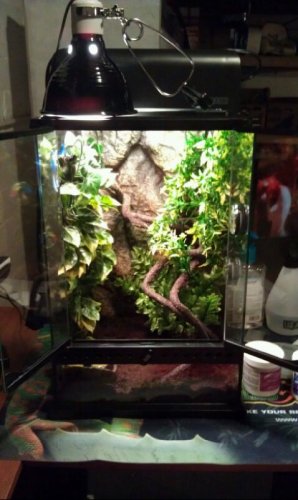
Cage Type - Its an all glass exo-terr in small size

Lighting - Flukers dimmer light w/ 75 watt repti basking spot lamp and repti-glo 5.0 compact for daytime.Nighttime we are using zoo-med nocturnal infra-red heat lamp 75 watt...10am-10pm.

Temperature - Daytime temp is between 80 in cage and basking spot is 90.Nighttime is roughly 65.

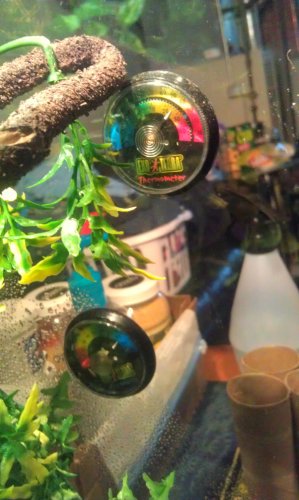
Humidity - During the day 65-80% and Nigttime 50-70% and Just misting the cage with a spritzer bottle

Plants - Not at the moment

Placement - 3.5 ft off the floor and on the computer desk

Location - Midwest- Iowa,US

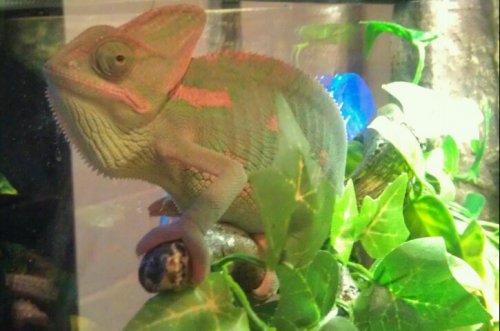
CURRENT PROBLEM- white substance collecting on her left nostril
 

Attachments

  • 1056.jpg
    1056.jpg
    67.7 KB · Views: 282
  • 1058.jpg
    1058.jpg
    254 KB · Views: 224
  • 15.jpg
    15.jpg
    79 KB · Views: 231
Some reptiles have a salt gland near the nose to get rid of excess salts from their diet or water source. This causes crusty white buildup around the nose sometimes. It is NOT excess calcium (a common myth). The salts are primarily excess sodium or potassium with just the tiniest bit of calcium sometimes. Do not change your calcium supplementation as the buildup is completely harmless and not a cause for concern. Check your water for sodium content and you may need to use distilled water. If the crusts bother you or your cham then gently wipe them away with a moist q-tip.
 
Some reptiles have a salt gland near the nose to get rid of excess salts from their diet or water source. This causes crusty white buildup around the nose sometimes. It is NOT excess calcium (a common myth). The salts are primarily excess sodium or potassium with just the tiniest bit of calcium sometimes. Do not change your calcium supplementation as the buildup is completely harmless and not a cause for concern. Check your water for sodium content and you may need to use distilled water. If the crusts bother you or your cham then gently wipe them away with a moist q-tip.

this is my guess i have had this happen to mine i now use water conditioner in my mister and drippers distilled water works also but aquatizer is cheaper in the long run i do believe
 
Some reptiles have a salt gland near the nose to get rid of excess salts from their diet or water source. This causes crusty white buildup around the nose sometimes. It is NOT excess calcium (a common myth). The salts are primarily excess sodium or potassium with just the tiniest bit of calcium sometimes. Do not change your calcium supplementation as the buildup is completely harmless and not a cause for concern. Check your water for sodium content and you may need to use distilled water. If the crusts bother you or your cham then gently wipe them away with a moist q-tip.

Currently im buying purified water from my local general store. I do member reading somewhere about the salt gland thingy but just wanted to make sure that it wasnt something else. thank you for your help!:D

About the Q-tip idea... i like it but right now she doesnt even like me. Very moody for some reason but i think its due to her being with her First clutch of eggs... not fully showing yet, but i did see a few today pressed against her side. so here in the next week or two hopefully she will bei9ng inside her laying buckey!!!
 
You might try giving her a shower, that might help dislodge the bit near the nose. The important thing to know is that if it's an excretion of the salt gland, it's not dangerous or harmful, it's just the chameleon doing what it's supposed to do.

You may find people suggesting you cut back on calcium to get it to go away. I'm going to say that you shouldn't do that. Especially as she's apparently bearing eggs.

I strongly suggest you read kinyongia's blog post on caring for females. I think your temps are high for a female and you may be over feeding her. Those things will contribute to egg production and the more clutches she has, the harder it is on her, the less likely she will live a long life.
 
Well from what i understand chams wont over eat. i feed her until she wont eat anymore.

about the temps. im aware that i do run a little higher than most, but i live in a very drafty home. It being winter and even with the heater on its only roughly 73 in my place most the time.

so i try to rock it at a higher temp so she can keep warm and active.

from reading about where her species come from in the world this is what i;ve gathered.

Natrual Distribution and Habitat
*distribution: high plataeu and grasslans of yemen, southwest Saudi Arabia
*climate preferance: Sudanese, Sudano-Guinean, Forest edge, plataeu
*forest stratum: Bushes, Shrubs eucalytus trees, culticated zones

Regional Climate Data (Sudanese)

PERIOD 1st-6th MONTH 7th-9th MONTH 10th-12th MONTH
Photoperiod 11-14 hours 10-11 hours 10-14 hours
Relative humidity 65%-75% 50%-65% 35-45%
Temprature 76-84 degree F 74-78 degrees F 78-88 degrees F

not an expert by any means i am open to sugestions?

also have read that wonderful article you have sugested as well :)

her in about 3 weeks i am upgrading to a new terra 18x18x24" one of these
http://lllreptile.com/store/catalog...e-packages/-/exo-terra-sri-lanka-habitat-kit/
http://lllreptile.com/store/catalog.../-/exo-terra-cameroon-rainforest-habitat-kit/

Have plans in the works for bigger and better living quarters will post "blue prints" once i have em. come august once i move into a new place plan on goint to a free range set up.
 
Well from what i understand chams wont over eat. i feed her until she wont eat anymore. some can over eat, and afemales should be fed less, almost to the point of them being hungry, so they dont produce large infertile clutches, which shortens their life span

about the temps. im aware that i do run a little higher than most, but i live in a very drafty home. It being winter and even with the heater on its only roughly 73 in my place most the time.basking temps are kept cooler as well, again to prevent large clutches.

so i try to rock it at a higher temp so she can keep warm and active.

from reading about where her species come from in the world this is what i;ve gathered.

Natrual Distribution and Habitat
*distribution: high plataeu and grasslans of yemen, southwest Saudi Arabia
*climate preferance: Sudanese, Sudano-Guinean, Forest edge, plataeu
*forest stratum: Bushes, Shrubs eucalytus trees, culticated zones

Regional Climate Data (Sudanese)

PERIOD 1st-6th MONTH 7th-9th MONTH 10th-12th MONTH
Photoperiod 11-14 hours 10-11 hours 10-14 hours
Relative humidity 65%-75% 50%-65% 35-45%
Temprature 76-84 degree F 74-78 degrees F 78-88 degrees F

not an expert by any means i am open to sugestions?

also have read that wonderful article you have sugested as well :)

her in about 3 weeks i am upgrading to a new terra 18x18x24" one of these
http://lllreptile.com/store/catalog...e-packages/-/exo-terra-sri-lanka-habitat-kit/
http://lllreptile.com/store/catalog.../-/exo-terra-cameroon-rainforest-habitat-kit/

Have plans in the works for bigger and better living quarters will post "blue prints" once i have em. come august once i move into a new place plan on goint to a free range set up.

this is what most do for females to prevent them laying alot of eggs. some people can stave off egg production until a female is 14 motnhs old and even older.

you dont want her laying 60+ eggs. trust me.
 
It might be counter intuitive, but you want to keep females at something less than ideal conditions. In the wild, it's only "ideal" a couple of seasons a year, if that. It being ideal triggers egg production. If you keep it ideal all year, you could find her producing 4 clutches of eggs a year. That really isn't healthy.
 
this is what most do for females to prevent them laying alot of eggs. some people can stave off egg production until a female is 14 motnhs old and even older.

you dont want her laying 60+ eggs. trust me.

that i was not aware of. just been trying to give her the "ideal" environment rather than trying to prevent her from doing what is natural.

guess i should really re-evaluate this then.

okay her eating habits - from what i've read on this forum and other sources juvenile cham can eat and are fed 15-30 feeders every other day if not every day. so to me feeding her 1-2 superworms and then, well more realistically, she has never ate more than 8 crickets at a time. most the time she eats 6 crickets and then no more. and now im going to start feeding her hornworms.

So.....

whats a good regiment for feeding? :confused:

cuz i know with what i have been doing she should be ready to lay her first clutch within the next 4 weeks.

so yea...
 
Does she have yellow/blue spots at all?

if not, then she wont lay eggs yet.

I would first and foremost, stop feeding supers all the time.

Next, I would reduce her basking temp to about 83.

and for food- I would feed about 4 crickets every day for righ tnow, then when she gets her spots in, i would feed 4 crickest every other day. or 2 per day. of large crickets.
 
You said you were feeding her 1-2 superworms and then, well more realistically, she has never ate more than 8 crickets at a time. most the time she eats 6 crickets and then no more"...if she's still growing and not sexually mature this is not too bad. If she produces eggs then you can cut her back.

Do you have a suitable place for her to dig in the cage?

You said..."Supplements - Rep-cal (calcium with vit.d and herptivite multivitamins) up until yesterday I was using 1:1 ratio mixture of both calcium and herptivite. I learned yesterday I was over supplementing and alternating once a week one calcium and the next herptivite. Also I was dusting every cricket instead of just one or two"...you also need to use a phos.-free calcium at most feedings.

Here's some information I hope will help you with supplementing, etc.....
Appropriate cage temperatures aid in digestion and thus play a part indirectly in nutrient absorption.

Exposure to UVB from either direct sunlight or a proper UVB light allows the chameleon to produce D3 so that it can use the calcium in its system to make/keep the bones strong and be used in other systems in the chameleon as well. The UVB should not pass through glass or plastic no matter whether its from the sun or the UVB light. The most often recommended UVB light is the long linear fluorescent Repti-sun 5.0 tube light. Some of the compacts, spirals and tube lights have caused health issues, but so far there have been no bad reports against this one.

A wide variety of insects that have been well fed and gutloaded should be fed to it.

Since many of the feeder insects we use in captivity have a poor ratio of calcium to phosphorus in them, its important to dust the insects just before you feed them to the chameleon at most feedings with a phos.-free calcium powder to help make up for it. (I use Rep-cal phosphorus-free calcium).

If you also dust twice a month with a phos.-free calcium/D3 powder it will ensure that your chameleon gets some D3 without overdoing it. It leaves the chameleon to produce the rest of what it needs through its exposure to the UVB light. D3 from supplements can build up in the system but D3 produced from exposure to UVB shouldn't as long as the chameleon can move in and out of it. (I use Rep-cal phos.-free calcium/D3).

Dusting twice a month as well with a vitamin powder that contains a beta carotene (prOformed) source of vitamin A will ensure that the chameleon gets some vitamins without the danger of overdosing the vitamin A. PrEformed sources of vitamin A can build up in the system and may prevent the D3 from doing its job and push the chameleon towards MBD. However, there is controversy as to whether all/any chameleons can convert the beta carotene and so some people give some prEformed vitamin A once in a while. (I use herptivite which has beta carotene.)

Gutloading/feeding the insects well helps to provide what the chameleon needs. I gutload crickets, roaches, locusts, superworms, etc. with an assortment of greens (dandelions, kale, collards, endive, escarole, mustard greens, etc.) and veggies (carrots, squash, sweet potato, sweet red pepper, zucchini, etc.)

Calcium, phos., D3 and vitamin A are important players in bone health and other systems in the chameleon (muscles, etc.) and they need to be in balance. When trying to balance them, you need to look at the supplements, what you feed the insects and what you feed the chameleon.
Please note that various supplements have various amounts of D3 and vitamin A and so some can be given more often than others. The idea still is not to overdo the fat soluble vitamins like D3 and prEformed vitamin A.

Here are some good sites for you to read too...
http://chameleonnews.com/07FebWheelock.html
http://web.archive.org/web/200605020...Vitamin.A.html
http://web.archive.org/web/200406080...d.Calcium.html
http://www.uvguide.co.uk/
http://web.archive.org/web/200601140...ww.adcham.com/
If you can't access the sites above that have the word "archive" in you can do it through the WayBackMachine.
 
6-15 crickets and off day 6 crickets and a superworm.
Maybe I didn't understand this, but I read it that she gets at 15 crickets alternating with 6 + a superworm. If they are small crickets, that's not too much. If they are full size, I would think no more than 10-12 every other day.
 
@kinyonga

I have a white 5 gallon bucket with play sand on stand by for her when she is ready to lay. Its not in her tera but located by her cage but on the floor. She sits on my desk roughly about 3ft of the ground.

The rep-cal calcium with d3 is phosphorus free... but still havent found a calcium powder without d3 locally im looking at the sponsor's websites today to see if i can find one on there.

Now where did you find you rep-cal phosphorus without d3 calcium powder?

*edit

Plz forgive my rudeness, Thank you for those wonderful links! :)
 
Maybe I didn't understand this, but I read it that she gets at 15 crickets alternating with 6 + a superworm. If they are small crickets, that's not too much. If they are full size, I would think no more than 10-12 every other day.

to clear this up

say the feeding scheduale starts on monday. on monday i feed her 6-15 1/2 inch crickets to my cham. On tuesday i give her 6 crickets and a superworm. (now that i have hornworms i will be alternating the superworms w/ the hornworms) then wedseday back to the 6-15 so on and so forth.

since having her she has not eaten 15 crickets in one feeding. usually she eats 8 but i offer her more but when she is full she stops eating.

Also i feed her once a day by hand with a pair of feeder tongs. i dont leave the crickets or any other insect in with her via a feeder cup/bowl.

this is so that i know what she is eating, how often, and how much. also i do this to promote interaction between the both of us to build trust. NO, i am not having her climb onto my hand before feeding. I simply open her Terra door present the insect to where so can see it and she comes a running.

I usually try to feed her every day between the hours of 10:30am - 11:30am.
 
1/2 inch crickets....that's probably not too much, though it's certainly enough. As she is hitting maturity you're going to want to cut that back a little bit. Leave her wanting a little bit more (like, if she readily eats 8, feed 7).

How is she getting access to the laying bin?
 
Back
Top Bottom